World must transform food production, scientists say

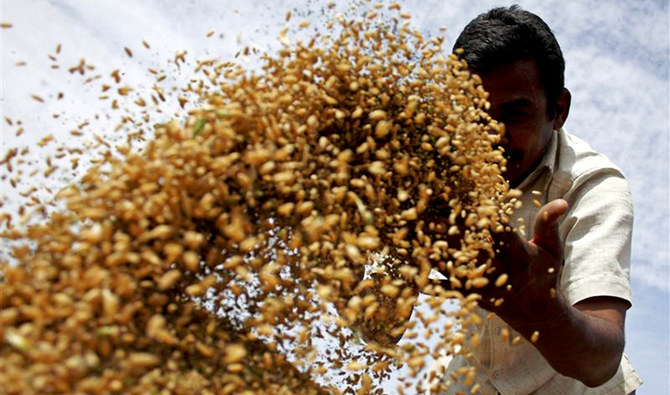
The study says the reforms can free up 1.2 billion hectares of agricultural land for restoration. (Reuters)
Updated 17 September 2019
Follow

World must transform food production, scientists say

  • Global over-dependence on a relatively small number of staple foods leaves populations vulnerable to crop failures

LONDON: The world must diversify its food production and consumption, or face damaging supply disruptions that could lead to suffering and social unrest, scientists warned on Monday.

A new global study found the health and environmental benefits of transforming the way we farm would heavily outweigh the cost of doing so, with the authors urging governments to do more to support sustainable agriculture.

“A small disruption in supply really can do a lot of damage and leads to huge price increases,” said Per Pharo of the Food and Land Use Coalition, the global alliance of economists and scientists behind the study.

“That creates suffering and social unrest. And it will highly likely also lead to hunger and instability,” he told the Thomson Reuters Foundation.

Global over-dependence on a relatively small number of staple foods leaves populations vulnerable to crop failures, with climate change adding to the strain, the report said.

“Four different crops provide 60 percent of our calories — wheat, rice, maize and potatoes. That increases our vulnerability,” said Pharo. The panel said the report was the first of its kind to assess the benefits of transforming global food systems as well as the cost of inaction.

The damage the modern food industry does to human health, development and the environment costs the world $12 trillion a year — equivalent to China’s GDP — the study found.

It proposes a series of solutions, from encouraging more diverse diets to improve health and reduce dependency on specific crops, to giving more support to the types of farming that can restore forests, a key tool in fighting climate change.

In Costa Rica, for example, the government has reversed deforestation by eliminating cattle subsidies and introducing payments to farmers who manage their land sustainably.

As a result, the amount of forest cover has risen from a quarter of the country’s land in 1983 to more than half today, the report said.

And it will highly likely also lead to hunger and instability

The study said the reforms could also free up 1.2 billion hectares of agricultural land for restoration.

That is more than twice the size of the Amazon rainforest, which spans seven nations.

“What we’re saying is realistic if the reform agenda is implemented,” said Pharo, adding that under the proposed changes, consumers would actually get “slightly more affordable food.”

“The excuse that we cannot prioritize environment at the same time because we’ve got to focus on development, on human welfare, is simply false. We can deliver both.”


Saudi Arabia’s cultural sector is a new economic engine between Riyadh and Paris, says ambassador

Updated 25 January 2026
Follow

Saudi Arabia’s cultural sector is a new economic engine between Riyadh and Paris, says ambassador

RIYADH: Culture has become a fundamental pillar in bilateral relations between France and Saudi Arabia, according to the French Ambassador to the Kingdom, Patrick Maisonnave.

Maisonnave noted its connection to the entertainment and tourism sectors, which makes it a new engine for economic cooperation between Riyadh and Paris.

He told Al-Eqtisadiah during the opening ceremony of La Fabrique in the Jax district of Diriyah that cultural cooperation with Saudi Arabia is an important element for its attractiveness in the coming decades.

La Fabrique is a space dedicated to artistic creativity and cultural exchange, launched as part of a partnership between the Riyadh Art program and the French Institute in Riyadh. 

Running from Jan. 22 until Feb 14, the initiative will provide an open workspace that allows artists to develop and work on their ideas within a collaborative framework.

Launching La Fabrique as a space dedicated to artistic creativity

The ambassador highlighted that the transformation journey in the Kingdom under Vision 2030 has contributed to the emergence of a new generation of young artists and creators, alongside a growing desire in Saudi society to connect with culture and to embrace what is happening globally. 

He affirmed that the relationship between the two countries is “profound, even cultural par excellence,” with interest from the Saudi side in French culture, matched by increasing interest from the French public and cultural institutions unfolding in the Kingdom.

Latest estimates indicate that the culture-based economy represents about 2.3 percent of France’s gross domestic product, equivalent to more than 90 billion euros ($106.4 billion) in annual revenues, according to government data. The sector directly employs more than 600,000 people, making it one of the largest job-creating sectors in the fields of creativity, publishing, cinema, and visual arts.

Saudi Arabia benefiting from French experience in the cultural field

Maisonnave explained that France possesses established cultural institutions, while Saudi Arabia is building a strong cultural sector, which opens the door for cooperation opportunities.

This comes as an extension of the signing of 10 major cultural agreements a year ago between French and Saudi institutions, aiming to enhance cooperation and transfer French expertise and knowledge to contribute to the development of the cultural system in the Kingdom.

He added that experiences like La Fabrique provide an opportunity to meet the new generation of Saudi creators, who have expressed interest in connecting with French institutions and artists in Paris and France.

La Fabrique encompasses a space for multiple contemporary artistic practices, including performance arts, digital and interactive arts, photography, music, and cinema, while providing the public with an opportunity to witness the stages of producing artistic works and interact with the creative process.