


BAGHDAD: Iraq on Sunday strongly denied claims that its territory had been used to launch a wave of drone strikes on two Saudi oil facilities.
In a statement from Iraqi Prime Minister Adel Abdul-Mahdi’s media office, the government vowed to take “firm” action against any parties that attempted “to violate the constitution,” and appealed for an end to the attacks which posed a major threat to regional and global security. And Iraqi commanders of pro-Iran armed factions warned they could now be targeted themselves by the US.
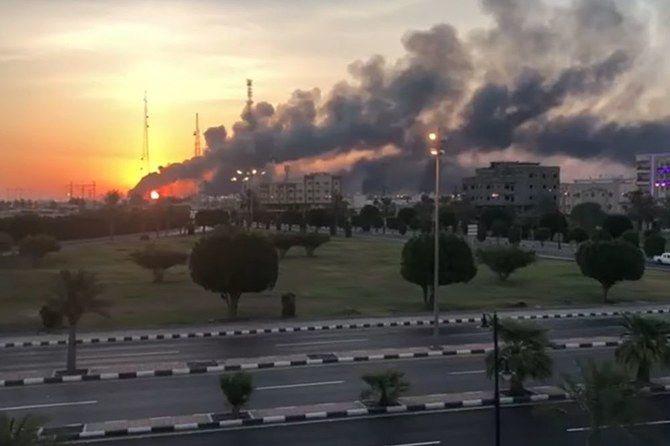
Drones hit Saudi Aramco refineries at Abqaiq and Khurais, in the Eastern Province, on Saturday setting them on fire and sparking international outrage.
Although the Iranian-backed Yemeni Houthi group has claimed responsibility for the attacks, while the US has officially blamed Iran, some regional and international media organizations have accused Iraqi factions linked to Iran of launching the strikes from Iraqi territory.
“Iraq denies news circulated by some media outlets that suggest its territory was used to attack Saudi oil facilities using drones, and stresses its constitutional commitment to prevent the use of its territory to attack its neighbors, brothers and friends,” the statement said.
“The Iraqi government will deal firmly with anyone who tries to violate the constitution … (and) calls on all parties to stop mutual attacks which cause great loss of life and facilities.
“The Iraqi government affirms that it follows with great interest these developments and solidarity with its brothers and expresses concern that the escalation and military solutions will complicate the humanitarian and political situation and threaten our common, regional and international security,” it added. The strikes, which have disrupted Saudi crude oil production, have raised fears of US retaliation and intensified concerns in the region, especially from Iraq, about the reaction of American President Donald Trump’s administration to Iran and its allies.
Iraq has become one of the biggest battlegrounds in the region between the US and Iran since 2003. The two sides control dozens of armed groups and their allies, and the Iraqi government has come under pressure, both internally and externally, to deal with the activities of pro-Iran factions.
For years Iraq has maintained a policy of distancing itself from any regional or international conflicts.
A senior Iraqi National Security source told Arab News: “We have no evidence to suggest that any armed Iraqi faction was involved in these attacks, and we have not received any accusation from Saudi Arabia, or any international or regional party involved.
“We were surprised by the prime minister’s statement and sent him a written reply saying that issuing this denial is wrong and if there is a need to provide some clarifications to our allies or friends in the region, including Saudi Arabia, diplomatic channels and back channels can play this role.”
The Iraqi Security and Defense Parliamentary Committee was also surprised that a statement had been issued denying Iraq’s involvement in the bombings, three committee members told Arab News.
“We in principle refuse to target innocent people and infrastructure in Saudi Arabia and anywhere in the world. We have no rivalry with Saudi Arabia, and the Iraqi government and its security forces, including the Popular Mobilization Units, have no interest in engaging in a war that we have nothing to do with,” Ahmad Assadi, a prominent Shiite member of the committee and commander of one of Jund Al-Imam’s armed factions, told Arab News.
“We do not understand the motive behind the accusations. If someone thinks that these attacks (on the Saudi oil installations) are part of our response to attacks that targeted our warehouses, they are wrong.
“We have already declared that the attacks on our warehouses were directly or indirectly carried out by the Zionist entity, and therefore Saudi Arabia has nothing to do with them, and we have no justification for attacking it.”
Iraqi commanders of pro-Iran armed factions said media reports of their involvement were an American attempt to put more pressure on the Iraqi government and justify future attacks on resistance leaders inside Iraq.
“We know that the accusations are baseless and the Americans cannot prove them. They would know if any drones took off from anywhere in Iraq as they fully control the Iraqi skies, so it is just a new pretext to target us,” a prominent commander of Asa’ib Ahl Al-Haq, one of the most powerful Shiite armed groups in Iraq, told Arab News.
“They (the US) will start a campaign to terminate the leaders of the resistance (pro-Iran) factions and some Shiite politicians who they (the Americans) believe are a threat for their (the US’) interests.
“We have taken precautions and whoever (commanders) thinks he will be a target will avoid public appearances for this period.”


