



RIYADH: Drone attacks caused fires in two major Saudi Aramco facilities in the kingdom, the Saudi interior ministry said on Saturday.
The attacks hit the world’s largest oil processing plant at Abqaiq near Damman in Eastern Province and the country’s second largest oilfield at Khurais, about 200 kilometers away.
Aramco’s industrial security teams have controlled the blazes and their spread in Aramco’s two facilities were limited, the ministry added, and further investigations were being undertaken regarding the incidents.

Yemen’s Iran-backed Houthi group said it had carried out the attacks.
Al-Masirah TV said the Houthis had deployed 10 drones against the sites, and the group pledged to widen the range of its attacks on Saudi Arabia, which is a key member of an Arab coalition fighting them in Yemen.
Donald Trump called Crown Prince Mohammed bin Salman Saturday evening to reassert his country's "readiness to cooperate with the Kingdom, by all means conducive to maintain its security and stability," Saudi Press Agency reported.
The US president said the negative effects of the attacks would be felt on the American economy as well as the world economy.
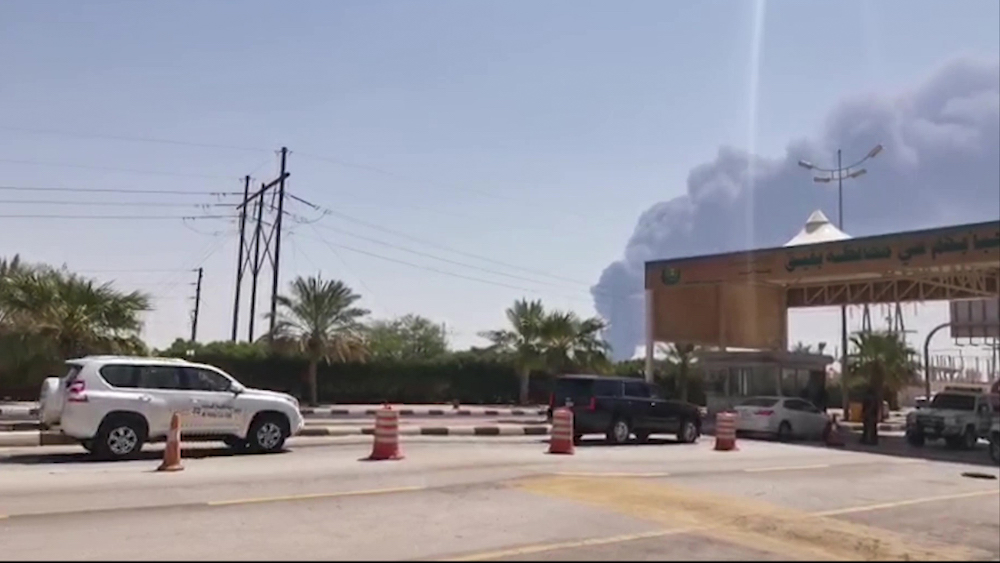
An AFPTV screengrab from a video shows smoke billowing from the Aramco oil facility in Abqaiq. (AFP)
The Crown Prince "underscored the Kingdom willingness and strength to thwart such a terrorist aggression and deal with its consequences."
The Arab coalition, which supports the internationally-recognized Yemeni government, said investigations were ongoing to determine those responsible for "planning and executing these terrorist attacks."
"The Coalition continues to adopt and implement necessary procedures to deal with such terrorist threats in order to safeguard national assets, international energy security and ensure stability of world economy," spokesman Col. Turki Al-Maliki said.
The US Ambassador to Saudi Arabia John Abizaid said the US “strongly condemns” the drone attacks on Aramco facilities in Abqaiq and Kurais. He added that the attacks “endanger civilians” and “are unacceptable.”
U.S. Ambassador John #Abizaid: “The U.S. strongly condemns today’s drone attacks against oil facilities in Abqaiq and Khurais. These attacks against critical infrastructure endanger civilians, are unacceptable, and sooner or later will result in innocent lives being lost.” pic.twitter.com/ZzDTNUz2Ik
— U.S. Mission to KSA (@USAinKSA) September 14, 2019
The UAE, another member of the coalition, also condemned the attack calling it an “act of terrorism and sabotage” and new evidence of terrorist groups attempting to undermine security and stability in the region.
The Emirates’ foreign ministry said the UAE stands with Saudi Arabia and supports any steps that it takes to protect the security and stability of its civilians.
The security of the UAE and Saudi Arabia are indivisible, the statement said, and any threat to the Kingdom is considered a threat to the UAE.
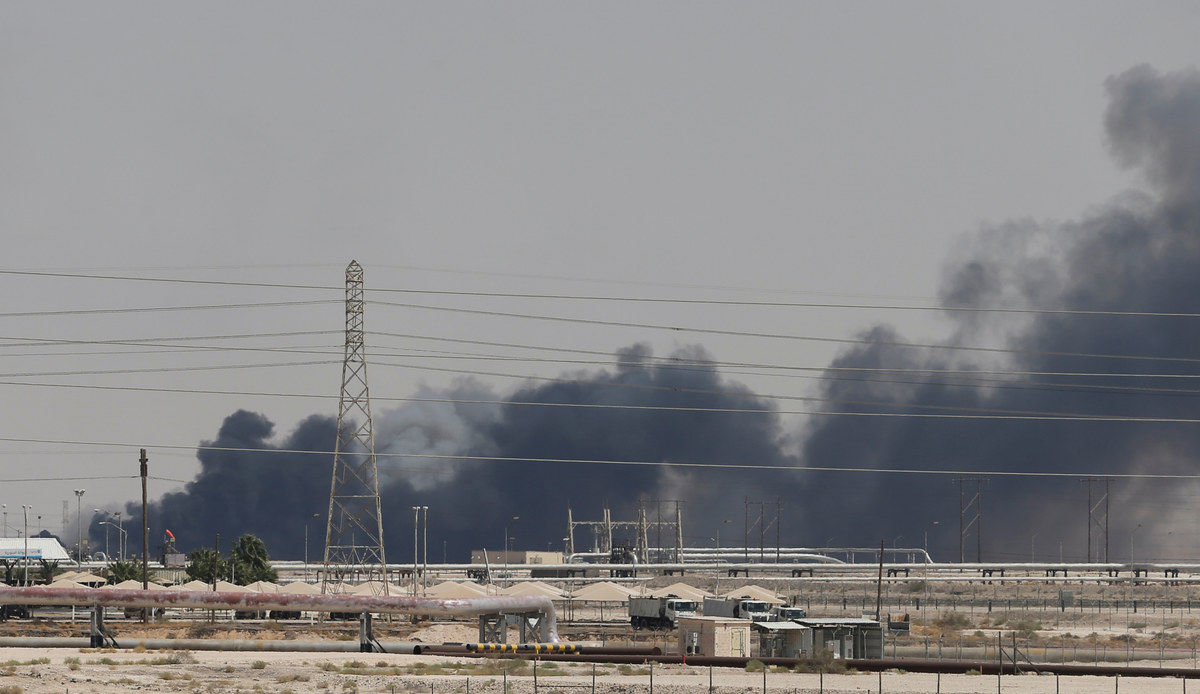
Smoke billows following a fire at the Aramco facility in the eastern city of Abqaiq, Saudi Arabia on Saturday, September 14, 2019. (Reuters)
Abqaiq is located 60 kilometers southwest of Aramco’s Dhahran headquarters. It contains the world’s largest oil processing plant, handling crude from the giant Ghawar field and for export to terminals Ras Tanura — the world’s biggest offshore oil loading facility — and Juaymah. It also pumps westwards across the kingdom to Red Sea export terminals.
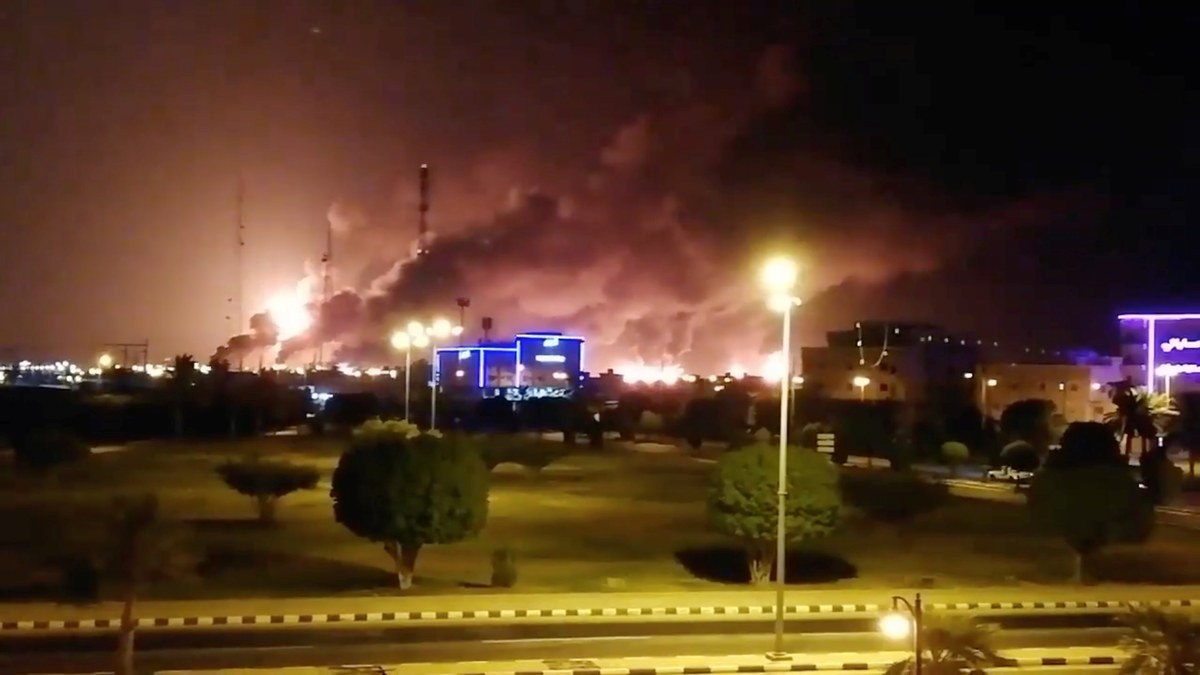
A screengrab of a video from social media shows smoke following a fire at the Aramco factory in Abqaiq, Saudi Arabia. (Reuters)
Khurais, 190 kilometers further southwest, is believed to produce over 1 million barrels of crude oil a day. It has estimated reserves of over 20 billion barrels of oil, according to Aramco.
Bahrain, Kuwait, Pakistan, Egypt, Jordan, the GCC and the Palestinian foreign ministry also reaffirmed their support for Saudi Arabia and strongly condemned the attack.
The UK condemned “the reckless drone attack” on Saudi Aramco oil facilities and called “upon the Houthis to immediately cease such attacks.”
The UN special envoy for Yemen says he is "extremely concerned" about the drone attack.
Martin Griffiths urged all parties to "prevent such further incidents, which pose a serious threat to regional security, complicate the already fragile situation and jeopardize UN-led political process.”
The Arab League and the Organization for Islamic Cooperation both added their voices to the widespread condemnation.
King Salman received a telephone call from Jordan’s King Abdullah II during which he condemned the attacks.
Prince Abdullah bin Khalid, director of research, and head of the Security Studies Research Unit at King Faisal Center for Research and Islamic Studies, said Iran will continue its escalation in the region whether "north or south" through its proxies.
"The attacks on an Aramco oil refinery in Abqaiq are the last ring in this interconnected chain, which should be considered and dealt with once and for all," he said on Twitter.
“The international community must take a decisive stance toward Iranian excesses in the region, and its continued threats to the freedom of navigation, energy security and global economy. Most important, the mistakes of the past should not be repeated with regards to the issue of nuclear weapons and dealing with it separately from other issues and threats.”
Salman Al-Ansari, a political analyst and president of the Saudi American Public Relations Affairs Committee (SAPRAC), said the incident “is another proof that Houthis are nothing but an Iranian-backed terrorist militia.
“Targeting the world’s biggest oil field is an Iranian terrorist attempt to project influence in the region since it is under sanctions and prevented globally from selling its oil,” he told Arab News. “It’s puzzling that the international community and the world’s media is not outraged by such terrorist actions. It seems they only get outraged when Saudi (Arabia) hits terrorists in Yemen,” he said.
Al-Ansari said the US should seriously consider declaring the Houthis terrorists, which would not necessarily undermine a possibility for the US-Houthi talks in the future as some US officials may think.
“It’s insanity to not consider listing the Iranian-backed terrorist militia. The Houthis proclaimed the slogan of ‘death to America’ and killed thousands of civilians and targeted the US navy multiple times and disturbed peace in the region. What else can qualify for getting listed as a terror group?”


