Pakistan strongly condemns Houthi drone attack on Saudi Aramco facilities

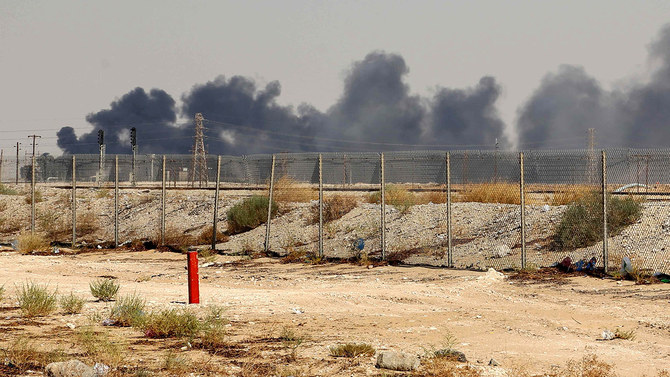
Smoke billows from an Aramco oil facility in Abqaiq about 60km (37 miles) southwest of Dhahran in Saudi Arabia’s eastern province on Sept. 14, 2019. (REUTERS)
Updated 14 September 2019
Follow

Pakistan strongly condemns Houthi drone attack on Saudi Aramco facilities

  • Foreign office says such acts of sabotage cannot be condoned
  • Pakistan’s political leaders say the country is ready “to take any step” for the safety and security of Saudi Arabia

ISLAMABAD: Pakistan’s Ministry of Foreign Affairs on Saturday issued a strong condemnation of the drone attack on two Saudi oil processing facilities, Buqayq and the Khurais oil field, which had caused fire and damage.
Yemen’s Houthi group claimed responsibility for the attacks on the two facilities in the kingdom’s Eastern province on Saturday, the group’s military spokesman said on Al-Masirah TV.
“Such acts to sabotage and disrupt commercial activities causing fear and terror cannot be condoned,” a statement issued by Pakistan’s Foreign Office said.
“Pakistan reiterates its full support and solidarity with the brotherly Kingdom of Saudi Arabia against any threat to its security and territorial integrity,” it further stated.
PML-N Chairman Raja Zafarul Haq, who is leader of the opposition in the Senate, told Arab News that Pakistan was “ready” to safeguard Saudi Arabia’s sovereignty.
“Saudi Arabia has the right to act in self defense,” Haq said. 
“Pakistan is ready to take any step for the safety and security of Saudi Arabia,” he said and added that countries who “claim to be friends of Saudi Arabia should stand by it to stop such attacks on the sovereignty...of the country.”
Latif Khosa, Former Governor of Punjab province and a central leader of Pakistan Peoples Party, told Arab News that it was increasingly dangerous that militant groups like Houthis had got their hands on drones.
“World powers should support Saudis against such militant groups,” Khosa said.
He added that Pakistanis had “special respect for Saudis” and that the kingdom could bank on Pakistan.
The broadcaster, Al-Masirah TV, said the Houthis had deployed 10 drones against the sites in Abqaiq and Khurais, and the group pledged to widen the range of its attacks on Saudi Arabia, which leads a coalition fighting them in Yemen.
Dr. Abdul Ghaffar Aziz, Director International Affairs of Pakistan's religious-politico party, Jamat-i-Islami, said the attacks must be condemned across the table.
“All the countries of the region, whether they are friends of Saudi Arabia or have differences with them, should condemn this militant attack which cannot be justified in any case,” he told Arab News.
Khalid Rehman, Director General of the Institute of Policy Studies Islamabad, said it was unfortunate that the Houthis were spreading unrest in Yemen and attacking sovereign countries.
“The whole Muslim world should join hands with Saudi Arabia to stop such evil forces and to bring peace in Yemen as well as the region,” Rehman said.


Pakistan’s ‘Air Punjab’ faces scrutiny over Gulfstream jet purchase

Updated 6 sec ago
Follow

Pakistan’s ‘Air Punjab’ faces scrutiny over Gulfstream jet purchase

  • Punjab government calls luxury jet part of planned airline awaiting regulatory approval
  • Aviation experts question the viability of the 17-seat aircraft for commercial operations

ISLAMABAD: Aviation experts and an official on Saturday questioned the commercial viability of the move as the Punjab government said it had acquired a Gulfstream luxury aircraft as part of “Air Punjab,” an upcoming airline registered with the Securities and Exchange Commission of Pakistan (SECP) but yet to secure key regulatory approvals.

The development comes months after the federal government moved ahead with the privatization of Pakistan International Airlines (PIA), citing its inability to sustainably run the debt-ridden national carrier.

Air Punjab (Private) Limited was incorporated with the SECP on July 24, 2025, under registration number 0302317. The concept was first introduced by Punjab Chief Minister Maryam Nawaz in April 2025, with plans to launch operations within a year using leased aircraft. The provincial cabinet subsequently approved the airline’s establishment. However, an official told Arab News that the project remains at a preliminary stage.

“They have not got their license yet,” the official in the aviation department told Arab News on condition of anonymity, adding the airline still has to go through processes to be able to start operations.

The aircraft in question, a Gulfstream G500, registration N144S, arrived in Lahore from North America in December 2025 and began local flight operations on February 6, 2026. Online flight records show the jet was used at least 15 times between February 9 and February 18 for short trips to cities including Lahore, Rawalpindi, Sialkot, Dera Ghazi Khan and Faisalabad, with flight durations ranging from 14 to 37 minutes. It frequently used the call sign “Punjab 2.”

Responding to criticism that the aircraft had been inducted for the Punjab chief minister, the provincial information minister Azma Bukhari on Friday defended the purchase.

“For our ‘Air Punjab,’ we are buying various aircraft and some we will take on lease,” she said. “This means we have to build a fleet which will have all kinds of planes, and this is a part of that same link. Right now, as soon as the matters on this are finalized, I will definitely tell you.”

The aviation official said the aircraft was a 17-seater and couldn’t be used for commercial flights.

“The smallest aircraft used for commercial operations now is the ATR, which has around 48 [ATR 42-500] to 70 [ATR 72-500] seats. How can an airline be operated with a Gulfstream jet that is configured for VIP travel and has previously been used for executive flights? It is not commercially viable,” he said.

Speaking about the technical aspects, Afsar Malik, an independent aviation expert, said the provincial minister had probably been mistaken when she said the aircraft was for the upcoming airline.

“The Gulfstream is state aircraft and state aircraft cannot be used for commercial purpose,” he said. “Secondly, it’s not commercially viable. If Punjab information minister has said it, it would either be a slip of the tongue or ignorance.”

The planned launch of the provincial carrier comes as Pakistan’s aviation sector tries to recover from its deepest crisis in decades. The industry’s decline was interrupted in late 2025 by the federal government’s sale of the debt-ridden national carrier, Pakistan International Airlines (PIA), to a private consortium after the state could not sustain losses exceeding 800 billion rupees ($2.8 billion).

The private sector has proven equally volatile. Regulators recently suspended the license of Serene Air after its entire five-aircraft fleet was deemed “unserviceable,” leaving it with zero operational capacity.

“Twelve airlines have shut down since the sector’s inception,” said aviation consultant Irshad Ghani, noting that Serene Air joined a long list of failed carriers including Shaheen Air and Bhoja Air.

High capital requirements and rising airfares have hollowed out the domestic market, leaving ventures like Air Punjab facing immense skepticism in an industry Ghani describes as “fragile.”

Ghani, who heads an aviation consultancy firm, said PIA had operated 19-seater ATR turboprop aircraft in the past, particularly to serve smaller airports such as Sargodha where larger jets could not land. However, he drew a distinction between turboprops designed for commercial routes and executive jets.

“As far as the Gulfstream jet is concerned, it has been operated as a chartered aircraft, and it can also be used for charter operations by an airline. However, that would typically be the case for a well-established or large airline,” Ghani said.

He questioned the broader logic of the project.

“The question arises: when the federal government has just sold the national airline, acknowledging that the government could not successfully run it, how logical is it for a provincial government to operate its own airline?” he asked.

Ghani said he doubted it will be run successfully.

“If Punjab had the capacity to operate a public airline, why didn’t it consider purchasing PIA instead,” he wondered.

Minister Bukhari did not respond to Arab News queries regarding the Gulfstream and Air Punjab.