ISLAMABAD: Pakistan says firing by Indian troops across the highly militarized frontier in the disputed Kashmir region has killed one of its soldiers overnight.
A military statement Saturday says Indian troops opened fire “unprovoked” in the Hajjipir sector of the Pakistani side of Kashmir, killing one soldier.
Indian fire in the same area also killed one Pakistani soldier last Thursday.
Pakistan and India often trade fire across the militarized border splitting Kashmir, which is claimed by both countries.
Tensions between the two nuclear-armed South Asian neighbors increased since Aug. 5, when India downgraded the autonomy of its side of Kashmir and imposed a curfew.

Pakistan says Indian fire kills 1 soldier in Kashmir
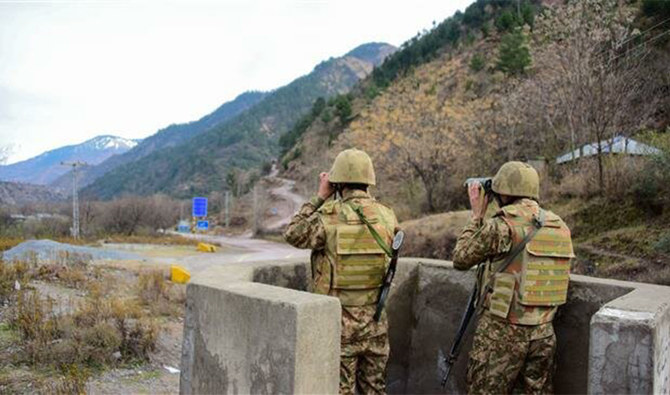
- Border skirmishes have become a norm between India and Pakistan in recent years
- Tensions mounted between the two countries after New Delhi's changed Kashmir's constitutional status
Pakistan raises India's suspension of water-sharing treaty with UNGA president, seeks action
- New Delhi said in April last year it was holding the treaty in abeyance after a gun attack in Indian-administered Kashmir
- Official says such actions threaten lives of 240 million Pakistanis, particularly at a time of climate stress, water scarcity
ISLAMABAD: Pakistan has taken up India’s suspension of a decades-old water-sharing treaty with the president of the United Nations General Assembly (UNGA), urging action over the move that Islamabad said sets "dangerous precedents."
The Indus Waters Treaty (IWT) divides control of the Indus basin rivers between the two nuclear-armed neighbors. India said in April last year it would hold the treaty “in abeyance” after a gun attack in Indian-administered Kashmir killed more than 26 tourists. New Delhi blamed the assault on Pakistan, Islamabad denied it.
The attack led to a four-day military conflict between the neighbors last May that say them attack each other with fighter jets, missiles, drones and artillery before the United States-brokered a ceasefire. Tensions have remained high between the nuclear-armed neighbors.
During a meeting on the sidelines of the Inter-Parliamentary Union (IPU) annual hearing, Pakistan Senate Chairman Yusuf Raza Gilani told UNGA President Annalena Baerbock that India's unlawful action constituted a blatant violation of the treaty’s provisions and principles of customary international law.
"Such actions threaten the lives and livelihoods of over 240 million Pakistanis and set dangerous precedents, particularly at a time when climate stress and water scarcity demand cooperation and strict respect for international agreements," he was quoted as saying by the Pakistani information ministry.
The treaty, mediated by the World Bank, grants Pakistan rights to the Indus basin’s western rivers — Indus, Jhelum, and Chenab — for irrigation, drinking, and non-consumptive uses like hydropower, while India controls the eastern rivers — Ravi, Beas, and Sutlej — for unrestricted use but must not significantly alter their flow.
Highlighting the adverse impacts of climate change, Gilani said countries like Pakistan remain among the most severely affected and underscored the urgency of collective action, climate justice and strengthened international cooperation.
"The United Nations provides an indispensable platform for addressing these interconnected challenges," he said at the meeting.
Gilani, who was leading a six-member parliamentary delegation, this week delivered the national statement at the IPU annual hearing at the UN headquarters, calling for democratic, transparent, and accountable decision-making in order to enhance the UN’s credibility, according to the Senate of Pakistan.
“Parliaments are indispensable partners in ensuring national ownership of international commitments,” he was quoted as saying by the Senate. “Reform is essential. But it must be ‘Reform for All, Privilege for None’.”
The Senate chairman highlighted the continuing importance of the United Nations as the cornerstone of multilateral cooperation, stressing that the organization’s universal membership and Charter-based mandate remain central to promoting global peace and security.


