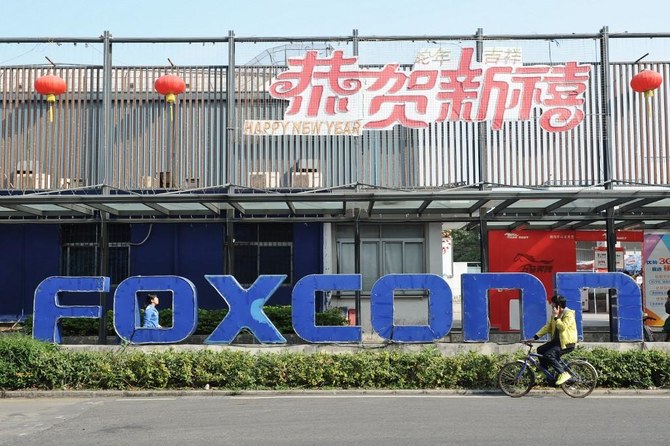
SHANGHAI: Apple and manufacturing partner Foxconn Technology on Monday rebutted allegations of lapses in people management levelled by a non-profit monitor of worker rights, though confirmed they employed too many temporary workers.
The response comes after China Labor Watch on Monday issued a lengthy report accusing the two companies of breaching numerous Chinese labor laws, including one barring temporary staff from exceeding 10 percent of the total workforce.
US tech firm Apple relies heavily on Taiwan’s Foxconn and its Chinese manufacturing facilities to produce devices such as the iPhone, the next line of which will be unveiled on Tuesday.
In a statement, Apple said it investigated the percentage of temporary workers among the overall workforce and found it “exceeded our standards.” It said it was working with Foxconn to “immediately resolve the issue.”
Apple did not state whether the excess amounted to a breach of Chinese law. It declined to comment when asked directly by Reuters.
China’s Ministry of Human Resources and Security did not respond to a Reuters fax seeking comment. Reuters could not immediately determine any penalty for temporary employees exceeding 10 percent of the workforce.
Apple also said it discovered interns at a supplier facility had worked overtime at night, violating company policy, and that “this issue has been corrected.” It said the interns worked overtime voluntarily and were properly compensated.
Foxconn separately confirmed over-reliance on temporary workers, known internally dispatch workers.
“We did find evidence that the use of dispatch workers and the number of hours of overtime work carried out by employees, which we have confirmed was always voluntary, was not consistent with company guidelines,” Foxconn said.
It said it “immediately began a detailed process to ensure that all issues were addressed.”
The labor report comes at a time of trade tension between the United States and China that has threatened to upend supply chains across the technology industry with tit-for-tat import tariffs.
Earlier this year, media reports said Apple was considering moving some operations out of China to avoid new US tariffs, with Japan’s Nikkei Asian Review in June putting the figure at 15 percent to 30 percent of production.
In an earnings call in July, Apple Chief Executive Tim Cook downplayed such speculation, stating the vast majority of Apple’s products “are kind of made everywhere.”
“There’s a significant level of content from the United States and a lot from Japan to Korea to China, and the European Union also contributes a fair amount. And so, that’s the nature of a global supply chain. Largely, I think that will carry the day in the future as well.”


![]()

Apple, Foxconn: We overly relied on temporary workers in China
Apple, Foxconn: We overly relied on temporary workers in China
- Apple said it investigated the percentage of temporary workers among the overall workforce and found it ‘exceeded our standards’
- Earllier media reports said Apple was considering moving some operations out of China to avoid new US tariffs


Latest updates







© 2026 SAUDI RESEARCH & PUBLISHING COMPANY, All Rights Reserved And subject to Terms of Use Agreement.