

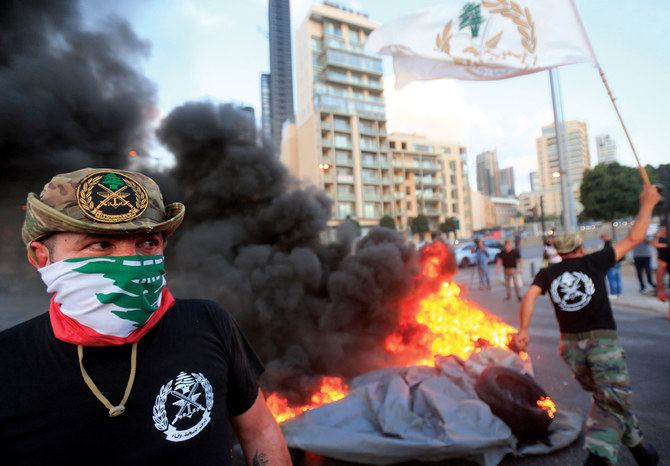
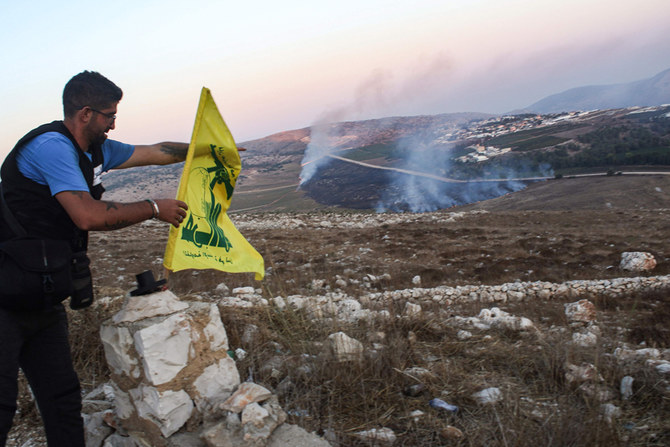

JEDDAH: First, the international ratings agency Fitch downgraded Lebanon’s credit rating. Next, tensions on the border with Israel soared as Hezbollah let loose a barrage of anti-tank missiles. Finally, Lebanon’s political leaders declared “an economic state of emergency,” raising questions about the country’s ability to service its debts.
Sounds familiar? That’s because the more things change for Lebanon, the more they remain the same.
In an interview with CNBC last week, Lebanon’s prime minister Saad Hariri expressed concern that planned austerity measures such as a state hiring freeze and higher taxes on imported goods could lead to public demonstrations.
His warning followed a speech by Hezbollah chief Hassan Nasrallah, who said his fighters’ new focus would be Israeli drones that enter Lebanon’s skies, and that there would be “no more red lines.”
Experts say neither Israel nor Hezbollah can risk a return to the situation of 2006 when their month-long war claimed at least 1,500 lives and forced 974,000 Lebanese from their homes. But a new conflagration could still strain the parlous state of Lebanon’s political economy.
IN NUMBERS
- 5.9 million - Estimated Lebanese population.
- 3.2 million - People in need.
- 1.5 million - Displaced Syrians in Lebanon.
- 28,000 - Palestinian refugees from Syria.
- 25% - Unemployment rate. (Source: UNHCR & Lebanon’s Ministry of Social Affairs)
Randa Slim, director of the Conflict Resolution and Track II Dialogues Program at the Middle East Institute in Washington DC, says a large military escalation, especially on the Israel-Hezbollah front, will accelerate an economic collapse.
“It is clear that both sides are interested for now in maintaining the ‘mutual deterrence’ equation that has been in place on the Lebanon-Israel border since the end of the last large confrontation between them in the summer of 2006,” she told Arab News.
The biggest difference for Hezbollah since 2006 is the significant combat experience it has gained from the battlefields of Syria. Thousands of Hezbollah fighters took part in the civil war there and helped turned the tide of war in President Bashar Assad’s favor.
“Hezbollah has the military capacity to inflict serious damage on Israel, but it is not in its interest to initiate such a confrontation while it is busy fighting Sunni militancy in Syria and Iraq,” said Imad Salamey, associate professor of political science at the Lebanese American University in Beirut.
“For Hezbollah and Iran, confrontation with Saudi Arabia and, to a lesser extent, Turkey is a priority.”
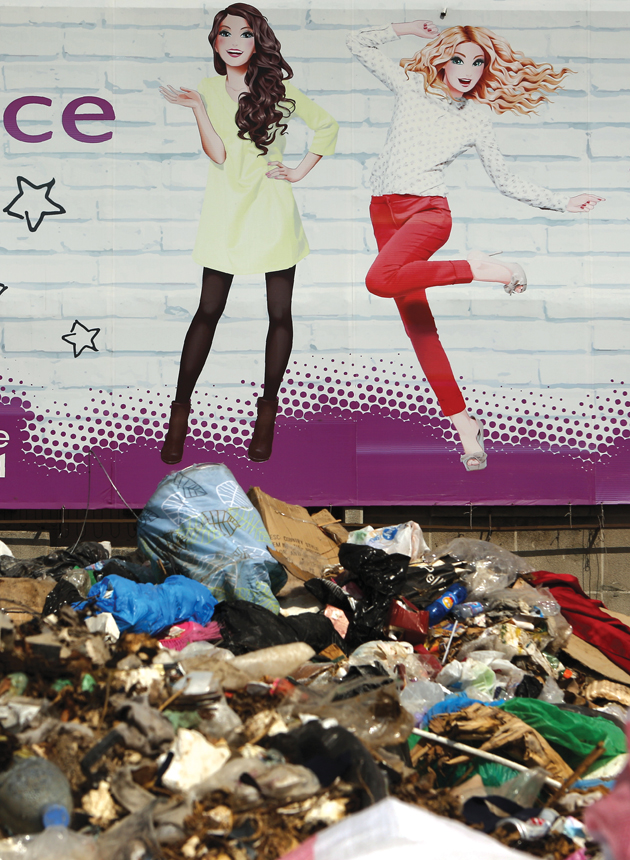
Lebanon is struggling even to keep its garbage under control. (AFP)
Slim argues that “the dynamics underpinning the state of ‘controlled’ conflict between Hezbollah and Israel have changed.”
“Israel now frames its conflict with Hezbollah through two strategic priorities: Rolling back Iranian regional entrenchment with Hezbollah being the linchpin of Iran’s regional enterprise; and preventing Hezbollah from developing a precision-guided missile arsenal,” she told Arab News.
“Iran and Hezbollah see both this regional network of Iranian proxies and Hezbollah’s missile arsenal as an integral component of Iran’s forward defense strategy and Hezbollah’s mutual deterrence strategy vis-a-vis Israel.
“If both parties still see the costs and benefits of a limited tit-for-tat strategy acceptable, which seems to be the case for now, they will continue to test each other’s red lines through a limited and calibrated escalation strategy. At some point, either and/or both sides will come to the conclusion that this strategy is no longer working.”
The dire economic situation in Lebanon is a reflection of its many-sided crisis. The country has been struggling with one of the world’s heaviest public debt burdens, high unemployment, instability and years of slow economic growth. The banking sector, which is a critical source of finance for this small Arab state, has witnessed a reduction in deposits, especially this year.
Foreign reserves have plunged and continue to fall. A report released by the Lebanese Center for Policy Studies in February 2019 said the unemployment rate in the country is nearly 25 percent overall and 37 percent for those under the age of 25.
The World Bank says one of the key issues facing Lebanon is the economic and social impact of the Syrian crisis, now in its ninth year.
According to government and independent sources, up to 1.5 million Syrians have taken refuge in Lebanon since the conflict erupted in March 2011. An estimated 28,000 Palestinians from Syria have also sought refuge in Lebanon, in addition to the 174,000 longstanding Palestinian refugees from previous Middle East wars.
Beset by so many intractable problems, gross domestic product growth in Lebanon in 2018 fell to a measly 0.2 percent, down from 0.6 percent in 2017. Meanwhile, inflation averaged 6.1 percent, up from 4.7 percent in 2017.
The International Monetary Fund said last month that Lebanon’s budget deficit in 2019 would likely be well above the government’s target of 7.6 percent.
Salamey says Lebanon can at best mitigate the major repercussions of a crisis but cannot resolve its fundamental structural problems, including those associated with domestic and regional conflicts.
Furthermore, he says, the government cannot be held to account for its actions because of its confessional composition, which prevents an opposition from emerging to keep a check on its performance. Consequently, corruption flourishes and the economy suffers.
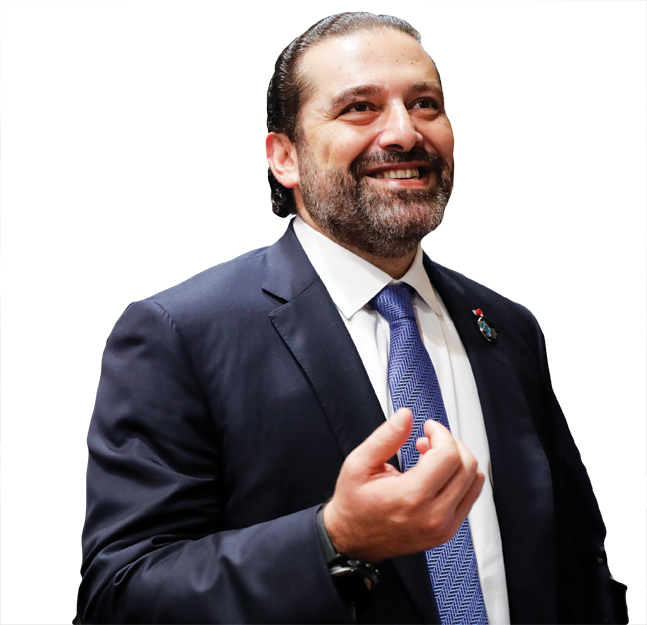
Lebanon’s Prime Minister Saad Hariri has warned of public unrest. (AFP)
Lebanon ranked 138 globally on the index of 180 countries and 13 among 22 Arab countries in Transparency International’s “Corruption Perceptions Index 2018.” The watchdog group said corruption was widespread; it is present in many levels of society and in the country’s institutions.
“Steps against corruption must be political so as to undermine sectarianism in the country through ‘deconfessionalization’ of parliament as stipulated by the Taif agreement,” Salamey said, “as well as through electoral reforms that can end the monopoly of the major confessional parties in favor of genuine opposition or the division of sectarian parties into smaller ones.”
The Taif accord, signed in Saudi Arabia in 1989, provides the basis for the ending of the civil war and return to political normality.
Salamey’s views are echoed by Slim, who says corruption in Lebanon is rooted in the structure of the political system that is based on the division of political and economic power among a few leaders of confessional groups.
“The strongest step to take against corruption in Lebanon requires a major overhaul of this political system. Needless to say, corruption in Lebanon is here to stay,” she said.
According to Salamey, the presence of a large informal economy undermines the ability of the state to increase revenues and develop the comprehensive infrastructure essential for efficient performance, for example in the energy sector.
“These are irreversible and deeply rooted problems and the country can only provide temporary fixes,” he told Arab News.
As for the latest austerity measures, Salamey says they will help, but they need to be complemented by political stability and incentives for investments and deposits.
Slim points out that the Hariri government made a solemn promise to undertake economic measures before foreign governments and donor institutions announced a $11 billion infrastructure investment package at the 2018 CEDRE conference in Paris. “It is a fragile situation,” she said.
Clearly, Prime Minister Hariri has no illusions about the task that lies ahead. “Everyone is conscious there is a problem and everyone wants to take action,” he told CNBC’s Hadley Gamble. “The issue is how to combine all our efforts in one big package of reform that will come with all the things we need to do.”


