NEW YORK: Detroit carmakers and the United Auto Workers faced a challenging backdrop to contract talks even before prosecutors escalated a corruption probe of the union in recent days.
Uncertainties surrounding US trade policy and fuel economy rules have clouded the industry’s outlook for months, while residual anger over plant closures has deepened worker suspicions of management as the US economy shows signs of slowing.
But rank-and-file workers — who must ratify any contract agreement — are also feeling skeptical of union management.
On August 28, less than three weeks before the four-year UAW contract with General Motors, Ford and Fiat Chrysler Automobiles (FCA) expires, the FBI raided the home of UAW President Gary Jones.
Then on Wednesday, former union official Michael Grimes pleaded guilty to charges of taking bribes from vendors connected to a training fund, the ninth guilty plea in the long-running US criminal investigation.
The scandal has boosted the already elevated odds of a strike, labor experts say.
“It makes it much more difficult to get it ratified,” said Arthur Wheaton, an expert in industrial labor relations at Cornell University, who thinks the odds of a strike are especially high at GM and FCA.
Talks began in July to replace a four-year contract that expires September 14. Besides a strike or new contract, the two sides could agree to temporarily extend the contract.
The automakers’ contracts, negotiated in three separate rounds, are usually similar but not identical.
GM said Tuesday that it hopes for “an agreement that builds a strong future for our employees and our business.”
The UAW, for its part, won overwhelming support from all three workforces to authorize a strike if necessary.
“We are ready to stand strong for our future,” Jones said in a statement. “We are focused. We are prepared and we are all ready to stand up for our members, our communities and our manufacturing future.”
The list of unpredictables includes the limbo state of a revamped North American Free Trade Agreement, a burgeoning fight between California and the Trump administration over fuel economy rules, and the volatile, wild-card role of President Donald Trump, who has not been shy about going after companies or union officials on Twitter.
“There’s a ton of uncertainty,” said Kristin Dziczek, vice president of industry, labor and economics at the Center for Automotive Research in Michigan. She sees a higher chance of a strike than in past contract talks.
“We don’t know the rules of trade in North America yet, we don’t know the fuel economy regulations,” she added. “These are huge things.”
Key issues once again include nuts-and-bolts items such as wages and health care benefits. The companies are also hoping to win concessions on greater use of temporary workers, a bone of contention for labor.
The talks come at the tail end of a strong period of auto sales that has begun to ebb as more economists predict a recession in the next couple of years.
Both sides are aware of the forecasts, and the union will want guarantees on work levels and pay, while companies will be seeking flexibility.
Dziczek pointed to a “fundamental friction” between the two sides that translates into this sort of conflicting thinking: “’If things get worse, let’s make sure we’re protected,’ versus ‘If things get worse, let’s make sure we don’t get locked in to higher costs.’“
The union is also likely to press for strengthened contract language after GM announced last November that it was effectively shuttering five plants in North America, including facilities in Ohio and Michigan that were “unallocated” for production.
Politicians from both parties criticized GM loudly. They included Trump, whose re-election could hinge on Ohio, Michigan and other industrial Midwestern states.
The announcement affected 2,800 hourly workers, all of whom were eligible for a new job if they could relocate.
The union cried foul, saying the move violated the existing contract that promised no plant closures during the contract’s lifespan. The matter is now being litigated in court.
Wheaton said frustration over GM’s move increases the chances of a strike, as the union will want to “draw a line in the sand to show they pushed GM as hard as they could” over a company move that was seen as “playing games” with contract language.
Wheaton expressed skepticism that the union would achieve its ultimate goal, however, which is to reverse the plant closures.
“In the end, the company always has the right to say what they’re going to build and where they’re going to build it,” he said.


![]()

United Auto Workers scandal, weakening car sales mean tough contract talks
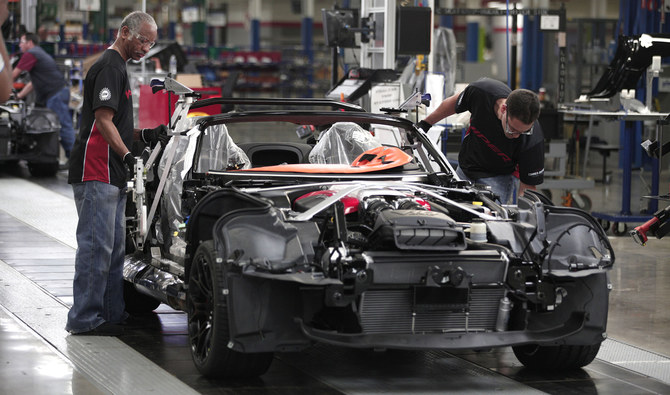
United Auto Workers scandal, weakening car sales mean tough contract talks
- Rank-and-file workers are feeling skeptical of union management
- The FBI raided the home of UAW President Gary Jones in August


Latest updates





© 2026 SAUDI RESEARCH & PUBLISHING COMPANY, All Rights Reserved And subject to Terms of Use Agreement.