Stockpiles of tomatoes? UK retailers bristle at demands of no-deal Brexit

Updated 08 September 2019
Follow

Stockpiles of tomatoes? UK retailers bristle at demands of no-deal Brexit

  • Race to Oct. 31 is building tensions across industry
  • Supermarkets say they cannot stockpile fresh food

LONDON: A British demand for supermarkets to prepare for a potentially chaotic no-deal Brexit by stockpiling food is stoking anger in the industry, with bosses saying they should not be blamed if people can’t find everything they want on the shelves.
With British politics spiralling toward an unpredictable endgame, makers of food and drugs are having to restructure operations in case the arrival of customs checks shatters supply chains, clogs ports and delays deliveries.
The food industry has warned that their stockpiling can only go so far, and executives have expressed incredulity at Michael Gove, the minister in charge of no-deal Brexit planning, who vowed this month that there would be no shortages of fresh food if Britain leaves the European Union (EU) without agreement on Oct. 31.
Already burned twice by the government delaying supposedly steadfast dates for Britain’s exit from the EU, the industry is also wary of spending hundreds of millions of pounds again when the outcome is so uncertain.
“There is a clear attempt (by government) to talk to a narrative which is that companies, if only they prepared properly, would be able to cope and it’s companies fault if they haven’t,” said Justin King, who was CEO of Sainsbury’s, Britain’s second largest supermarket chain, for 10 years.
“As night follows day, if 50% of lorries are delayed there will be gaps on the shelves inside seven days,” King, currently a director at retailer Marks & Spencer, told Reuters.
A senior executive at one of Britain’s big four supermarkets, which includes Tesco, Morrisons and Asda, said the government was increasingly treating the industry as an extended arm of the state.
“The fundamental question is, whose job is it to provide food for the UK in the case of a blockade?” he said, speaking on condition of anonymity.
“Taking measures to reasonably protect our business from the impact of Brexit is our duty. When you start to say ‘what is your business doing to feed the nation’ – that starts to move us out of reasonable steps.”
In an emailed statement, the Department of Environment, Food and Rural Affairs said the UK had robust supply chains across a range of countries and was meeting regularly with industry and retailers to make sure they were fully prepared for Brexit.
“We have a highly-resilient food supply chain and consumers in the UK have access to a range of sources of food. This will continue to be the case when we leave the EU on 31 October, whatever the circumstances,” the statement said.
Gove told parliament on Thursday that delays at the main port of Dover were a material risk but all would run smoothly if companies have the necessary customs declarations. While scarcity of some product lines may push up prices, it was unlikely to lead to full-scale shortages, he said.
“There is no good time of year to leave the European Union without a deal,” he said. “However we have to be ready for the consequences.”
Once considered the industry’s nightmare scenario at the extreme edge of probability, a no-deal Brexit is now looking ever more possible after Prime Minister Boris Johnson vowed to take Britain out of the EU without an agreement if necessary.
While opposition parties are trying to force another delay, a looming election means nothing can be taken for granted.
That marks a major challenge for a food industry which relies heavily on imports from Europe during the autumn when warmer climes are needed to grow some fruit and vegetables.
While Britain normally buys in around half of its food, with about a third coming from the EU, by the end of October the bloc provides some 86% of lettuces, 70% of tomatoes and 27% of soft fruit, according to the British Retail Consortium (BRC).
Food grown in North Africa also comes through Spain.
“I don’t believe there is any risk that the UK will go hungry, the question is will the UK be able to eat what it wants to eat in terms of fresh food?,” said the senior supermarket executive.
Autumn is also when retailers fill their warehouses ahead of the year’s busiest shopping season — Christmas.
Tesco boss Dave Lewis has said Britain’s biggest retailer stockpiled over 200 million pounds worth of long-life goods by the original Brexit deadline of end March, but will struggle to repeat that due to the millions of mince pies, hams and cheeses that already sit in warehouses.
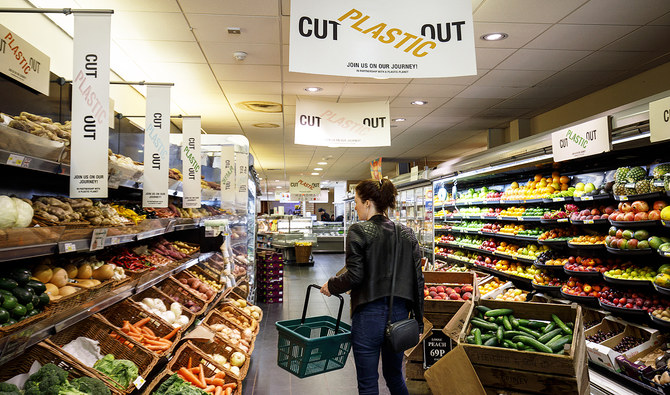
Fresh food can’t be stockpiled and border delays of a few days would wilt such produce meaning it could be put on final discount almost as soon as it arrives in store.
Tesco, with a No. 1 grocery market share of 27%, a workforce of 320,000 and a sourcing base of over 50 countries, expects to hold its own alongside rivals.
Sainsbury’s sources a higher proportion of cucumbers, tomatoes and peppers in Britain than others, Morrisons makes half of all its own brand and fresh food and Asda benefits from being part of Walmart, the world’s biggest retailer.
The major supermarkets have declined to say how much they are spending on their Brexit preparations, and declined to give any more details about their current readiness for a no-deal departure.
Ahead of the deadline, manufacturers, suppliers and retailers are battling to unravel a system honed over decades that delivers fresh and non-perishable goods to the stores just in time for sale, and in the most economically efficient way.
The need to build up stocks — to mitigate for any delays at ports — is putting pressure on the vast warehouses that form the backbone of Britain’s food network.
Jonathan Baker, executive director at Lineage UK, the world’s largest temperature-controlled logistics firm, said his sites are at maximum capacity.
Working in the industry for 37 years, he said the whole system started to creak before the original March deadline, with some food deliveries failing as logistics providers struggled to extract goods on time from warehouses filled to the brim.
“It could be a lot worse in October,” he said. “The last Brexit deadline, we were coming out of a relatively quiet period whereas this is slap bang in the busiest time of year.”
With so much uncertainty in the air, supermarkets are asking suppliers to hold more stock, and are likely to source more longer-life vegetables such as carrots and potatoes to avoid any empty shelves, according to the BRC.
“If your competitor is doing better than you then the consumer will walk,” said Andrew Opie, a director at the BRC lobby group. “One of the key items that all consumers look for is tomatoes. If you can’t see it you think the whole store is somehow depleted.”


Saudi Arabia pulls in most of Partners for Growth $450m capital push

Updated 07 February 2026
Follow

Saudi Arabia pulls in most of Partners for Growth $450m capital push

  • Global private credit fund leans into region’s largest market for growth-stage technology financing

RIYADH: Saudi Arabia has captured the vast majority of Partners for Growth’s capital deployed in the Gulf Cooperation Council, as the global private credit fund leans into what it sees as the region’s largest market for growth-stage technology financing. 

The San Francisco-based firm has deployed about $450 million in commitments in the GCC, and “the vast majority of that is in Saudi,” said Armineh Baghoomian, managing director at the firm who also serves as head of Europe, the Middle East and Africa and co-head of global fintech. 

The company was one of the earliest lenders to Saudi fintech unicorn Tabby, and it’s clear the Kingdom is providing fertile territory for ongoing investments.

“We don’t target a specific country because of some other mandate. It’s just a larger market in the region, so in the types of deals we’re doing, it ends up weighing heavily to Saudi Arabia,” Baghoomian said. 

Partners for Growth, which Baghoomian described as a global private credit fund focused on “growth debt solutions,” lends to emerging tech and innovation companies, particularly those that struggle to access traditional credit. 

“We’re going into our 22nd year,” she said, tracing the strategy back to its roots in a Bay Area investment bank debt practice in the mid-1980s. 

Today, the firm lends globally, she said, deploying capital where it sees fit across markets including Australia, New Zealand, and Southeast Asia, as well as Latin America and the GCC, where it has been active for about six years. 

Shariah structures dominate PFG’s Gulf deals 

In the Gulf, the firm’s structures are often shaped by local expectations. “Most of the deals we’ve done in the region are Shariah-compliant,” Baghoomian said. 

“In terms of dollars we’ve deployed, they’re Shariah-structured,” she added. 

“Usually it’s the entrepreneur who requires that, or requests it, and we’re happy to structure it,” Baghoomian said, adding that the firm also views Shariah structures as “a better security position in certain regions.” 

Growth debt steps in where banks cannot 

Baghoomian framed growth debt as a practical complement to equity for companies that have moved beyond the earliest stage but are not yet “bankable.” 

She said: “The lower-cost bank type facilities don’t exist. There’s that gap.”

Baghoomian added that companies want to grow, “but they don’t want to keep selling big chunks of equity. That implies giving up control and ownership.” 

For businesses with the fundamentals private credit providers look for, she said, debt can extend runway while limiting dilution. 

“As long as they have predictable revenue, clear unit economics, and the right assets that can be financed, this is a nice solution to continue their path,” she added. 

That role becomes more pronounced as equity becomes harder to raise at later stages, Baghoomian believes. 

She pointed to a gap that “might be widening” around “series B-plus” fundraising, as later-stage investors become “more discriminating” about which deals they back. 

Asset-heavy fintechs cannot scale on equity alone 

For asset-heavy technology businesses, Baghoomian argued, debt is not just an option but a necessity. 

She pointed to buy-now-pay-later platform Tabby as an example of a model built on funding working capital at scale. 

“Tabby is an asset-heavy business,” she said. “They’re providing installment plans to consumers, but they still need to pay the merchant on day one. That’s capital-intensive. You need a lot of cash to do that.” 

Equity alone, she added, would be structurally inefficient. “You would not want to just raise equity. The founders, employees, everyone would own nothing and lose a lot of control.” 

We don’t target a specific country because of some other mandate. It’s just a larger market in the region, so in the types of deals we’re doing, it ends up weighing heavily to Saudi Arabia.

Armineh Baghoomian, PFG managing director and head of Europe, the Middle East and Africa and co-head of global fintech

Baghoomian said those dynamics are common across other asset-intensive models, including lending platforms and businesses that trade in large inventories such as vehicles or property. “Those are businesses that inherently end up having to raise quite a bit of credit,” she said. Partners for Growth’s relationship with Tabby also reflects how early the firm can deploy capital when the structure is asset-backed. “We started with Tabby with $10 million after their seed round, and then we grew, and we continue to be a lender to them,” Baghoomian said. 

“On the asset-backed side, we can go in quite early,” she said. “Most of the fintechs we work with are very early stage, post-seed, and then we’ll grow with them for as long as possible.” 

As the market for private credit expands in the Gulf, Baghoomian emphasized discipline — both for lenders and borrowers. 

For investors assessing startups seeking debt, she said the key is revenue quality and predictability, not just topline growth. “Revenue is one thing, but how predictable is it? How consistent is it? Is it growing?” she said. “This credit is not permanent capital. You have to pay it back. There’s a servicing element to it.” 

Her advice to founders was more blunt: stress-test the downside before taking leverage. 

“You have to do a stress test and ask: if growth slows by 30 to 40 percent, can I still service the debt? Can I still pay back what I’ve taken?” she said. 

Baghoomian warned against chasing the biggest facility on offer. “Sometimes companies compete on how much a lender is providing them,” she said. “We try to teach founders: take as much as you need, but not as much as you can. You have to pay that back.” 

Partners for Growth positions itself as an alternative to banks not only because many growth-stage companies cannot access bank financing, but because it can tailor structures to each business. 

HIGHLIGHTS

• Partners for Growth positions itself as an alternative to banks not only because many growth-stage companies cannot access bank financing, but because it can tailor structures to each business.

• The firm lends globally deploying capital where it sees fit across markets including Australia, New Zealand, and Southeast Asia, as well as Latin America and the GCC, where it has been active for about six years.

One of Partners for Growth’s differentiators, Baghoomian said, is how bespoke its financing is compared with bank products. 

“These facilities are very bespoke. They’re custom to each company and how they need to use the money,” she said, adding that the fund is not offering founders a rigid menu of standardized options. 

“No two deals of ours look alike,” she said, framing that flexibility as especially important at the growth stage, when business needs can shift quickly. 

That customization, she added, extends beyond signing. Baghoomian said the firm aims to structure facilities so companies can actually deploy capital without being constrained, adding: “We don’t want to handcuff you. We don’t want to constrain you in any way.” 

As a company evolves, she said the financing can evolve too, because what works on day one often won’t fit nine months later. 

“We’ll revise structures,” she said, describing flexibility as core to how private credit can serve fast-moving tech businesses. 

She added that a global lender can also bring operating support and market pattern recognition, while still accounting for local nuance. 

Baghoomian expects demand for private credit in the Gulf to keep rising. “They are going to require credit, for sure,” she said, pointing to the scale of new platforms and projects. 

“I don’t see it shrinking,” she said, adding that Partners for Growth is seeing more demand and is in late-stage discussions with several companies, though she declined to name them. 

PFG to stay selective despite rising competition 

Competition among lenders has increased since the firm began deploying in the region, Baghoomian said, calling that “very healthy for the ecosystem.” 

Most of what the firm does in the region is asset-backed, Baghoomian said, often through first warehouse facilities for businesses financing receivables or other tangible exposures, “almost always Shariah.” 

Keeping Egypt on its watchlist 

Beyond the Gulf, Baghoomian said the firm is monitoring Egypt closely, though macroeconomic volatility has delayed deployments. 

“We looked at Egypt very aggressively a few years ago, and then the macro issues changed,” she said, adding that the firm continues to speak with companies in the country and track conditions. 

Even as private credit becomes more common in the region, Baghoomian underscored that debt is not universally appropriate. 

“Not every company should take a loan or credit,” she said. “You don’t take it just to take it. It should be getting you to the next milestone.”