LONDON: Prime Minister Boris Johnson is sticking to his Brexit plan and will not seek a delay to Britain’s departure from the EU at a summit next month, two of his ministers said on Sunday following a resignation from his government.
After work and pensions minister Amber Rudd’s shock resignation late on Saturday over Johnson’s Brexit policy, two ministers said the prime minister was determined to “keep to the plan” to leave the European Union by Oct. 31 with or without an agreement.
Johnson’s determination to leave “do or die” by that deadline has been shaken by the events of recent days, which have prompted critics to describe him as a tyrant and deepened uncertainty over how Britain’s 2016 vote to leave the EU will play out.
He has lost his Conservative government’s majority in parliament, expelled 21 rebels from the party and failed to force through a new election. Then his own brother quit, saying he was torn between family loyalty and the national interest.
Saturday’s resignation of Amber Rudd as work and pensions minister over what she described as the government’s disproportionate focus on preparing for a no-deal Brexit has only heightened the sense of crisis.
On Sunday, Rudd denied she was accusing the government of lying over its efforts to negotiate a Brexit deal, saying she was just reporting what she had seen.
“I am saying that 80 to 90 percent of the work that I can see going on on the EU relationship is about preparation for no deal. It’s about disproportion,” she told the BBC’s Andrew Marr show.
“The purpose of this resignation is to make the point that the Conservative Party at its best should be a moderate party that embraces people with different views of the EU.”
But foreign minister Dominic Raab rebutted her view, describing ongoing “intense negotiations” in Brussels, and emphasized that Johnson’s government would not be deterred from what some describe as a hard-line strategy on Brexit.
“I do also think that on some of these key issues, people need to understand, and the voters get it, that we’ve got to keep to the plan,” Raab told Sky News.
Both he and finance minister Sajid Javid also contradicted EU officials who have said Britain has yet to come up with new suggestions for changes to the deal agreed by Johnson’s predecessor Theresa May.
Johnson, Javid said, would go to an EU summit on Oct. 17 to try to secure the new deal.
“First of all, the prime minister will go to the council meeting on the 17th and 18th (of October), he’ll be trying to strike a deal. He absolutely will not be asking for an extension in that meeting,” Javid told the BBC.
But France said Britain was failing to say what it wanted, and the Foreign Minister in Paris, Jean-Yves Le Drian, said that, as things stood, an extension would not be granted even if Britain asked for one next month.
“It’s very worrying. The British must tell us what they want,” Le Drian told Europe 1 radio.
Asked if an extension beyond Oct. 31 was possible, Le Drian said not under current conditions. “We are not going to do (extend) this every three months,” he said.
Britain’s political crisis stepped up a gear last week, when parliament passed legislation to try to force Johnson to secure a Brexit extension if parliament has not approved either a deal or consented to leaving without agreement by Oct. 19.
Queen Elizabeth is expected to sign it into law on Monday, but Johnson says he would rather be “dead in a ditch” than request such an extension — something that opposition parties say could mean seeing the British prime minister breaking the law.
Johnson has countered by asking for a new election on Oct. 15, but opposition parties, led by Labour, said they could not trust him to stick to his word by holding the new poll before Britain is due to leave the EU at the end of the month.
“Until we’ve ruled a no deal off the agenda, I can’t risk, with Boris Johnson being in power, that he wouldn’t somehow impose that on the country,” Labour’s finance policy chief John McDonnell told the BBC.
“So, we can get no deal off the agenda, then I’d like a general election and part of that would be saying let’s have a referendum.”

UK’s Johnson will not seek Brexit delay, sticking to plan: ministers
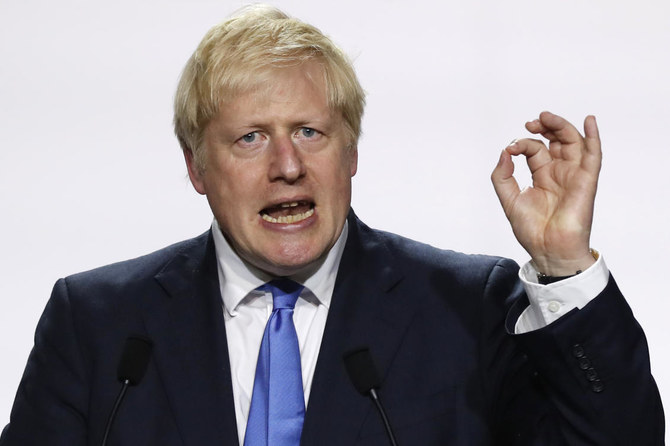
- Boris Johnson’s determination to leave ‘do or die’ by the October 31 deadline has been shaken by the events of recent days
Coast Guard is pursuing another tanker helping Venezuela skirt sanctions, US official says
- US oil companies dominated Venezuela’s petroleum industry until the country’s leaders moved to nationalize the sector, first in the 1970s and again in the 21st century under Maduro and his predecessor, Hugo Chávez
WEST PALM BEACH, Florida: The US Coast Guard on Sunday was pursuing another sanctioned oil tanker in the Caribbean Sea as the Trump administration appeared to be intensifying its targeting of such vessels connected to the Venezuelan government.
The pursuit of the tanker, which was confirmed by a US official briefed on the operation, comes after the US administration announced Saturday it had seized a tanker for the second time in less than two weeks.
The official, who was not authorized to comment publicly about the ongoing operation and spoke on the condition of anonymity, said Sunday’s pursuit involved “a sanctioned dark fleet vessel that is part of Venezuela’s illegal sanctions evasion.”
The official said the vessel was flying a false flag and under a judicial seizure order.
The Pentagon and Department of Homeland Security, which oversees the US Coast Guard, deferred questions about the operation to the White House, which did not offer comment on the operation.
Saturday’s predawn seizure of a Panama-flagged vessel called Centuries targeted what the White House described as a “falsely flagged vessel operating as part of the Venezuelan shadow fleet to traffic stolen oil.”
The Coast Guard, with assistance from the Navy, seized a sanctioned tanker called Skipper on Dec. 10, another part of the shadow fleet of tankers that the US says operates on the fringes of the law to move sanctioned cargo. It was not even flying a nation’s flag when it was seized by the Coast Guard.
President Donald Trump, after that first seizure, said that the US would carry out a “blockade” of Venezuela. It all comes as Trump has ratcheted up his rhetoric toward Venezuelan President Nicolás Maduro.
This past week Trump demanded that Venezuela return assets that it seized from US oil companies years ago, justifying anew his announcement of a “blockade” against oil tankers traveling to or from the South American country that face American sanctions.
Trump cited the lost US investments in Venezuela when asked about his newest tactic in a pressure campaign against Maduro, suggesting the Republican administration’s moves are at least somewhat motivated by disputes over oil investments, along with accusations of drug trafficking. Some sanctioned tankers already are diverting away from Venezuela.
US oil companies dominated Venezuela’s petroleum industry until the country’s leaders moved to nationalize the sector, first in the 1970s and again in the 21st century under Maduro and his predecessor, Hugo Chávez. Compensation offered by Venezuela was deemed insufficient, and in 2014, an international arbitration panel ordered the country’s socialist government to pay $1.6 billion to ExxonMobil.
Maduro said in a message Sunday on Telegram that Venezuela has spent months “denouncing, challenging and defeating a campaign of aggression that goes from psychological terrorism to corsairs attacking oil tankers.”
He added: “We are ready to accelerate the pace of our deep revolution!”
Sen. Rand Paul, R-Kentucky, who has been critical of Trump’s Venezuela policy, called the tanker seizures a “provocation and a prelude to war.”
“Look, at any point in time, there are 20, 30 governments around the world that we don’t like that are either socialist or communist or have human rights violations,” Paul said on ABC’s’ “This Week.” ”But it isn’t the job of the American soldier to be the policeman of the world.”
The targeting of tankers comes as Trump has ordered the Defense Department to carry out a series of attacks on vessels in the Caribbean and eastern Pacific Ocean that his administration alleges are smuggling fentanyl and other illegal drugs into the United States and beyond.
At least 104 people have been killed in 28 known strikes since early September. The strikes have faced scrutiny from US lawmakers and human rights activists, who say the administration has offered scant evidence that its targets are indeed drug smugglers and that the fatal strikes amount to extrajudicial killings.
Trump has repeatedly said Maduro’s days in power are numbered. White House chief of staff Susie Wiles said in an interview with Vanity Fair published last week that Trump “wants to keep on blowing boats up until Maduro cries uncle.”
Sen. Tim Kaine, D-Virginia, told NBC’s “Meet the Press” on Sunday that Trump’s use of military to mount pressure on Maduro runs contrary to Trump’s pledge to keep the United States out of unnecessary wars.
Democrats have been pressing Trump to seek congressional authorization for the military action in the Caribbean.
“We should be using sanctions and other tools at our disposal to punish this dictator who is violating the human rights of his civilians and has run the Venezuelan economy into the ground,” Kaine said. “But I’ll tell you, we should not be waging war against Venezuela. We definitely should not be waging war without a vote of Congress.