Pope arrives in Mozambique hoping to consolidate peace

1 / 2
Pope Francis and Mozambican President Felipe Nyusi inspect the guard of honor upon the Pope’s arrival at the Maputo International Airport near the capital on Sept. 4, 2019. Pope Francis will visit Mozambique from the Sept. 4-6. (AFP)
2 / 2
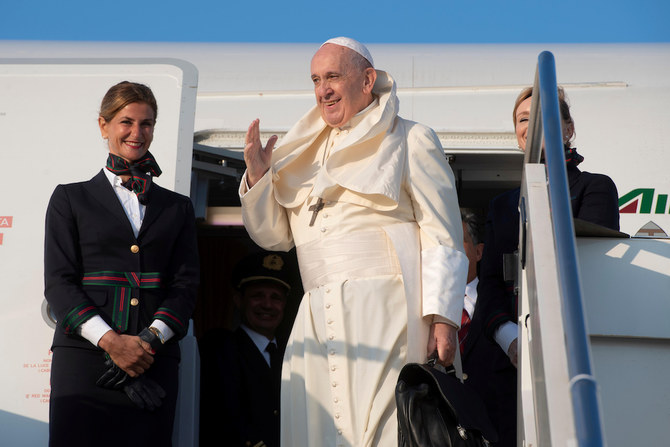
Pope Francis boards the airplane as he departs Fiumicino Airport to begin his visit to the African nations of Mozambique, Madagascar and Mauritius, in Rome, Italy Sept. 4, 2019. (Vatican Media/Reuters)
Updated 04 September 2019
Follow

Pope arrives in Mozambique hoping to consolidate peace

  • Pope is opening a 3-nation pilgrimage to southern Africa with a strategic visit to Mozambique
  • Francis will also reach out to Mozambicans affected by back-to-back cyclones as well

MAPUTO: Pope Francis arrived to a vibrant welcome in to Mozambique on Wednesday to encourage the country’s fragile peace, starting a three-nation African tour where climate change, poverty and corruption will also be high on the agenda.
The former Portuguese colony emerged from 15 years of civil war in 1992 but it was only last month that President Filipe Nyusi of the ruling Frelimo party and the leader of the Renamo opposition, Ossufo Momade, signed a permanent cease-fire.
Nyusi greeted the pope at Maputo airport, where the 82-year-old pontiff, arriving after a 10-hour flight from Rome, was treated to displays of dancing and singing.
Tens of thousands of cheering and singing people lined the streets of his motorcade into the city. The pope had no engagements for Wednesday night and was scheduled to hold talks with the president on Thursday morning.
Francis told reporters on the plane that he hoped the trip would bear “good fruit.” With elections scheduled for October, some fear violence may break out again.
“He is coming at a time when we Mozambicans are trying to consolidate peace,” said Manuela Muianga, a biologist and disaster relief manager in the capital, Maputo.
“We Catholics feel that he is a visionary man who can help Mozambique to strengthen hope and make us forget all those things that make us fight against each other. The biggest concern is the fighting between the two parties. I’m sure he will address this,” she said.
Francis, who is expected to talk about peace when he meets Mozambique’s leaders on Thursday, mentioned his concern in a video message to the country ahead of the seven-day trip, which will also take him to Madagascar and Mauritius.
“I think he is going to give a forceful message to the country’s leaders about their responsibility to bring about peace and reconciliation, but also about addressing the root causes of the conflict,” said Erica Dahl-Bredine, Mozambique country representative for Catholic Relief Services.
Climate change is expected to be a topic in Mozambique and Madagascar. Deforestation, along with soil erosion, made Mozambique more vulnerable when two cyclones hit the country this year.
Francis, making his second trip to sub-Saharan Africa, will not be able to visit the city of Beira because of the devastation.
According to the World Bank, Mozambique has lost 8 million hectares of forest, about the size of Portugal, since the 1970s.
Aides say the trip is a key opportunity for the pope to renew appeals enshrined in his 2015 encyclical “Laudato Si” on environmental protection.
“CLIMATE EMERGENCY“
Francis challenged governments on Sunday to take “drastic measures” to combat global warming and reduce the use of fossil fuels, saying the world was experiencing a climate emergency.
In Madagascar, the world’s fourth-largest island, about 44% of forests have disappeared over the past 60 years, according to the French agricultural research center CIRAD. The environmental danger there is aggravated because 80% of its plant and animal species are not found anywhere else.
Poverty and corruption will also loom large.
According to the UN World Food Programme (WFP), 80% of Mozambique’s population of about 30 million cannot afford the minimum costs for an adequate diet.
The WFP says more than 90% of Madagascar’s population of 26 million live on less than $2 a day and that chronic child malnutrition is widespread.
Francis has called for a fairer distribution of wealth between prosperous and developing countries, and defended the right of countries to control their mineral resources.
He has branded corruption “one of the most decimating plagues” in society.
Mozambique and Madagascar rank in the lowest quarter of Transparency International’s Corruption Perceptions Index.
“Corruption is huge. Many Mozambicans have lost faith completely in their political leaders,” said Dahl-Bredine.
Francis makes an eight-hour stop in Mauritius, a small island in the Indian Ocean that is relatively rich compared Madagascar and Mozambique.
But anti-poverty campaigners say Mauritius’ tax treaties and financial services industry facilitate tax avoidance, draining desperately-needed revenues from poor countries.


US intel did not suggest a preemptive strike from Iran before US-Israeli attacks, AP sources say

Updated 02 March 2026
Follow

US intel did not suggest a preemptive strike from Iran before US-Israeli attacks, AP sources say

  • The official said a variety of factors created a golden opportunity to take out much of Iran’s leadership

WASHINGTON: Trump administration officials told congressional staff in private briefings Sunday that US intelligence did not suggest Iran was preparing to launch a preemptive strike against the US, three people familiar with the briefings said.
The administration officials instead acknowledged there was a more general threat in the region from Iran’s missiles and proxy forces, two of the people said. The third person, however, said the administration emphasized that Iran’s missiles and proxy forces posed an imminent threat to US personnel and allies in the region.
The officials did not provide any clarity about what would happen next in Iran after the joint US-Israeli operation, the two people said. All three people insisted on anonymity to discuss details that have not been made public.
The information conveyed to the congressional staff contrasts with the message from President Donald Trump. “Our objective is to defend the American people by eliminating imminent threats from the Iranian regime. A vicious group of very hard, terrible people,” he said in a video message after launching strikes on Iran.
Senior Trump administration officials, who like others were not authorized to comment publicly and spoke on condition of anonymity, had told reporters Saturday that there were indicators that the Iranians could launch a preemptive attack.
The White House and Pentagon did not immediately reply to requests for comment on Sunday night. Details of the briefing were first reported by Politico.
On Tuesday, Secretary of State Marco Rubio, Defense Secretary Pete Hegseth, CIA Director John Ratcliffe and Gen. Dan Caine, chairman of the Joint Chiefs of Staff, will brief the full membership of Congress on the US military operation against Iran, the White House said Sunday. Rubio also was slated to brief Hill leadership Monday, the same day Hegseth and Caine are planning a press conference about the operation.
Three strikes, three locations, within a single minute
The military operation came after authorities from Israel and the US spent weeks tracking the movements of senior Iranian leaders, including Supreme Leader Ayatollah Ali Khamenei, and shared information that allowed the strikes to be carried out in a surprise daylight attack, according to an Israeli military official and another person familiar with the operation.
The eventual barrage of US-Israeli attacks on Iran came so quickly that they were nearly simultaneous — with three strikes in three locations hitting within a single minute — killing Khamenei and some 40 senior figures, including the head of the paramilitary Revolutionary Guard and the country’s defense minister, the Israeli military official said Sunday.
The official said a variety of factors created a golden opportunity to take out much of Iran’s leadership, like weeks of training and monitoring the movements of senior figures as well as intelligence in real-time before the attack began that key targets were gathered together.
Striking by day also gave an additional element of surprise, said the official, who said so many major, rapid-fire strikes were critical to keep key officials from fleeing after the first strike. The official said Israel closely cooperated with its US counterparts and had used a similar tactic at the beginning of last June’s war — which resulted in the killing of several senior Iranian figures.
The official also noted Khamenei having posted defiant tweets taunting President Donald Trump in the days before the attack.
The details about the strikes came as the conflict entered its second day, with Trump saying in a video message Sunday that he expected it would continue until “all of our objectives are achieved.” He did not spell out what those objectives were.
The Republican president also said the US military and its partners hit hundreds of targets in Iran, including Revolutionary Guard facilities, Iranian air defense systems and nine warships, “all in a matter of literally minutes.”
CIA had long tracked top Iranian leaders
Before the attacks, the CIA had for months tracked the movements of senior Iranian leaders, including Khamenei.
The intelligence was shared with Israeli officials, and the timing of the strikes was adjusted in part because of that information about the Iranian leaders’ location, according to the person familiar with the planning.
The intelligence-sharing between US and Israel reflects the preparation that went into the strikes, which threw the future of the Islamic Republic into uncertainty and raised the risk of escalating regional conflict.
The US regularly shares intelligence with allies including Israel. Those partnerships, and the accuracy of the intelligence they yield, is often critical not only to the success of a military operation but also to the public’s support for it.
Virginia Sen. Mark Warner, the senior Democrat on the committee, told The Associated Press that, historically, “our working relationship with the Mossad and Israel is really strong.” Mossad is the Israeli spy agency.
Warner said he has serious concerns about the justification for the strikes, Trump’s long-term plans for the conflict and the risks that US service members will face. The military announced Sunday that three American troops had been killed in the Iran operation.
“No tears will be shed over their leadership being eliminated, but always the question is: OK, what next?” Warner said.
Iran has signaled it’s open to talks with the US
A senior White House official said Iran’s “new potential leadership” has suggested it is open to talks with the United States. That official, who spoke on condition of anonymity to discuss internal administration deliberations, said Trump has indicated he’s “eventually” willing to talk but that for now the military operation “continues unabated.”
The official did not say who the potential new Iranian leaders are or how they made their alleged willingness to talk known. Separately, Trump told The Atlantic that he planned to speak with Iran’s new leadership.
“They want to talk, and I have agreed to talk, so I will be talking to them,” he said Sunday, declining comment on the timing.