LAHORE: Pakistan Wednesday appointed former captain Misbah-ul-Haq as head coach and chief selector in a bid to lift the national team's performance.
The cricket-mad nation failed to reach the semi-finals of the 2019 World Cup in July, prompting the Pakistan Cricket Board (PCB) not to renew head coach Mickey Arthur's tenure.
Bowling coach Azhar Mahmood and batting coach Grant Flower were also shown the door.
The PCB said Misbah will be head coach for three years.
"Former captain Misbah is confirmed as Pakistan men's national team head coach in all three formats on a three-year contract," said a statement.
"In line with the PCB's commitment to ensure transparency, accountability and role clarity at all levels, Misbah was also named as the chairman of selectors with head coaches of the six first-class cricket association sides as his fellow selectors."
Misbah will be Pakistan's 30th head coach -- but it is the first time that the head coach will also be the chief selector, along the lines of the system in New Zealand.
Another former captain, legendary paceman Waqar Younis, was named as bowling coach for three years. He had two previous stints as head coach.
A five-man PCB committee also interviewed former Australian batsman Dean Jones and former Pakistan coach Mohsin Khan before deciding unanimously in Misbah's favour.
Misbah and Younis will start with a three one-day internationals and three Twenty20s at home against Sri Lanka from September 27 to October 9.
Pakistan travel to Australia in November for Tests in Brisbane and Adelaide.
Misbah is Pakistan's most successful Test captain with 26 wins in 56 Tests and 11 draws.
He played 75 Tests, 162 one-day internationals and 39 Twenty20 matches for Pakistan in a career which ended in 2017.
Misbah described the role as challenging.
"I know expectations are high, but I am absolutely ready and up for the task otherwise I would not have thrown my name in the hat for one of the most challenging and coveted roles in Pakistan cricket," he said in a press release.
"We have some of the most talented and exciting cricketers, and I will like to help them train and prepare in such a way that they can play intelligently, smartly and fearlessly.
"I am aware this will require a change in the dressing room culture but if we have to compete consistently at the highest level, we have to embrace these modern day requirements."
Pakistan are seventh in Test rankings, sixth in ODIs but are top ranked in Twenty20s.

Pakistan appoints Misbah head coach, chief selector
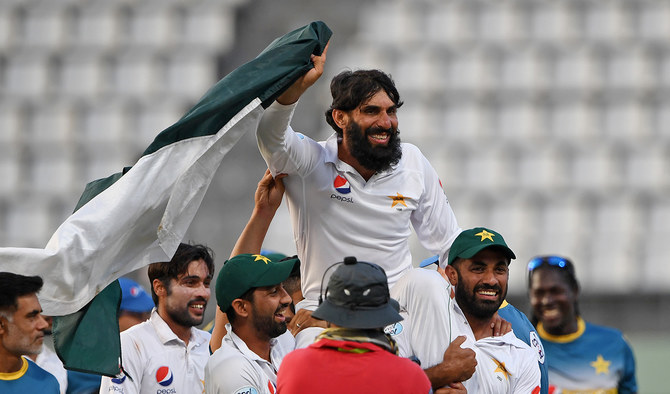
- Misbah will be head coach for three years
- He was Pakistan's most successful Test captain with 26 wins in 56 Tests
Pakistan assembly speaker, Indian FM shake hands in first high-level contact since May
- Tensions persist between India and Pakistan after they engaged in brief military conflict in May this year
- Pakistan assembly speaker, Indian FM both attend former Bangladesh PM Khaleda Zia’s funeral in Dhaka
ISLAMABAD: Pakistan’s National Assembly Speaker Sardar Ayaz Sadiq and India’s External Affairs Minister Subrahmanyam Jaishankar shook hands in Dhaka on Wednesday, establishing the first high-level contact between officials of both countries since their brief military conflict in May.
Sadiq and Jaishankar arrived in Dhaka to attend the funeral of Bangladesh’s first female prime minister Khaleda Zia, who passed away earlier this week at the age of 80 after prolonged illness. Diplomats from several countries attended Zia’s funeral on Wednesday, which drew large crowds to the Bangladeshi capital.
Tensions persist between nuclear-armed neighbors India and Pakistan, who engaged in a four-day military conflict in May this year. The conflict was triggered when India blamed Pakistan for supporting a militant attack in Indian-administered Kashmir in April that killed over 20 tourists. Pakistan denied involvement and called for a transparent probe into the incident.
“Sardar Ayaz Sadiq, Speaker of the National Assembly of Pakistan, exchanges greetings with Indian External Affairs Minister S. Jaishankar in Dhaka on Wednesday ahead of the funeral program of former Bangladesh Prime Minister Khaleda Zia,” the official X account of Bangladesh’s Chief Adviser Muhammad Younus wrote.
https://x.com/ChiefAdviserGoB/status/2006340330585833665
Sadiq also met Zia’s son Tarique Rahman, the acting chairperson of the Bangladesh Nationalist Party (BNP), to convey condolences over his mother’s demise from the people and government of Pakistan, the Pakistan High Commission in Bangladesh said.
“During the meeting, he recalled Begum Zia’s remarkable political leadership and noted her pivotal role in promoting historical affinities, mutual respect and cooperation between our two nations,” the high commission wrote on social media platform X.
https://x.com/PakinBangladesh/status/2006313161088204976
Senior officials from both India and Pakistan have refrained from shaking hands or exchanging pleasantries since the May conflict, as tensions persist between the two sides.
The May conflict saw both countries exchange artillery fire, pound each other with fighter jets and trade missiles and drone strikes before Washington brokered a ceasefire on May 10.
Sadiq is expected to meet senior officials of Bangladesh’s interim government during his trip, according to an earlier statement issued by his office.
Prime Minister Shehbaz Sharif had described Zia as a “committed friend of Pakistan” on Tuesday, praising her role in Bangladesh’s political life and expressing solidarity with the Bangladeshi people during what he called a difficult moment.
Zia, who served three terms as prime minister, led the BNP and remained a central figure in Bangladeshi politics despite years of ill health and imprisonment under the government of her longtime rival, Sheikh Hasina. She was released last year following Hasina’s ouster after a violent uprising.
Pakistan and Bangladesh were part of the same country until Bangladesh’s secession following a bloody civil war in 1971, an event that has long cast a shadow over bilateral ties. Relations remained largely strained for decades, shaped by historical grievances and political mistrust.
However, Islamabad enjoyed comparatively warmer ties with Dhaka during Zia’s tenure than under Hasina.
Engagement between Islamabad and Dhaka has increased since Hasina’s removal and the formation of an interim administration, with both sides signaling interest in improving political, diplomatic, economic and security ties.


