Lebanon PM targets deficit of 7% of GDP next year amid ‘economic emergency’

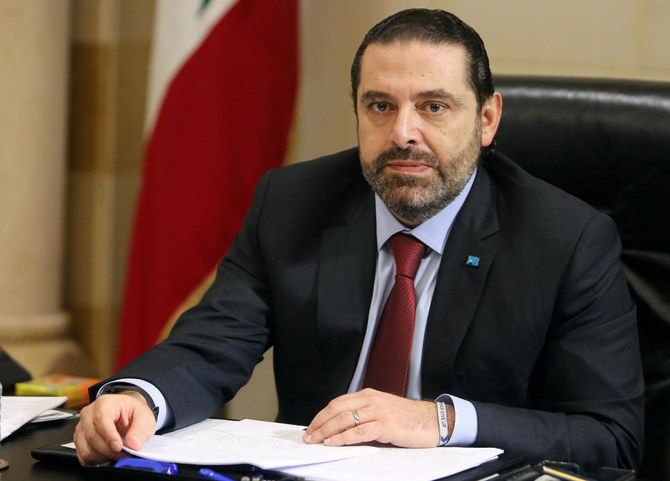
Lebanese Prime Minister Saad Al-Hariri is seen during the meeting to discuss a draft policy statement at the governmental palace in Beirut, Lebanon February 6, 2019. (Reuters)
Updated 05 September 2019
Follow

Lebanon PM targets deficit of 7% of GDP next year amid ‘economic emergency’

  • Lebanon also plans to keep the local currency peg to the dollar, Saad Hariri says
  • Lebanon has one of the world’s largest public debt burdens at 150 percent of GDP

BEIRUT: Lebanese Prime Minister Saad Al-Hariri said his government would aim to cut the budget deficit to 7 percent of GDP next year as part of reforms to shore up state finances and rein in public debt.
Lebanon also plans to keep the local currency peg to the dollar which was crucial to move ahead with reforms, Hariri told CNBC in an interview.
“So what we are doing is, fixing our debt to GDP, our deficit and the budget to 7.6 percent this year, we want to go down to 7 percent next year, or maybe a little bit less,” he said in the interview aired on Wednesday.
The prime minister also said that “keeping the Lebanese pound at 1,500” is the only stable way to proceed with the government’s reforms.
Hariri said his country would not consider an International Monetary Fund (IMF) program since it would leave market forces to decide the pricing of the country’s currency.
“I think the IMF has certain criteria that we do not, especially when it comes to the Lebanese pound. This is something that we feel extremely sensitive about.”
The IMF said in July the deficit in 2019 would likely be well above the government’s target of 7.6 percent of national output.
Lebanon has one of the world’s largest public debt burdens at 150 percent of GDP.
On Monday, Lebanon declared a “state of economic emergency,” with Hariri saying the government would take emergency measures to speed up economic reforms to help overcome a worsening economic crisis.
Fitch downgraded Lebanon’s credit rating to CCC on debt-servicing concerns 10 days ago.


Saudi Fund for Development, Omani Ministry of Finance sign MoU to establish industrial city

Updated 6 sec ago
Follow

Saudi Fund for Development, Omani Ministry of Finance sign MoU to establish industrial city

RIYADH: The CEO of the Saudi Fund for Development, Sultan bin Abdulrahman Al-Murshid, and the Omani Minister of Finance, Sultan bin Salem Al-Habsi, signed a development memorandum of understanding to support the establishment of the Thumrait Industrial City Project in Oman.

The project is funded by Saudi Arabia through the SFD with $40 million.

The signing ceremony was attended by the Saudi Ambassador to Oman, Ibrahim bin Saad bin Bishan, and several officials from both sides.

The MoU aims to develop the industrial, logistical, developmental, and social sectors in the Dhofar Governorate through the establishment of the integrated Thumrait Industrial City, covering an area of ​​approximately 3.94 million sq. meters.

The city will be equipped with all necessary infrastructure services. The project includes the construction and equipping of administrative and service buildings as well as public facilities. It also includes road works and electrical installations, as well as water networks and the construction of two wastewater treatment plants.

Engineering consultancy services will also be provided, reflecting the expected developmental impact in enhancing the industrial and service sectors in the governorate.

The CEO of the SFD affirmed that this MoU reflects the Kingdom’s efforts, through the fund, to support development sectors in Oman and strengthen the close development partnership between the two sides.

This will be achieved through the implementation of high-quality projects that contribute to developing infrastructure and creating an integrated and stimulating environment for industrial and logistical activities, which will positively impact the empowerment of the private sector and enhance economic as well as social development.

For his part, the Omani Minister of Finance emphasized that the signing of this agreement stems from a desire to strengthen developmental, economic, and investment relations and encourage partnerships across various sectors between the two countries.

At a time when the world is getting fragmented due to geopolitical tensions and ongoing wars, Saudi Arabia’s development fund is becoming a beacon of hope, as it continues to provide soft loans and grants for emerging economies.

Established in 1974 and commencing operations in 1975, the Saudi Fund for Development has financed more than 800 development projects in over 100 countries, with a cumulative value exceeding $21 billion.

SFD’s financing spans across multiple sectors, including health, education, and transport, as well as water and energy, with the aim of improving living conditions, enhancing capacity building, and creating job opportunities for millions of people in emerging nations.