

Turkish minister threatens Istanbul mayor

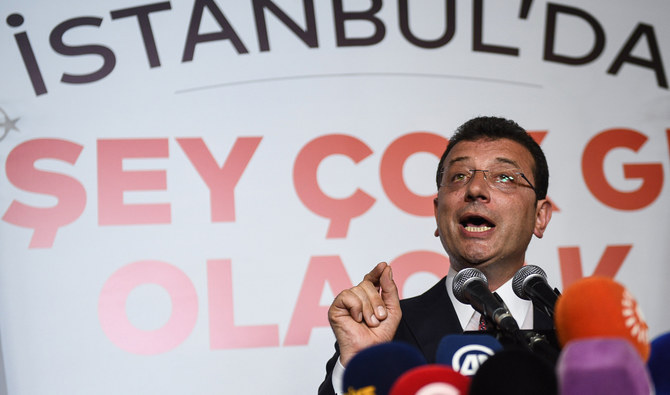
Istanbul Mayor Ekrem Imamoglu was told ‘know your place and your limits,’ (AFP)
Updated 03 September 2019
Follow

Turkish minister threatens Istanbul mayor

  • Istanbul Mayor Ekrem Imamoglu met with two of the ousted mayors

ISTANBUL: Turkey’s interior minister on Tuesday threatened “to devastate” the mayor of Istanbul over his support for three Kurdish mayors who were replaced by state officials over alleged terror links less than five months after the trio were elected.

Last month, Turkey replaced pro-Kurdish Peoples’ Democratic Party (HDP) mayors in Diyarbakir, Van and Mardin with state officials, and detained more than 400 people over suspected militant links, in a move sharply criticized by the opposition.

BACKGROUND

Turkey replaced pro-Kurdish Peoples’ Democratic Party mayors in Diyarbakir, Van and Mardin with state official, and detained more than 400 people over suspected militant links, in a move sharply criticized by the opposition.

Istanbul Mayor Ekrem Imamoglu — who dealt President Tayyip Erdogan the biggest defeat of his career when he defeated the ruling AK Party (AKP) in June local elections — has slammed the move as illegal and undemocratic and called for it to be reversed.

At the weekend Imamoglu — of the main opposition Republican People’s Party (CHP), who was backed by HDP when he was elected in June — visited Kurdish town of Diyarbakir and met with two of the ousted mayors.

Erdogan and his government accuse the HDP of links to the PKK that is designated a terrorist group by Turkey, the EU and the US. The HDP denies such links. 

Speaking in the northeastern province of Bursa on Tuesday, Interior Minister Suleyman Soylu said the dismissals of the three mayors, who were elected in late March, were in line with the law.

“Ignorant. Know your place and your limits,” Soylu said of Imamoglu. “This country has been handling this terrorist organization for 40 years ... If you meddle in things that are not your job, we will devastate you.”

The minister added: “This is very clear ... While there are people who have suffered from terror for years, such a support for men who mourn at terrorist funerals will hurt our hearts and those of our people.”

The comments come a week after Imamoglu’s announcement that the Istanbul municipality canceled the transfer of more than 350 million lira ($61 million) to some pro-AKP foundations, in one of his first moves against Erdogan since being elected.

Erdogan has previously said that his government would also replace mayors in other parts of the country if they were found to be linked to militants. But Imamoglu has dismissed those comments as meaningless and saddening.

Ex-PM to be expelled from AKP

The executive committee of AKP on Monday unanimously agreed to send former premier and party member Ahmet Davutoglu to a disciplinary board for dismissal, local media reported.

The decision came after a nearly five-hour meeting of the central executive committee chaired by Erdogan, the Hurriyet newspaper reported on its website.

A leading AKP figure who served both as foreign minister and prime minister, Davutoglu has recently accused the party of deviating from its core principles.

His criticism included the party’s insistence on a rerun of the Istanbul vote after the AKP lost the city to the opposition in March local elections, as well as the removal of three mayors in eastern Turkey on terror-related claims.

The party’s move to expel the ex-premier comes as other former allies have fallen out with Erdogan including former president Abdullah Gul and former deputy prime minister Ali Babacan — both founding AKP members.

Babacan quit the party in July citing “deep differences” over policy and said Turkey was in need of a “new vision.”

He is expected to launch a new political party.


Israel accused of move expanding Jerusalem borders for first time since 1967

Updated 4 sec ago
Follow

Israel accused of move expanding Jerusalem borders for first time since 1967

  • Planned development is formally a westward expansion of the Geva Binyamin, or Adam, settlement situated north-east of Jerusalem in the West Bank
  • Some 200,000 Israelis live in Israeli-annexed east Jerusalem, while more than 500,000 others live in West Bank settlements and outposts
JERUSALEM: Israeli NGOs have raised the alarm over a settlement plan signed by the government which they say would mark the first expansion of Jerusalem’s borders into the occupied West Bank since 1967.
Israel has occupied east Jerusalem since 1967 and later annexed it in a move not recognized by the international community.
Palestinians view east Jerusalem as the capital of their future state.
The proposal, published in early February but reported by Israeli media only on Monday, comes as international outrage mounts over creeping measures aimed at strengthening Israeli control over the West Bank.
Critics say these actions by the Israeli authorities are aimed at the de facto annexation of the Palestinian territory.
The planned development, announced by Israel’s Ministry of Construction and Housing, is formally a westward expansion of the Geva Binyamin, or Adam, settlement situated north-east of Jerusalem in the West Bank.
In a statement, the ministry said the development agreement included the construction of around 2,780 housing units for the settlement, with an investment of roughly 120 million Israeli shekels (around $38.7 million).
But the area to be developed lies on the Jerusalem side of the separation barrier built by Israel in the early 2000s, while Geva Binyamin sits on the West Bank side of the barrier, and the two are separated by a road.
In a statement, Israeli settlement watchdog Peace Now said there would be no “territorial or functional connection” between the area to be developed and the settlement.
“The new neighborhood will be integral to the city of Jerusalem,” Lior Amihai, Peace Now’s executive director, told AFP.
“What is unique about that one is that it will be connected directly to Jerusalem, but it will be beyond the annexed municipal border. So it will be in complete West Bank territory, but just adjacent to Jerusalem,” he said.

‘Living there as Jerusalemites’

The move comes days after Israel’s government approved a process to register land in the West Bank as “state property,” drawing widespread international condemnation and fears among critics that it would accelerate annexation of the Palestinian territory.
Days earlier, Israel’s security cabinet approved a series of measures to tighten control over areas of the West Bank administered by the Palestinian Authority under the Oslo accords.
Those measures, which also sparked international backlash, include allowing Jewish Israelis to buy West Bank land directly and allowing Israeli authorities to administer certain religious sites in areas under the Palestinian Authority’s control.
Amihai said that the current government — one of the most right-wing in Israel’s history — was “systematically working to annex the occupied territories and to prevent Palestinian statehood.”
The case of Jerusalem, he said, was particularly symbolic.
“Every change to Jerusalem is sensitive to both the Israeli public, but also to the Palestinians,” he told AFP.
Aviv Tatarsky, a researcher at Ir Amim, an Israeli NGO focusing on Jerusalem within the context of the Israeli-Palestinian conflict, said the latest planned development amounted to a de facto expansion of the city of Jerusalem.
“If it is built, and people live there, the people who will live there, they will be living there as Jerusalemites,” he told AFP.
“In all practical terms, it’s basically not the settlement that will be expanded, but Jerusalem.”

‘Facts on the ground’

The development agreement was signed by Israel’s Construction and Housing Ministry, the Finance Ministry and the Binyamin Regional Council, which represents settlements north of Ramallah in the central West Bank.
It has yet to be reviewed by the Civil Administration’s Higher Planning Committee, in a process which could take several months or years.
Tatarsky said that international pressure had so far made it difficult for recent Israeli governments to make formal declarations on annexation.
“It’s much easier to create facts on the ground, which, altogether... actually add up to annexation,” the researcher said.
The West Bank, occupied since 1967, would form the largest part of any future Palestinian state but is seen by many on the religious right as Israeli land.
Some 200,000 Israelis live in Israeli-annexed east Jerusalem, while more than 500,000 others live in West Bank settlements and outposts, which are illegal under international law.
Around three million Palestinians live in the territory.
The current Israeli government has fast-tracked settlement expansion, approving a record 52 settlements in 2025.