

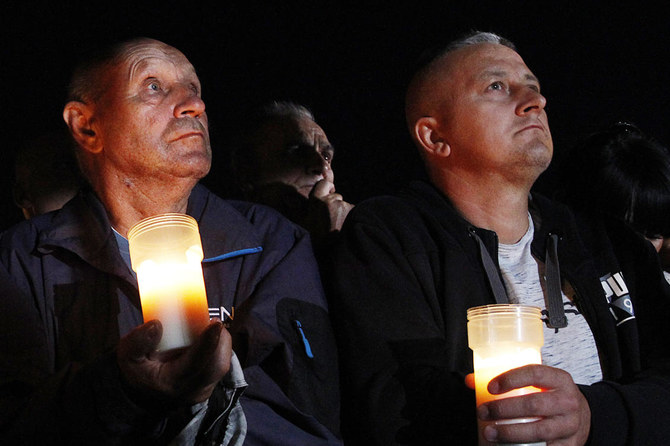

WIELUN, Poland: German President Frank-Walter Steinmeier on Sunday asked Poland’s forgiveness for history’s bloodiest conflict during a ceremony in the Polish city of Wielun, where the first World War II bombs fell 80 years ago.
“I bow my head before the victims of the attack on Wielun. I bow my head before the Polish victims of Germany’s tyranny. And I ask forgiveness,” Steinmeier said in both German and Polish.
Poland suffered some of the worst horrors of World War II: nearly six million Poles died in the conflict that killed more than 50 million people overall. That figure includes the six million Jews who died in the Holocaust, half of them Polish.
“It is the Germans who committed a crime against humanity in Poland. Anyone who claims it is over, that the national-socialists’ reign of terror over Europe is a marginal event in German history judges that for himself,” Steinmeier added in the presence of his Polish counterpart. The line appeared to be a clear reference to the German far-right, whose co-leader Alexander Gauland once called the 12-year Third Reich a “speck of bird poop” in an otherwise glorious German past.
“We will never forget. We want to remember and we will remember,” Steinmeier said.
Polish President Andrzej Duda for his part denounced Nazi Germany’s attack on Poland, calling it “an act of barbarity” and “a war crime.” “I am convinced that this ceremony will go down in the history of Polish-German friendship,” he added, thanking Steinmeier for his presence.
The heads of state will later tour the Wielun museum and meet with local survivors of the September 1, 1939 bombing. “I saw dead bodies, the wounded... Smoke, noise, explosions. Everything was burning,” Wielun bombing survivor Tadeusz Sierandt, 88, told AFP ahead of the anniversary.
The carpet-bombing came one week after Germany and the Soviet Union secretly agreed to carve up Eastern Europe between them by signing the Molotov-Ribbentrop Pact. Polish Prime Minister Mateusz Morawiecki and European Commission Vice President Frans Timmermans attended a separate dawn remembrance Sunday in Westerplatte, where a Nazi German battleship opened fire on a Polish fort on September 1, 1939.
Hitler’s attacks on Poland led Britain and France to declare war on Nazi Germany. On September 17, the Soviet Union in turn invaded Poland. After the Nazis tore up the pact with Moscow, two alliances battled it out to the end: the Axis powers led by Germany, Italy and Japan and the victorious Allied forces led by Britain, the Soviet Union and the United States.
Later Sunday, US Vice President Mike Pence, Steinmeier and Duda will deliver speeches at a ceremony in Warsaw’s Pilsudski Square, the site of the Tomb of the Unknown Soldier.
Though it has been 80 years since the war started, there are still unresolved matters according to Poland, which says Germany owes it war reparations. A parliamentary commission is currently working on a new analysis of the extent of Poland’s wartime human and material losses. Berlin, however, believes the case is closed.
German Chancellor Angela Merkel will attend the Warsaw ceremony, but no other major world leaders are expected. US President Donald Trump had planned to attend the war commemorations but canceled at the last minute so that he could monitor Hurricane Dorian.
Also not attending are French President Emmanuel Macron and British Prime Minister Boris Johnson, while Russian President Vladimir Putin was not invited — unlike 10 years ago — because of Moscow’s 2014 annexation of Crimea from Ukraine.
The Polish presidency had said the commemorations would be attended by around 40 foreign delegations, a few of them led by heads of state. They include Ukrainian President Volodymyr Zelensky whose partnership matters to Poland, which believes its security depends on Ukraine remaining outside of Russia’s sphere of influence.
Duda said Poland wants neighbor “Ukraine to be closer to the European Union, to be closer to NATO” after meeting with Zelensky in Warsaw on Saturday.


