

Sudan’s ex-president Bashir charged with corruption, holding illicit foreign currency

1 / 3
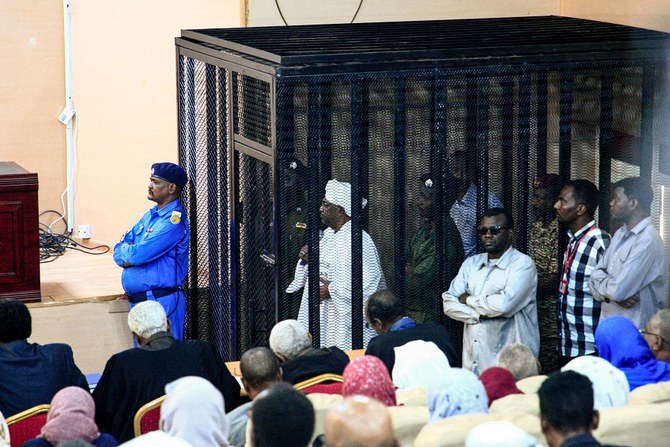
Sudan’s ousted president Omar Al-Bashir appears in court in the capital Khartoum on Aug. 31, 2019 to face charges of illegal acquisition and use of foreign funds. (AFP)
2 / 3
Sudan's ex-president Omar Al-Bashir (C) appears in court in the capital Khartoum on August 31, 2019 to face charges of illegal acquisition and use of foreign funds. (AFP)
3 / 3
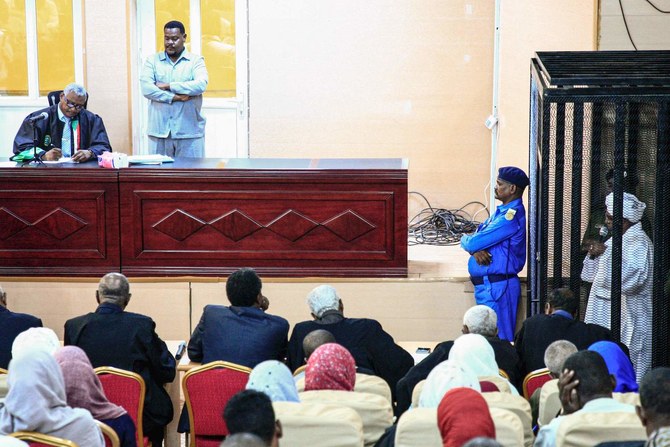
Sudan's ex-president Omar Al-Bashir (R) appears in court in the capital Khartoum on August 31, 2019 to face charges of illegal acquisition and use of foreign funds. (AFP)
Updated 31 August 2019
Follow

Sudan’s ex-president Bashir charged with corruption, holding illicit foreign currency

  • The judge has refused to grant Bashir bail
  • The former Sudan ruler is accused of receiving millions in illegal funds

KHARTOUM: A Sudanese judge formally indicted former president Omar Al-Bashir on charges of possessing illicit foreign currency and corruption on Saturday.

A lawyer for Bashir said that his client denied the charges against him and that witnesses for the defense would be presented at the next hearing.
Questioned in court, Bashir claimed he received millions of dollars from various sources, including Saudi Arabia, but that he never used it for his own benefit
The judge denied a request for bail and said a decision on the duration of Bashir's detention would be taken at a hearing on Sept. 7.
Sudan's military ousted and arrested Bashir in April after months of protests across the country. His prosecution is seen as a test of how far military and civilian authorities now sharing power will go to counter the legacy of his 30-year rule.
Bashir was also charged in May with incitement and involvement in the killing of protesters. He has been indicted by the International Criminal Court in The Hague on charges of masterminding genocide in Sudan's Darfur region.

(With Reuters)


Al-Aqsa Mosque remains closed amid action from US, Israel against Iran

Updated 4 sec ago
Follow

Al-Aqsa Mosque remains closed amid action from US, Israel against Iran

  • Compound has been closed since Saturday morning
  • Israeli forces barred worshippers from entering site on Sunday, citing state of emergency

LONDON: Al-Aqsa Mosque has been closed for a second successive day by the Israeli authorities in light of the country’s action against Iran and increased tension in the occupied West Bank and East Jerusalem.

The Palestinian Authority announced that Israeli forces had barred worshippers from entering the site on Sunday, citing a state of emergency, according to the WAFA News Agency.

The agency added that Al-Aqsa compound had been closed since Saturday morning, preventing worshippers from performing Taraweeh prayers during Ramadan.

The Israeli authorities implemented strict security measures in Jerusalem as the month of Ramadan began in February. They restricted access to the mosque to men over 55, women over 50, and accompanied children under the age of 12.

The Israeli authorities shut down Al-Aqsa in June 2025 during 12 days of conflict with Iran, marking the longest period the site had been closed since 1967.

Israel and the US conducted numerous airstrikes inside Iran on Saturday, targeting military facilities. The strikes also resulted in the death of Ayatollah Ali Khamenei, the Iranian supreme leader, and other senior officials. Iran retaliated by launching missiles into Israel and attacking US bases in Gulf countries.
