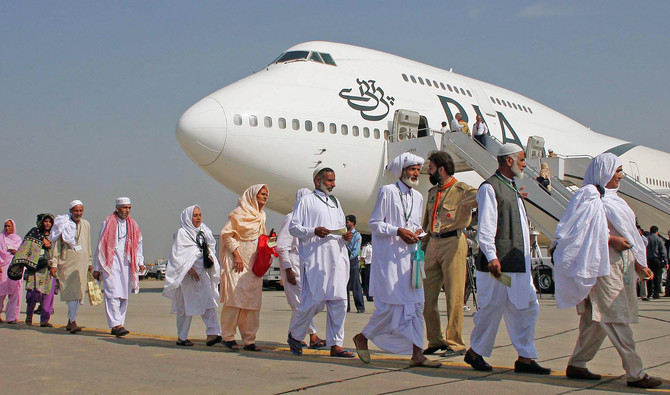
ISLAMABAD: Air Marshal Arshad Malik, President and CEO of Pakistan’s national carrier, on Friday called Hajj flight operations a “success,” saying Pakistan International Airlines was making “all-efforts” to ensure that pilgrims returned home on time.
Over 200,000 Pakistanis performed Hajj this year, according to figures from the Pakistani religious affairs ministry. Post-Hajj flight operations to bring the pilgrims home commenced on August 17 in Jeddah and will continue until September 15.
“He [PIA CEO] termed the ongoing Hajj operation a success with almost 90 percent efficiency achieved in the pre-Hajj flight operation,” the finance ministry said in a statement released on Friday, adding that similar results were expected in post-Hajj flight operations “for which all-out efforts were made to bring back the pilgrims as per schedule.”
Saudi Arabia extended its flagship “Road to Makkah” project to Pakistan during a February visit to Islamabad by Crown Prince Mohammad bin Salman, after which it was announced that all pilgrims traveling from Pakistan would be able to clear immigration at local airports in Islamabad, Karachi, Lahore, and Peshawar. Malaysia and Indonesia are also part of the project.
Pakistani nationals constitute the third largest group, after Saudis and Indonesians, to perform Hajj each year.
“All-out efforts” being made to bring Pakistani Hajjis home on schedule — PIA CEO

- Calls Hajj operations a success, says 90 percent efficiency achieved in pre-Hajj flights
- Around 200,000 Pakistanis performed Hajj this year, post-hajj flights to continue until Sept 15
‘Fully stand with Bangladesh’: Pakistan PM backs decision to boycott India match
- Pakistan’s government have not allowed the national cricket team to play its World Cup match against India on Feb. 15
- Pakistan has accused India of influencing ICC decisions, criticized global cricket body for replacing Bangladesh in World Cup
ISLAMABAD: Prime Minister Shehbaz Sharif on Wednesday backed his government’s decision to bar the national men’s cricket team from playing against India in the upcoming T20 World Cup tournament, reaffirming support for Bangladesh.
Pakistan’s government announced on social media platform X last week that it has allowed its national team to travel to Sri Lanka for the World Cup. However, it said the Green Shirts will not take the field against India on their scheduled match on Feb. 15.
Pakistan’s participation in the tournament was thrown into doubt after Pakistan Cricket Board (PCB) Chairman Mohsin Naqvi criticized the International Cricket Council (ICC) for replacing Bangladesh with Scotland. The decision was taken after Bangladesh said it would not let its team travel to India out of security concerns.
During a meeting of the federal cabinet, Sharif highlighted that Pakistan has said that politics should be kept away from sports.
“We have taken this stand after careful consideration and in this regard, we should stand fully with Bangladesh,” Sharif said in televised remarks.
“And I believe this is a very reasonable decision.”
Pakistan has blamed India for influencing the ICC’s decisions. The global cricket governing body is currently led by Jay Shah, the head of the Board of Control for Cricket in India. Shah is the son of Indian Home Minister Amit Shah.
Pakistan’s boycott announcement has triggered media frenzy worldwide, with several Indian cricket experts and analysts criticizing Islamabad for the decision. An India-Pakistan cricket contest is by far the most lucrative and eagerly watched match of any ICC tournament.
The ICC has ensured that the two rivals and Asian cricket giants are always in the same group of any ICC event since 2012 to capitalize on the high-stakes game.
The two teams have played each other at neutral venues over the past several years, as bilateral cricket remains suspended between them since 2013 due to political tensions.
Those tensions have persisted since the two nuclear-armed nations engaged in the worst fighting between them since 1999 in May 2025, after India blamed Pakistan for an attack in Indian-administered Kashmir that killed tourists.
Pakistan denied India’s allegations that it was involved in the attack, calling for a credible probe into the incident.