

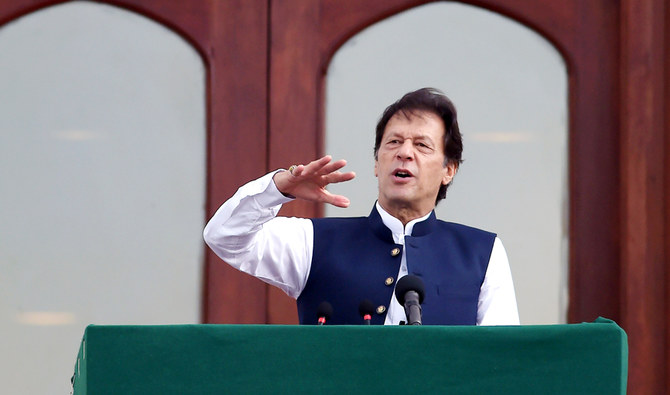

ISLAMABAD: Pakistani Prime Minister Imran Khan warned on Friday that war between two nuclear powers was a threat to the entire world, as thousands rallied across Pakistan in mass demonstrations protesting Delhi’s move this month to remove the special status of Indian-administered Kashmir and impose a security clampdown on the region.
Tensions between India and Pakistan have escalated since Aug. 5 when India revoked the autonomy of the part of the Himalayan region of Kashmir that it administers and moved to quell objections by shutting down communications and clamping down on local leaders.
Pakistan has reacted with fury to India’s decision, cutting trade and transport ties and expelling India’s ambassador. Both countries claim Kashmir in full but rule it in part.
Cities around Pakistan came to a standstill from noon to 12:30 p.m. on Friday as tens of thousands of people poured on to the streets in a government-led demonstration of solidarity.
The Pakistani national anthem and an anthem for Kashmir played across television and radio, while traffic came to a standstill, traffic lights were switched off and trains stopped, as part of Khan’s campaign to draw global attention to the plight of the divided region.
“The world should know that if two nuclear countries (Pakistan and India) go to war, this will affect not only the subcontinent but also the whole world,” Khan told a charged crowd in Islamabad.
“We want to tell Kashmiris that we all are standing with them and will continue to stand by them till they get freedom (from India),” Khan said. The prime minister lamented what he called the silence of the UN and the international community in the face of the oppression of Muslims around the world.
“Had Kashmiris not been Muslims, the world would have raised a hue and cry,” Khan said.
He warned that if the international community failed to confront what he called the “fascist and racist” government of Indian Prime Minister Narendra Modi, this would ultimately impact the whole world.
Khan also said India was mulling a false flag operation in Azad Kashmir, the part of Kashmir controlled by Pakistan, to divert the world’s attention from the crisis, but “if it does so, we are fully prepared to respond.”
Criticizing India’s ruling Bharatiya Janata Party and its parent body, the Rashtriya Swayamsevak Sangh (RSS), Khan said: “The RSS ideology has taken over India like Adolf Hitler’s Nazi Party had taken over Germany, and they think that Muslims should be taught a lesson.”
The prime minister said he would engage human rights organizations, celebrities and international media to highlight India’s human rights violations in Kashmir and raise the issue with international leaders and the UN General Assembly, which he will attend next month.
President Dr. Arif Alvi also addressed crowds in Islamabad, urging Pakistanis to unite for the country’s economic growth as “only a strong Pakistan can raise its voice for Kashmiris effectively.”
“I pray to God that in your and my lifetime, we see an independent Kashmir in which their rights are not repressed,” the president said.


