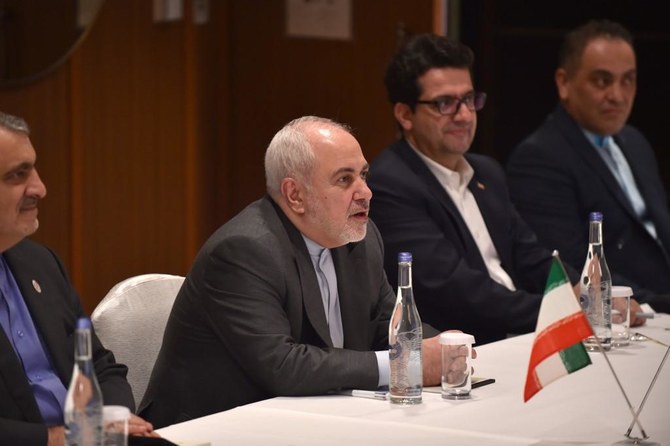
TOKYO: Iran is not seeking to increase tension but every country should be able to enjoy its rights under international law, Foreign Minister Mohammad Javad Zarif said on Wednesday.
Zarif made the comment in Yokohama, near Tokyo, at the beginning of a meeting with Japanese Prime Minister Shinzo Abe.
“As our president has said, we are not at all seeking heightened tensions,” Zarif said, speaking through a translator.
“We believe every country should be able to enjoy its rights under international law.”
US President Donald Trump pulled the United States out of an international agreement aimed at curbing Iran’s nuclear program in 2015 and reimposed sanctions on it.
Trump said on Monday he would meet Iran’s president under the right circumstances to end the confrontation over the nuclear deal, and that talks were underway to see how countries could open credit lines to keep Iran’s economy afloat.
But Trump ruled out lifting economic sanctions to compensate for losses suffered by Iran.
On Tuesday, President Hassan Rouhani said Iran would not talk to the United States until all sanctions were lifted.
Japan, Washington’s closest Asian ally, has historically had friendly ties with Iran. Abe visited Tehran in June to try to ease tensions.

Iran’s Zarif to Japan PM: we are not seeking heightened tensions
- Trump said he would meet Iranian president under the right circumstances
- Rouhani said there will no talks until US lifts sanctions off Iran
Turkish lawmakers to vote on report advancing PKK peace process
- The vote in Ankara, proposes making legal reforms in parallel with the PKK laying down arms
ANKARA: A Turkish parliamentary commission was set to vote on Wednesday on adopting a draft report to facilitate the disarmament of the outlawed Kurdistan Workers Party (PKK), which would advance a peace process meant to end a more than 40-year conflict. The roughly 60-page report, shared with reporters ahead of the vote in Ankara, proposes making legal reforms in parallel with the PKK laying down arms, urging the judiciary to review legislation and comply with European Court of Human Rights and Constitutional Court rulings. Its core objectives are a “terrorism-free Turkiye” and strengthening democracy, said the draft, which presents a conditional legal framework that prompted some objections earlier in the week from opposition parties.
A vote to back the report would shift the peace process to the legislative theater, where President Tayyip Erdogan, Turkiye’s leader of more than two decades, has an opportunity to end a bloody conflict between the PKK and the state that has sown deep political, economic and social discord at home, and spread violence across borders into Iraq and Syria.
The commission was formed in August 2025 to support a potential new phase in efforts to end the conflict that has killed more than 40,000 people and stymied economic development in Turkiye’s mainly Kurdish southeast.
A vote to back the report would shift the peace process to the legislative theater, where President Tayyip Erdogan, Turkiye’s leader of more than two decades, has an opportunity to end a bloody conflict between the PKK and the state that has sown deep political, economic and social discord at home, and spread violence across borders into Iraq and Syria.
The commission was formed in August 2025 to support a potential new phase in efforts to end the conflict that has killed more than 40,000 people and stymied economic development in Turkiye’s mainly Kurdish southeast.
© 2026 SAUDI RESEARCH & PUBLISHING COMPANY, All Rights Reserved And subject to Terms of Use Agreement.


