

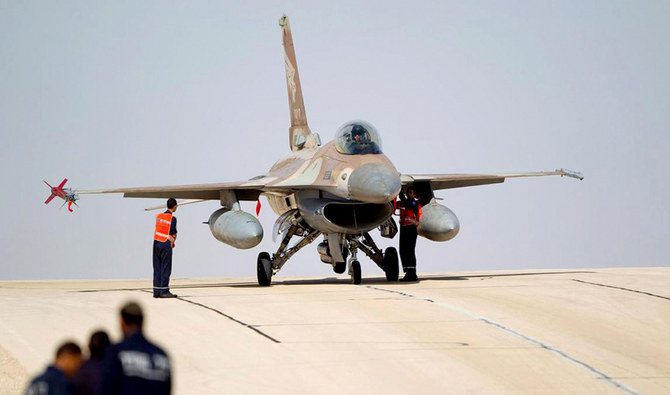
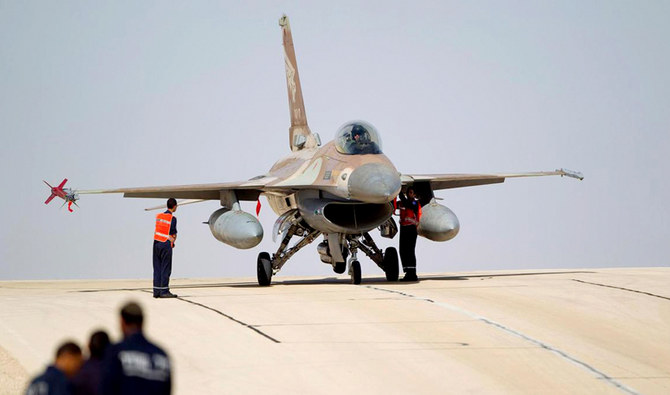
BEIRUT, DAMASCUS: Israel airstrikes near the Syrian capital overnight killed two fighters of the Lebanese Shiite movement Hezbollah and one Iranian combatant, the Syrian Observatory for Human Rights war monitor said on Sunday.
“The Israeli raids targeting Iranian and Hezbollah posts ... in the southeast of Damascus killed at least three people — two from Hezbollah and a third who was Iranian,” Observatory chief Rami Abdel Rahman said.
Israel said on Sunday an airstrike against an arm of Iran’s Revolutionary Guards in Syria that it accused of planning “killer drone attacks” showed Tehran that its forces were vulnerable anywhere.
A senior Revolutionary Guards commander denied that Iranian targets had been hit late on Saturday and said its military “advisory centers have not been harmed,” the semi-official ILNA news agency reported.
The Israeli military said its aircraft struck “Iranian Quds Force operatives and Shiite militias which were preparing to advance attack plans targeting sites in Israel from within Syria over the last number of days.”
The elite Quds Force is the overseas arm of Iran’s Revolutionary Guards (IRGC). Israeli military spokesman Jonathan Conricus told reporters the forces had been preparing to launch “killer drones” armed with explosives at northern Israel.
Israeli Prime Minister Benjamin Netanyahu said the military had thwarted the planned Iranian attack.
“Iran has no immunity anywhere. Our forces operate in every sector against the Iranian aggression,” he said on Twitter. “If someone rises up to kill you, kill him first.”
Syrian state media said Syrian air defenses intercepted “hostile targets” over Damascus, the capital, on Saturday night.
Witnesses in Damascus said they heard and saw explosions in the sky.
The Syrian forces said in a statement that “the majority of the Israeli missiles were destroyed before reaching their targets.” Conricus, however, said the impact of the Israeli strikes was “significant.”
A war monitor said on Sunday that two members of Tehran-backed Lebanese militia Hezbollah and one Iranian were killed in the strikes.
Israel says it has carried out hundreds of strikes in Syria against Iranian targets trying to establish a permanent military presence there and against advanced weapon shipments to Hezbollah.
Iran and Hezbollah are helping President Bashar Assad in the eight-year Syria war. Russia, which is also aiding Assad, has largely turned a blind eye to the Israeli airstrikes. Netanyahu spoke with Russian President Vladimir Putin on Friday, the Israeli leader’s office said.
Israel made no comment on what the Lebanese army and Hezbollah said was the crash of two Israeli drones in the Hezbollah-dominated southern suburbs of Beirut early on Sunday. Hezbollah officials said one of the drones was rigged with explosives and caused some damage to the organization’s media center.
On Thursday, Netanyahu hinted of possible Israeli involvement in a series of blasts in the past few weeks that have hit weapon depots and bases belonging to paramilitary groups in Iraq, many of them backed by Iran.
On Wednesday, the PMF, the umbrella grouping of Iraq’s paramilitary groups, said the US had allowed four Israeli drones to enter the region accompanying US forces and carry out missions on Iraqi territory.
The US-led coalition, in Iraq to fight remnants of Daesh, dismissed the statement and the Pentagon denied it.
On the popular Israeli YNet news website, military affairs commentator Ron Ben-Yishai described the alleged Iranian killer drone attack plans as revenge by Tehran for the purported Israeli drone strikes in Iraq, noting that the two enemies were using similar weapons. Amos Yadlin, a former head of Israeli military intelligence, and now executive director of Tel Aviv University’s Institute for National Security Studies (INSS), said neither Iran nor Israel were interested in all-out war.
“We’re not there yet,” he said on Israel Radio. “But sometimes, someone makes a mistake.”


