LAMPEDUSA, Italy: Eighty-three migrants who disembarked on Italy’s Lampedusa island were again in limbo on Wednesday as a European deal to redistribute them failed to materialize and Madrid said it could hit the Spanish charity with a hefty fine for rescuing them.
The prospect of a fine comes after a protracted standoff between the Spanish NGO Proactiva Open Arms and Italy’s far-right Interior Minister Matteo Salvini finally came to an end.
The boat had spent six days anchored off Lampedusa before a local prosecutor ordered the migrants be allowed to land amid a probe of Salvini for forbidding their entry to port.
Many of them had spent 19 days on board the ship after being picked up while in difficulty trying to make the perilous journey from Libya to Europe in small boats.
As they walked down the gang plank one by one to the island’s shore overnight, some could be seen limping or in bandages.
Salvini, whose Prime Minister Giuseppe Conte resigned in protest at the League leader’s bid to bring the government down, had forbidden all NGO rescue boats from entering Italian ports.
The last remaining charity vessel operating in the Mediterranean, the Ocean Viking, was on Wednesday still seeking a safe port for its 356 rescued migrants.
The ship operated by French charities SOS Mediterranee and Doctors Without Borders (MSF) has been holding its position for 10 days between Malta and Lampedusa, asking for a safe port.
“As maritime law stipulates, we’ve been asking Italian and Maltese search and rescue coordination centers for a safe port since we made our first rescue on August 9,” said Frederic Penard, head of operations for SOS Mediterranee.
“For the time being we’ve had no reply from Italy and a rather negative one from Malta,” he told AFP by phone.
The Open Arms on Wednesday sailed to Porto Empedocle on Sicily where the prosecutor ordered it temporarily seized as part of his investigation.
Spain’s Deputy Prime Minister Carmen Calvo told Spanish radio, “the Open Arms doesn’t have a permit to rescue.”
The vessel had in April been authorized to leave Barcelona, where it was immobilized for three months, to transport humanitarian aid to Greece.
It was banned from heading to the seas off Libya, often the launchpad for migrants attempting to reach Europe, but went anyway.
A document from the directorate-general for Spain’s merchant navy sent to AFP by the Proactiva Open Arms charity said it risks a fine of up to 901,000 euros ($1 million) for violating this ban.
There were initially 147 mainly African migrants on the ship but as the days passed, some were evacuated for medical care and all minors were allowed to disembark.
Six European Union countries — France, Germany, Romania, Portugal, Spain and Luxembourg — have offered to take them all in.
Calvo said the military ship sent to Lampedusa could take charge of those migrants allocated to Spain if this agreement is implemented.
Sicily prosecutor Luigi Patronaggio intervened as part of a probe into alleged kidnapping and refusing to obey orders targeting Salvini.
Salvini hit back on Facebook about the decision to let the migrants off the boat, saying: “If anybody thinks they can scare me with the umpteenth complaint and wants a trial, they’re mistaken.”
A Spanish naval patrol boat, the Audaz, set off from Rota in southwestern Spain on Tuesday on a three-day trip to Lampedusa to fetch the Open Arms migrants.
Spain had tried to break the standoff over the migrants at the weekend by offering up its southern port of Algeciras, which the NGO said could “not be achieved” due to the distance and tensions on board.
Madrid then suggested Mallorca in the Balearic Islands, nearer but still around 1,000 kilometers (600 miles) from Lampedusa.
The charity described the offer as “totally incomprehensible” and continued to demand the ship be allowed to dock in Lampedusa.

Migrants in limbo again after landing in Italy
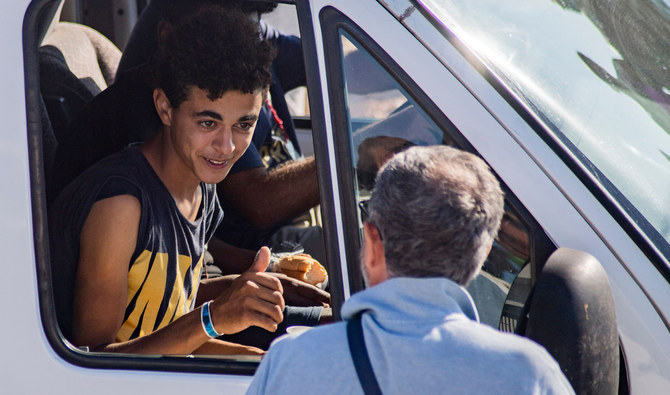
- As they walked down the gang plank one by one to the island’s shore overnight, some could be seen limping or in bandages
UPDATE 9-Iran foreign minister says progress made in nuclear talks with US in Geneva
* Araqchi says progress made on the main guiding principles
* Iranian media say parts of Strait of Hormuz to be temporarily closed
* The talks involved officials from both Iran and US
* US President Trump said he was involved indirectly
GENEVA: Iran and the United States reached an understanding on Tuesday on main “guiding principles” in talks aimed at resolving their longstanding nuclear dispute, but that does not mean a deal is imminent, Iranian Foreign Minister Abbas Araqchi said.
Oil futures fell and the benchmark Brent crude contract tumbled more than 1 percent after Araqchi’s comments, which helped ease fears of conflict in the region, where the US has deployed a battle force to press Tehran for concessions.
“Different ideas have been presented, these ideas have been seriously discussed, ultimately we’ve been able to reach a general agreement on some guiding principles,” Araqchi told Iranian media after the talks concluded in Geneva.
BOTH SIDES HAVE ‘CLEAR NEXT STEPS’
The indirect discussions between US Special Envoy Steve Witkoff and US President Donald Trump’s son-in-law Jared Kushner, alongside Araqchi, were mediated by Oman. The White House did not respond to emailed questions about the meeting.
Oman’s Foreign Minister Badr Al-Busaidi said in a post on X “much work is yet to be done” but Iran and the US were leaving with “clear next steps” .
Just as talks began on Tuesday, Iranian state media said Iran would temporarily shut part of the Strait of Hormuz, a vital global oil supply route, due to “security precautions” while Iran’s elite Revolutionary Guards conducted military drills there.
Tehran has in the past threatened to shut down the strait to commercial shipping if it is attacked, a move that would choke off a fifth of global oil flows and drive up crude prices.
Responding to comments by Trump that “regime change” in Iran might be the best course, the country’s Supreme Leader Ayatollah Ali Khamenei, 86, warned that any US attempts to depose his government would fail.
“The US President says their army is the world’s strongest, but the strongest army in the world can sometimes be slapped so hard it cannot get up,” he said, in comments published by Iranian media.
Speaking at a disarmament conference in Geneva after the talks, Araqchi said that a “new window of opportunity” had opened and that he hoped discussions would lead to a “sustainable” solution that ensured the full recognition of Iran’s legitimate rights.
Earlier, Trump said he himself would be involved “indirectly” in the Geneva talks and that he believed Tehran wanted to make a deal.
“I don’t think they want the consequences of not making a deal,” Trump told reporters aboard Air Force One on Monday. “We could have had a deal instead of sending the B-2s in to knock out their nuclear potential. And we had to send the B-2s.”
The US joined Israel last June in bombing Iranian nuclear facilities. The US and Israel believe Iran aspires to build a nuclear weapon that could threaten Israel’s existence. Iran says its nuclear program is purely peaceful, even though it has enriched uranium far beyond the purity needed for power generation, and close to what is required for a bomb.
IRAN SAYS IT WILL ONLY DISCUSS NUCLEAR PROGRAMME
Since those strikes, Iran’s Islamic rulers have been weakened by street protests, suppressed at a cost of thousands of lives, against a cost-of-living crisis driven in part by international sanctions that have strangled Iran’s oil income.
Washington has sought to expand the scope of talks to non-nuclear issues such as Iran’s missile stockpile. Tehran says it is willing only to discuss curbs on its nuclear program — in exchange for sanctions relief — and that it will not give up uranium enrichment completely or discuss its missile program.
Khamenei reiterated Iran’s position that its formidable missile stockpile is non-negotiable and missile type and range have nothing to do with the United States.
A senior Iranian official told Reuters on Tuesday the success of the Geneva talks hinged on the US not making unrealistic demands and on its seriousness on lifting the crippling sanctions on Iran.
US B-2 BOMBERS STRUCK NUCLEAR TARGETS
Tehran and Washington were scheduled to hold a sixth round of talks in June last year when Washington’s ally Israel launched a bombing campaign against Iran, and was then joined by US B-2 bombers that struck nuclear targets. Tehran has since said it has halted uranium enrichment activity.
Iran has joined the nuclear Non-Proliferation Treaty, which guarantees countries the right to pursue civilian nuclear power in return for requiring them to forgo atomic weapons and cooperate with the UN nuclear watchdog, the International Atomic Energy Agency.
Israel, which has not signed the NPT, neither confirms nor denies having nuclear weapons, under a decades-old ambiguity policy designed to deter surrounding enemies. Scholars believe it does.
* Iranian media say parts of Strait of Hormuz to be temporarily closed
* The talks involved officials from both Iran and US
* US President Trump said he was involved indirectly
GENEVA: Iran and the United States reached an understanding on Tuesday on main “guiding principles” in talks aimed at resolving their longstanding nuclear dispute, but that does not mean a deal is imminent, Iranian Foreign Minister Abbas Araqchi said.
Oil futures fell and the benchmark Brent crude contract tumbled more than 1 percent after Araqchi’s comments, which helped ease fears of conflict in the region, where the US has deployed a battle force to press Tehran for concessions.
“Different ideas have been presented, these ideas have been seriously discussed, ultimately we’ve been able to reach a general agreement on some guiding principles,” Araqchi told Iranian media after the talks concluded in Geneva.
BOTH SIDES HAVE ‘CLEAR NEXT STEPS’
The indirect discussions between US Special Envoy Steve Witkoff and US President Donald Trump’s son-in-law Jared Kushner, alongside Araqchi, were mediated by Oman. The White House did not respond to emailed questions about the meeting.
Oman’s Foreign Minister Badr Al-Busaidi said in a post on X “much work is yet to be done” but Iran and the US were leaving with “clear next steps” .
Just as talks began on Tuesday, Iranian state media said Iran would temporarily shut part of the Strait of Hormuz, a vital global oil supply route, due to “security precautions” while Iran’s elite Revolutionary Guards conducted military drills there.
Tehran has in the past threatened to shut down the strait to commercial shipping if it is attacked, a move that would choke off a fifth of global oil flows and drive up crude prices.
Responding to comments by Trump that “regime change” in Iran might be the best course, the country’s Supreme Leader Ayatollah Ali Khamenei, 86, warned that any US attempts to depose his government would fail.
“The US President says their army is the world’s strongest, but the strongest army in the world can sometimes be slapped so hard it cannot get up,” he said, in comments published by Iranian media.
Speaking at a disarmament conference in Geneva after the talks, Araqchi said that a “new window of opportunity” had opened and that he hoped discussions would lead to a “sustainable” solution that ensured the full recognition of Iran’s legitimate rights.
Earlier, Trump said he himself would be involved “indirectly” in the Geneva talks and that he believed Tehran wanted to make a deal.
“I don’t think they want the consequences of not making a deal,” Trump told reporters aboard Air Force One on Monday. “We could have had a deal instead of sending the B-2s in to knock out their nuclear potential. And we had to send the B-2s.”
The US joined Israel last June in bombing Iranian nuclear facilities. The US and Israel believe Iran aspires to build a nuclear weapon that could threaten Israel’s existence. Iran says its nuclear program is purely peaceful, even though it has enriched uranium far beyond the purity needed for power generation, and close to what is required for a bomb.
IRAN SAYS IT WILL ONLY DISCUSS NUCLEAR PROGRAMME
Since those strikes, Iran’s Islamic rulers have been weakened by street protests, suppressed at a cost of thousands of lives, against a cost-of-living crisis driven in part by international sanctions that have strangled Iran’s oil income.
Washington has sought to expand the scope of talks to non-nuclear issues such as Iran’s missile stockpile. Tehran says it is willing only to discuss curbs on its nuclear program — in exchange for sanctions relief — and that it will not give up uranium enrichment completely or discuss its missile program.
Khamenei reiterated Iran’s position that its formidable missile stockpile is non-negotiable and missile type and range have nothing to do with the United States.
A senior Iranian official told Reuters on Tuesday the success of the Geneva talks hinged on the US not making unrealistic demands and on its seriousness on lifting the crippling sanctions on Iran.
US B-2 BOMBERS STRUCK NUCLEAR TARGETS
Tehran and Washington were scheduled to hold a sixth round of talks in June last year when Washington’s ally Israel launched a bombing campaign against Iran, and was then joined by US B-2 bombers that struck nuclear targets. Tehran has since said it has halted uranium enrichment activity.
Iran has joined the nuclear Non-Proliferation Treaty, which guarantees countries the right to pursue civilian nuclear power in return for requiring them to forgo atomic weapons and cooperate with the UN nuclear watchdog, the International Atomic Energy Agency.
Israel, which has not signed the NPT, neither confirms nor denies having nuclear weapons, under a decades-old ambiguity policy designed to deter surrounding enemies. Scholars believe it does.
© 2026 SAUDI RESEARCH & PUBLISHING COMPANY, All Rights Reserved And subject to Terms of Use Agreement.


