Iran upbeat after US talks but Vance says ‘red lines’ not met

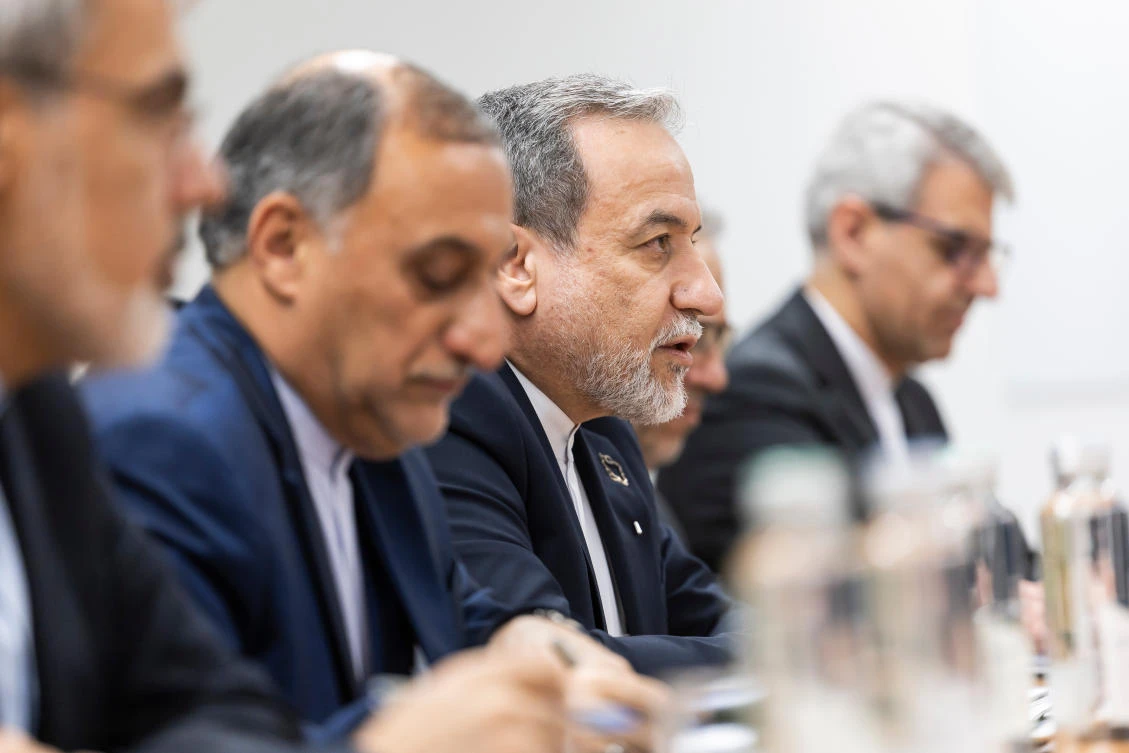
Iranian Foreign Minister Abbas Araghchi, speaks during a bilateral meeting between Switzerland and Iran, in Geneva, Switzerland, Tuesday, Feb. 17, 2026. (Keystone via AP)
Short Url
Updated 22 February 2026
Follow

Iran upbeat after US talks but Vance says ‘red lines’ not met

  • Araqchi says progress made on the main guiding principles
  • Talks involved officials from both Iran and US, President Trump said he was involved indirectly
  • Iranian media said Tuesday parts of Strait of Hormuz ‌to be temporarily closed

Geneva: Iran said Tuesday it had agreed with the United States in talks in Geneva on “guiding principles” for a deal to avoid conflict, but Vice President JD Vance said Tehran had not yet acknowledged all of Washington’s red lines.
The Omani-mediated talks were aimed at averting the possibility of US military intervention to curb Iran’s nuclear program, weeks after the cleric-run state killed thousands of people as it crushed mass demonstrations.
Iran’s supreme leader had warned earlier in the day that the country had the ability to sink a US warship recently deployed to the region, after President Donald Trump alluded to “consequences” should the two sides fail to strike a deal.
“Ultimately, we were able to reach broad agreement on a set of guiding principles, based on which we will move forward and begin working on the text of a potential agreement,” Foreign Minister Abbas Araghchi told state television after Tuesday’s talks, which he described as “more constructive” than the previous round earlier this month.
He added that once both sides had come up with draft texts for an agreement, “the drafts would be exchanged and a date for a third round (of talks) would be set.”

US to stop Iran’s nuclear ambitions ‘one way or the other’

PARIS: The United States will deter Iran from acquiring nuclear weapons “one way or the other,” US Energy Secretary Chris Wright warned on Wednesday.

“They’ve been very clear about what they would do with nuclear weapons. It’s entirely unacceptable,” Wright told reporters in Paris on the sidelines of meetings of the International Energy Agency. – AFP


In Washington, Vance also appeared to indicate that the United States preferred diplomacy but painted a more mixed picture.
“In some ways, it went well; they agreed to meet afterwards,” Vance said in a Fox News interview.
“But in other ways, it was very clear that the president has set some red lines that the Iranians are not yet willing to actually acknowledge and work through,” Vance told “The Story with Martha MacCallum” program.
“We’re going to keep on working it. But of course, the president reserves the ability to say when he thinks that diplomacy has reached its natural end,” Vance said.

Key gaps

Araghchi also acknowledged that it “will take time to narrow” the gap between the countries after the talks with Trump’s friend and roving envoy Steve Witkoff and the president’s son-in-law Jared Kushner.
Iran for years has been seeking relief from sweeping sanctions imposed by the United States, including a US-imposed ban on other countries buying its oil.
Omani Foreign Minister Badr Albusaidi said the two sides had made “good progress,” but likewise cautioned “much work is left to be done.”
Washington has ordered two aircraft carriers to the region as it piles on pressure. The first — the USS Abraham Lincoln, with nearly 80 aircraft — was positioned about 700 kilometers (435 miles) from the Iranian coast as of Sunday, satellite images showed.
Its location puts at least a dozen US F?35s and F?18 fighter jets within striking distance. A second carrier was dispatched over the weekend.
“A warship is certainly a dangerous weapon, but even more dangerous is the weapon capable of sinking it,” Khamenei said in a speech Tuesday.
Iran has insisted the talks be limited to the nuclear issue, though Washington has previously pushed for other topics to be discussed, including Tehran’s ballistic missiles program and support for armed groups in the region.

War games

Iran has also sought to display its military might, with its Islamic Revolutionary Guard Corps beginning a series of war games Monday in the Strait of Hormuz to prepare for “potential security and military threats,” state television said.
Iranian politicians have repeatedly threatened to block the strait, a strategic route for oil and gas.
A previous attempt at diplomacy collapsed last year when Israel launched surprise strikes on Iran in June, beginning a 12-day war that Washington briefly joined to bomb Iranian nuclear sites.
The West fears Iran’s nuclear program is aimed at making a bomb, which Tehran denies.
Iranian President Masoud Pezeshkian reiterated in an interview published Tuesday that Tehran was “absolutely not seeking nuclear weapons.”
“If anyone wants to verify this, we are open to such verification to take place,” he said.
Ali Fathollah-Nejad, director of the Berlin-based Center for Middle East and Global Order, said Iran was faced with an “existential dilemma.”
“Giving in to US demands could bring sanctions relief that it would desperately need to stabilize the regime and fund its repressive apparatus,” he told AFP.
“However, any significant concessions on the nuclear, ballistic missile and regional proxies issues would sensitively undermine its ideological and military standing.”
Washington presses Syria to shift from Chinese telecom systems

Updated 27 min 24 sec ago
Follow

Washington presses Syria to shift from Chinese telecom systems

  • Syria is exploring the possibility of procuring Chinese technology
  • It was unclear whether the United States ⁠pledged financial or logistical support to Syria to do so

DAMASCUS: The United States has warned Syria against relying on Chinese technology in its telecommunications sector, arguing it conflicts with US interests and threatens US national security, according to three sources familiar with the matter.
The message was conveyed during an unreported meeting between a US State Department team and Syrian Communications Minister Abdulsalam Haykal in San Francisco on Tuesday. Washington has been coordinating closely with Damascus since 2024, when Syria’s now President Ahmed Al-Sharaa ousted longtime leader Bashar Assad, who had a strategic partnership with China.
Syria is exploring the possibility of procuring Chinese technology to support its telecommunications towers and the infrastructure of local Internet service providers, according to a Syrian businessman involved in the procurement talks.
“The US side asked for clarity on the ministry’s plans regarding Chinese telecom equipment,” said ⁠another source briefed on ⁠the talks.
But Syrian officials said infrastructure development projects were time-critical and that Damascus was seeking greater vendor diversity, the source added.
SYRIAN OFFICIALS CITE US EXPORT CONTROLS AS TELECOMS BARRIER
Syria is open to partnering with US firms but the matter was urgent and export controls and “over-compliance” remained an issue, according to person familiar with the meeting in San Francisco.
A US diplomat familiar with the discussions told Reuters that the US State Department “clearly urged Syrians to use American technology or technology from allied countries in the telecoms sector.”
It was unclear whether the United States ⁠pledged financial or logistical support to Syria to do so.
Responding to Reuters questions, a US State Department spokesperson said: “We urge countries to prioritize national security and privacy over lower-priced equipment and services in all critical infrastructure procurement. If it seems too good to be true, it probably is.”
The spokesperson added that Chinese intelligence and security services “can legally compel Chinese citizens and companies to share sensitive data or grant unauthorized access to their customers’ systems” and promises by Chinese companies to protect customers’ privacy were “entirely inconsistent with China’s own laws and well-established practices.”
China has repeatedly rejected allegations of it using technology for spying purposes.
The Syrian Ministry of telecommunications told Reuters any decisions related to equipment and infrastructure are made “in accordance with national technical and security standards, ensuring data protection and service continuity.”
The ministry said it is also prioritizing the diversification of partnerships and technology sources to ⁠serve the national interest.
Syria’s telecom ⁠infrastructure has relied heavily on Chinese technology due to US sanctions imposed on successive Assad governments over the civil war that grew from a crackdown on anti-government protests in 2011.
Huawei technology accounts for more than 50 percent of the infrastructure of Syriatel and MTN, the country’s only telecom operators, according to a senior source at one of the companies and documents reviewed by Reuters. Huawei did not immediately respond to a request for comment.
Syria is seeking to develop its private telecommunications sector, devastated by 14 years of war, by attracting foreign investment.
In early February, Saudi Arabia’s largest telecom operator, STC, announced it would invest $800 million to “strengthen telecommunications infrastructure and connect Syria regionally and internationally through a fiber-optic network extending over 4,500 kilometers.”
The ministry of telecommunications says that US restrictions “hinder the availability of many American technologies and services in the Syrian market,” emphasizing that it welcomes expanding cooperation with US companies when these restrictions are lifted.
Syria has inadequate telecommunications infrastructure, with network coverage weak outside city centers and connection speeds in many areas barely exceeding a few kilobits per second.