

Remove Priyanka Chopra as peace ambassador, Pakistani minister asks UNICEF

Priyanka Chopra attends the UNICEF 70th Anniversary event at the United Nations Headquarters in Manhattan, New York City, U.S., December 12, 2016. REUTERS/Andrew Kelly
Updated 22 August 2019
Follow

Remove Priyanka Chopra as peace ambassador, Pakistani minister asks UNICEF

  • Indian actress under fire for tweeting in support of Indian army, backing war with Pakistan 
  • Pakistani-American influencer called Chopra a “hypocrite” in a viral clip 

ISLAMABAD: Pakistan’s minister for human rights has written a letter to UNICEF calling for the removal of Indian actress Priyanka Chopra as a UNICEF goodwill ambassador for peace over her comments in support of the Indian armed forces and the government of Prime Minister Narendra Modi. 
On August 5, the Indian government revoked Kashmir’s special status under which people from the rest of India could not buy the property or compete for government jobs and college places in the Muslim-majority region.
Modi’s ruling party had long sought an end to Kashmir’s autonomy, seeing it as appeasement of minorities and a barrier to its integration with the rest of the country.
Modi’s surprise move has also increased tensions with arch-rival Pakistan which lays claim to Kashmir and has accused India of human rights violations in the territory at the heart of more than 70 years of hostility between the two countries, both of whom have nuclear weapons. 
The move has stirred anger in the region and beyond but many Indian celebrities have openly backed their government. 
Earlier this month, a Pakistani-American woman accused Chopra at Beautycon, the cosmetic industry’s traveling trade show event, of being a “hypocrite” for tweeting in support of Indian security forces. The clip of the frosty exchange has since gone viral. 
Malik criticized Chopra over a February 26 tweet that read “Jai Hind” (“Long Live India”) and “#IndianArmedForces.”
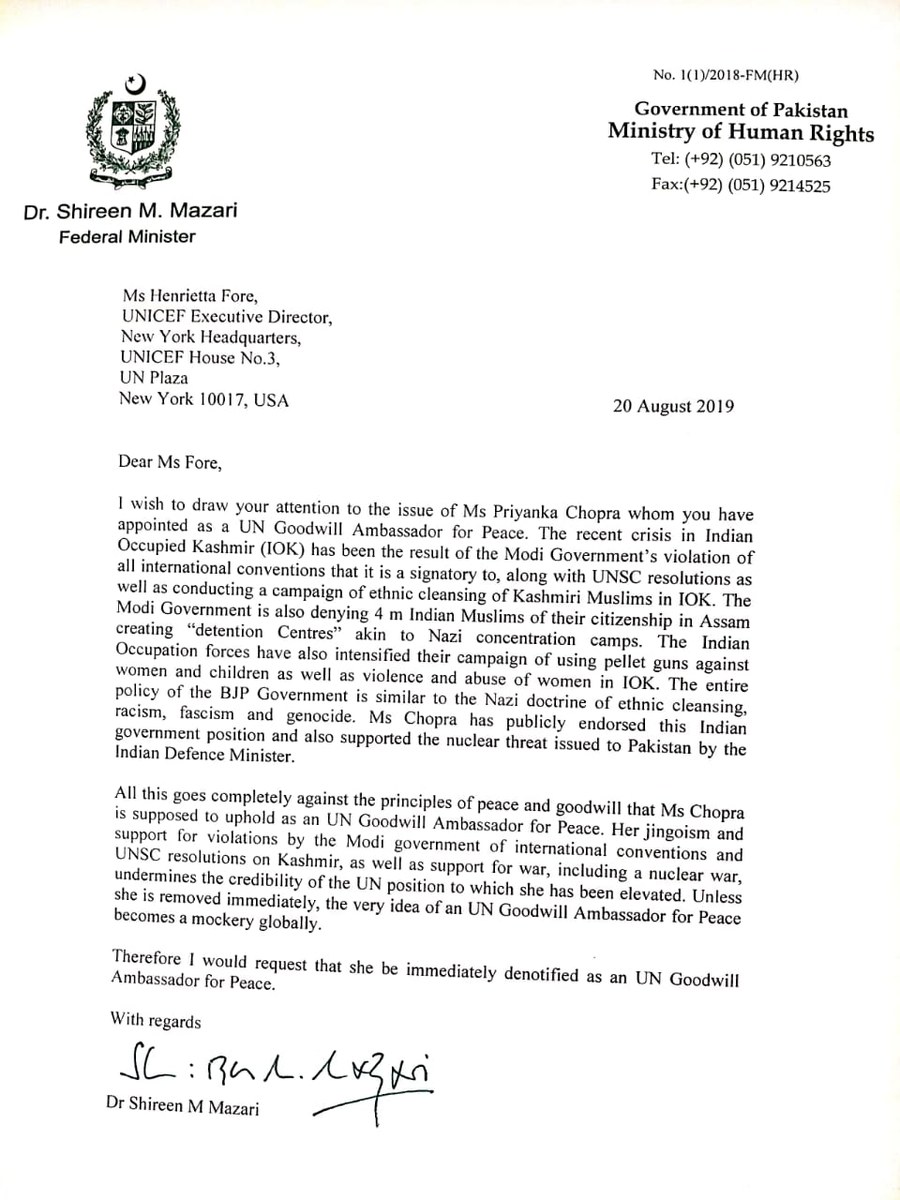


Remove Priyanka Chopra as a peace ambassador, Pakistan’s minister for human rights, Dr. Shireen Mazari writes a letter to UNICEF (Photo Courtesy: Shireen Mazari Twitter account)

“Ms. Chopra has publicly endorsed [Modi’s] Indian government position and also supported the nuclear threat issued to Pakistan by the Indian Defense Minister,” Pakistan’s Mazari said in her letter to the UNICEF executive director. “Her jingoism and support for violations by the Modi government of international conventions and UNSC resolutions on Kashmir, as well as support for the war, including nuclear war, undermines the credibility of the UN position to which she has been elevated.”
Therefore, Mazari concluded, Chopra needed to be immediately removed as a UNICEF goodwill ambassador for peace: “Unless she is removed immediately, the very idea of a UN Goodwill Ambassador for Peace becomes a mockery globally. Therefore I would request that she be immediately denotified.”
“It was kind of hard hearing you talk about humanity because as your neighbor, a Pakistani, I know you’re a bit of a hypocrite,” the Pakistani-American influencer Ayesha Malik had said to Chopra at the Beautycon panel. “You’re a UNICEF ambassador for peace and you’re encouraging nuclear war against Pakistan. There’s no winner in this.”
While she was speaking, Malik’s microphone was taken away.
Chopra then asked if Malik was done “venting,” and responded that while she doesn’t support the war, she does support India.
“I have many, many friends from Pakistan, and I am from India, and war is not something that I’m really fond of but I am patriotic,” Chopra said. “So I’m sorry if I hurt sentiments to people who do love me and have loved me, but I think that all of us have a sort of middle ground that we all have to walk.”
The confrontation has drawn attention to both Chopra’s February tweet and the larger conflict between India and Pakistan, who have fought three wars over the disputed Kashmir region. 


UK announces ‘major reset’ of Pakistan development partnership with new trade, climate, education initiatives

Updated 10 December 2025
Follow

UK announces ‘major reset’ of Pakistan development partnership with new trade, climate, education initiatives

  • UK commits to increased investment-led cooperation in climate, business regulation and higher education
  • London shifts from aid donor to investment-focused partner as bilateral trade crosses $7.3 billion

ISLAMABAD: The United Kingdom on Wednesday unveiled what it called a “major reset” in its development partnership with Pakistan, announcing new investment-focused cooperation, education programs and a bilateral climate compact during a visit by UK Minister for Development Jennifer Chapman.

The trip marks the first federal-level development dialogue between the two governments in eight years and reflects London’s shift from a traditional aid-donor role toward investment-based partnerships. The British government said the new approach aims to use UK expertise to help partner economies build capacity and unlock domestic growth.

Pakistan-UK trade has also reached a record high, crossing £5.5 billion ($7.3 billion) for the first time, with more than 200 British firms now active in Pakistan, an increase London says signals growing two-way commercial confidence.

“Pakistan is a crucial partner for the UK. We work together to tackle the drivers behind organized crime and illegal migration, keeping both our countries safer,” Chapman was quoted as saying in a statement by the British High Commission in Islamabad. 

“Our strong bilateral trading relationship brings jobs and growth to us both. And we’re working together to tackle climate change, a global threat.”

The minister and Prime Minister Shehbaz Sharif on Tuesday jointly launched a package of business regulatory reforms aimed at improving Pakistan’s investment climate and making it easier for UK firms to operate. Officials said the initiative supports Pakistan’s economic recovery agenda and creates new commercial avenues for British companies.

A second key announcement was the next phase of the Pak-UK Education Gateway, developed with the British Council and Pakistan’s Higher Education Commission. The expanded program will enable joint research between universities in both countries, support climate- and technology-focused academic collaboration, and introduce a startup fund to help commercialize research. The Gateway will also promote UK university courses delivered inside Pakistan, giving students access to British degrees without traveling abroad.

Accompanied by Pakistan’s Minister for Climate Change Dr. Musadik Malik, Chapman also launched a Green Compact, a framework for climate cooperation, green investment, environmental protection and joint work at global climate forums.

The UK emphasized it remains one of Pakistan’s largest development partners, citing ongoing work in education, health, climate resilience and anti-trafficking capacity building. 

During the visit to Pakistan, Chapman will meet communities benefiting from UK-supported climate programs, which London says helped 2.5 million Pakistanis adapt to climate impacts in the past year, and observe training of airport officers working to prevent human trafficking.

“We remain firm friends of Pakistan, including in times of crisis, as shown through our floods response,” Chapman said. “And we know to accelerate growth in both our countries, we must work together in partnership to tackle the problems we face.”