Emotions stir in Jerusalem as HBO’s ‘Our Boys’ hits local airwaves

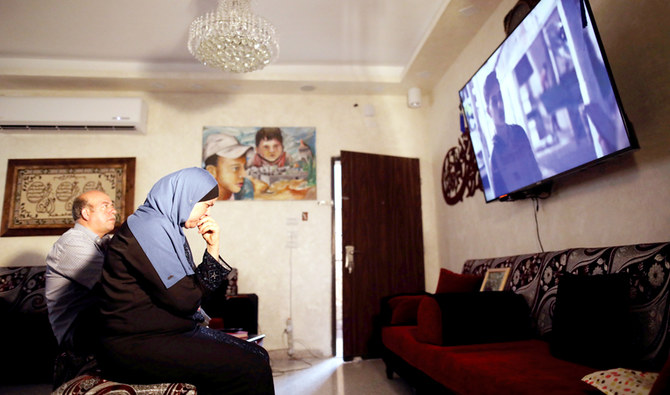
The mother of the murdered Mohammed Abu Khdeir watches the show. (Reuters)
Updated 20 August 2019
Follow

Emotions stir in Jerusalem as HBO’s ‘Our Boys’ hits local airwaves

  • The deaths of the four youths spiraled into a seven-week war between Israel and Hamas, which rules Gaza

JERUSALEM: A new HBO series on the killing of a Palestinian youth after three Israeli teens were murdered in a deadly summer five years ago is stirring up painful memories for bereaved families on both sides of the conflict.

“Our Boys,” which premiered in Israel and the US last week, centers on Mohammed Abu Khdeir, a 16-year-old Palestinian who was abducted near his East Jerusalem home and burned to death by three Israelis, two of them also teenagers, in July 2014.

“I wish I could reach into the screen and grab hold of my son,” Abu Khdeir’s mother, Suha, told Reuters, her voice breaking, soon after watching the first two episodes of the series, a co-production of HBO and Israel’s Keshet International and produced by Movie Plus.

“The show brought me right back to the pain, to the day he was kidnapped,” she said.

Prosecutors said Abu Khdeir’s convicted killers were avenging the kidnapping and murder of three Israeli teens — Naftali Frankel, Gilad Sha’er and Eyal Yifrach — in the occupied West Bank two weeks earlier by members of Hamas.

The deaths of the four youths spiraled into a seven-week war between Israel and Hamas, which rules the Gaza Strip.

HBO’s 10-episode dramatization dissects Israel’s internal investigation into the three ultra-Orthodox Jews eventually convicted of Abu Khdeir’s murder and the frantic initial days after his parents learned of his disappearance and death.

The Hebrew- and Arabic-language series was written, directed and produced by two Jewish Israelis and an Arab Israeli, who mix documentary footage with live production to delve into the micro details they say drive the conflict.

“We live in an extremely nuanced world where wars erupt because of tiny things,” co-director Joseph Cedar, 50, said in an interview alongside collaborators Hagai Levi and Tawfik Abu Wael. “We tried to peel back the layers of this hate crime,” he said.

But some bereaved Israeli families have said the show largely glosses over the murder of the three Israeli teens, who are referenced throughout the series but not included as characters.

Two Hamas suspects in the murders were killed in a 2014 shootout and in 2015 an Israeli court sentenced a third Hamas member to three life terms for the teens’ abduction and murder.

Levi said the creators felt they had portrayed the context of Abu Khdeir’s killing. “But the crime is the story,” he said.


Turkiye to forge on with tight economic policy, some fine-tuning, VP Yilmaz says

Updated 2 sec ago
Follow

Turkiye to forge on with tight economic policy, some fine-tuning, VP Yilmaz says

ISTANBUL: Turkiye is committed to carrying on its tight economic policies ​in order to cool inflation, and though it may fine-tune the program it will not change course, Vice President Cevdet Yilmaz said in comments embargoed to Friday.
“There is no plan to pause our program,” Yilmaz said at a briefing with reporters in Istanbul on Thursday. “All programs are dynamic, and adjustments can always be made.”
Yilmaz, who plays a key role overseeing economic policy at the presidency, said any such adjustments would aim to support production, investment and ‌exports while moderating consumption.
Turkiye ‌has pursued tight monetary and fiscal policies ‌for more ⁠than ​two years ‌in order to reduce price pressure, leading to high financing and borrowing costs that have weighed on businesses and households. Inflation has eased slowly but steadily over the last year but remains elevated at 31 percent annually.
Last month, Is Bank CEO Hakan Aran warned that focusing solely on one target — inflation — could create side effects, suggesting a “pause and restart” might be healthy once the program achieves certain targets.
Yılmaz said the ⁠government expects improvements in inflation in the first quarter, which should reflect to market expectations for year-end ‌inflation around 23 percent. The government projects inflation to dip ‍as far as 16 percent by year end, ‍within a 13-19 percent range, and falling to 9 percent in 2027. The central ‍bank forecasts inflation between 13-19 percent by end-2026.
Yilmaz noted inflation fell by nearly 45 points despite pressure from elevated food prices, hit by agricultural frost and drought.
The agricultural sector is expected to support growth and help ease price rises this year, which could ​help achieve official inflation targets, he said.
Yilmaz said the government wants to avoid a rapid drop in inflation that could hurt economic ⁠growth, jobs and social stability.
Turkiye’s economic program was established in 2023 after years of unorthodox easy money that aimed to stoke growth but that sent inflation soaring and the lira plunging. The program aims to dislodge high inflation expectations while boosting production and exports, in order to address long-standing current account deficits.
The central bank, having raised interest rates as high as 50 percent in 2024, eased policy through most of last year, bringing the key rate down to 38 percent.
Asked whether lower rates could trigger an exit from the lira currency, Yilmaz said: “What matters is real interest rates. Lowering rates as inflation falls does not affect real rates, so we do ‌not expect such an impact.”
He added that the government will strengthen mechanisms that selectively support companies while improving overall financial conditions.