KABUL: Afghan President Ashraf Ghani vowed to wipe out Daesh, after a deadly attack on a wedding party in Kabul killed more than 60 people. The suicide bombing also injured 200 others late on Saturday evening.
Ghani, whose government is facing intense criticism for failing to deter attacks by sympathizers of Daesh and the Taliban, also announced the postponement of 100th anniversary celebrations of the country’s independence from Britain that were due to take place.
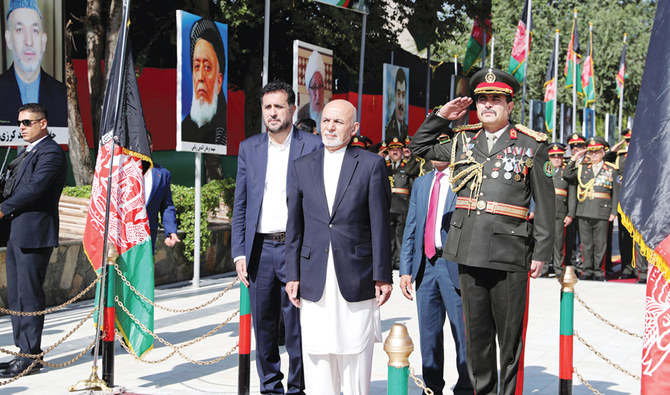
“We will eliminate Daesh hideouts all around the country … the fight against Daesh will be intensified,” Ghani said during a brief state ceremony to mark independence, even though formal festivities were put on hold.
The government had allocated millions of dollars and set aside two years for planning the event. “We postponed celebrations to honor the victims, but we will take the revenge of our people,” he added.
Daesh claimed responsibility for Saturday’s attack, which happened while guests and family members of the bride and groom were in segregated halls for men and women.
Most of the victims were Shiite and ethnic Hazaras. Daesh considers them to be heretics and has targeted them in recent years.
“I think many of us are merely alive by appearance and physically. Mentally, we are all dead. We have collapsed from the inside,” Zaman Shah, a 25-year-old survivor who lost three brothers in the attack, told Arab News.
The bomber blew himself up in the men’s hall. The groom was with the bride in the women’s section and survived, but both lost at least 25 family members.
Six children from one family perished. Other families lost loved ones too.
“I lost two of my brothers and four nephews, life has no meaning for me anymore,” Ahmad Fawad told reporters. “Postponing the independence anniversary will not cure our grief, this government is weak and useless and cannot protect people.”
Hasmat Hussien, another survivor, lost eight close members of his family and relatives in the attack. “We do not know why this calamity has befallen us. You cannot understand or comprehend our grief, misery and pain. We have not managed to sleep or eat for nearly two days now,” he said.
Amir Mohammad a 50-year-old man whose son died and had two others wounded in the attack, said: “Life has become meaningless for my family. These people who were targeted were poor, ordinary civilians, not government authorities or generals.”
The suicide bombing took place even as the US and the Taliban near a peace deal that could eventually lead to the complete withdrawal of foreign troops and end decades of conflict.
The Taliban, for its part, has pledged not to allow any group to use Afghanistan for attacks against any country.
“The US is making a peace deal with the Taliban, but we fear Daesh will be the next group that will expand its activities and there will be fighting for an uncertain future,” Kabul shopkeeper Rahim Dad said. “There will be peace with one group, but war with another. That means we won’t have peace, even if America and the Taliban make peace,” he added.
Ghani blamed the Taliban for the attack, saying it had given rise to extremist networks such as Daesh.
The Taliban, whose fighters have battled Daesh in some parts of the country, condemned the attack and showed sympathy with the victims.
US Special Envoy Zalmay Khalilzad, who has led the US side in peace talks with the Taliban since last year, tweeted Sunday that it was time to step up efforts to end fighting.
But the peace talks have faltered, mostly because the Taliban refuses to engage with Ghani’s government.
“We condemn Daesh (Daesh) and yesterday’s heinous attack on a Kabul wedding hall that killed scores of innocent Afghan families,” Khalilzad tweeted. “We must accelerate the #AfghanPeaceProcess including intra-Afghan negotiations. Success here will put Afghans in a much stronger position to defeat Daesh.”
There was tight security in major cities as thousands of Afghans poured onto the streets to mark the 100th independence anniversary.
But blasts in the eastern city of Jalalabad disrupted the day. Officials said at least 50 people were wounded. There was no immediate claim of responsibility for the blasts in the city, parts of which have been a Daesh bastion.


![]()

Afghan president vows to crush Daesh after deadly Kabul wedding strike
Afghan president vows to crush Daesh after deadly Kabul wedding strike
- ‘We have collapsed from the inside,’ says attack survivor


Latest updates


© 2026 SAUDI RESEARCH & PUBLISHING COMPANY, All Rights Reserved And subject to Terms of Use Agreement.