

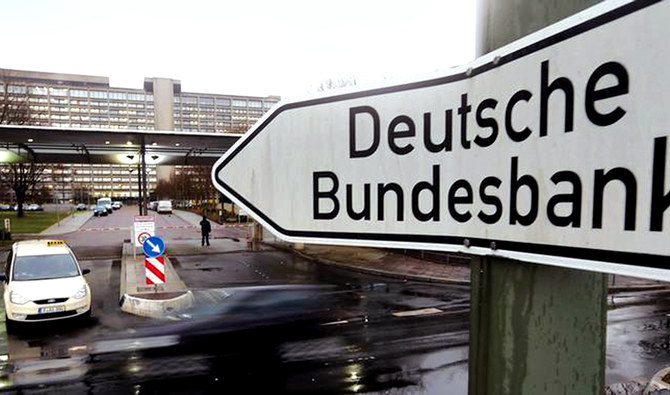
German economy might continue to shrink, says Bundesbank

The main reason for the decline is the continuing downturn in the industry. (Reuters)
Updated 19 August 2019
Follow

German economy might continue to shrink, says Bundesbank

  • The jobs market is showing signs of weakness and confidence in the services sector is also dropping

FRANKFURT: The German economy could have continued to shrink over the summer as industrial production drops amid a dearth of orders, the Bundesbank said on Monday, suggesting that the eurozone’s biggest economy is now in a recession.

German growth contracted in the second quarter on slumping exports as a global trade war, China’s own slowdown and Brexit uncertainty sapped confidence, dealing a blow to an export-focused economy.

“Overall economic performance could again decline slightly,” the Bundesbank said in a monthly report.

“The main reason for this is the continuing downturn in industry,” the central bank said, pointing to a significant decline in orders and a big drop in sentiment indicators for manufacturing firms.

While domestic consumption continues to isolate the economy, the jobs market is already showing signs of weakness and confidence in the services sector is also dropping, the Bundesbank added.

Still, the construction boom is likely to continue, providing some support. While Germany has so far rejected the idea of boosting public spending to offset the slowdown, Finance Minister Olaf Scholz said that Berlin has the fiscal strength to counter any future economic crisis “with full force.”

Speaking on Sunday, Scholz said the global financial crisis in 2008/2009 had cost Germany roughly €50 billion and the government could again muster such a sum, if necessary.

Obsessed with running a balanced budget, Germany has produced surpluses for years, ignoring calls for more spending to boost growth.

QatarEnergy and Malaysia’s Petronas sign 20-year LNG supply agreement

Updated 5 sec ago
Follow

QatarEnergy and Malaysia’s Petronas sign 20-year LNG supply agreement

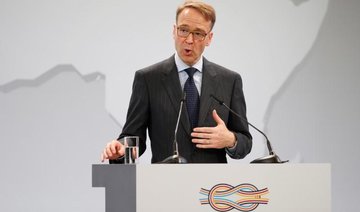
RIYADH: QatarEnergy has entered into a 20-year sales and purchase agreement with Malaysia’s Petronas for the supply of liquefied natural gas, the companies have announced.

Under the deal, QatarEnergy will supply 2 million tonnes per annum of LNG to Petronas, starting in 2028.

The SPA was signed in Doha at a ceremony held alongside the 21st International Conference & Exhibition on Liquefied Natural Gas “LNG2026.”

This marks the first long-term LNG SPA between the two state-owned energy corporations.

The agreement underscores Qatar’s expanding role as one of the world’s leading LNG suppliers, as the country advances major production growth projects aimed at increasing its export capacity later this decade.

According to the press release, the deal “reflects the continued confidence and trust between the two organizations and underscores their shared vision for a sustainable energy future and the strengthening of bilateral cooperation.”

The signatories were Saad Sherida Al-Kaabi, the minister of state for energy affairs as well as president and CEO of QatarEnergy, and YM Tan Sri Tengku Muhammad Taufik Tengku Kamadjaja Aziz, the president and group CEO of Petronas.

Al-Kaabi stated: “QatarEnergy is pleased to enter into this new LNG SPA with Petronas, which highlights our continued commitment to support the growing energy needs of Malaysia as well as our customers across the globe.”

QatarEnergy stated the agreement reflects its ongoing dedication to strengthening global partnerships, promoting cleaner energy solutions, and supporting the economic development goals of key markets worldwide.

On Feb. 3, QatarEnergy signed a memorandum of understanding with Japan’s Ministry of Economy, Trade and Industry and JERA, the country’s largest power generation company, for supplying Japan with additional liquefied natural gas quantities during emergency situations.

The MoU, signed on the sidelines of the same conference in Doha, stipulates QatarEnergy’s response in the event of unforeseen emergencies that could affect Japan, such as natural disasters. The agreement also includes mechanisms for bilateral consultation on appropriate response measures in such situations.

The MoU also underlines QatarEnergy’s role in ensuring energy security to all its customers through access to supplemental LNG volumes during emergencies and supply disruptions, it said in a press release. It also emphasizes Qatar’s ability to provide stable LNG supplies as well as its well established reputation as a reliable and trustworthy energy provider.