DUBAI: Iran appears to be preparing another satellite launch after twice failing this year to put one in orbit, despite US accusations that the Islamic Republic’s program helps it develop ballistic missiles.
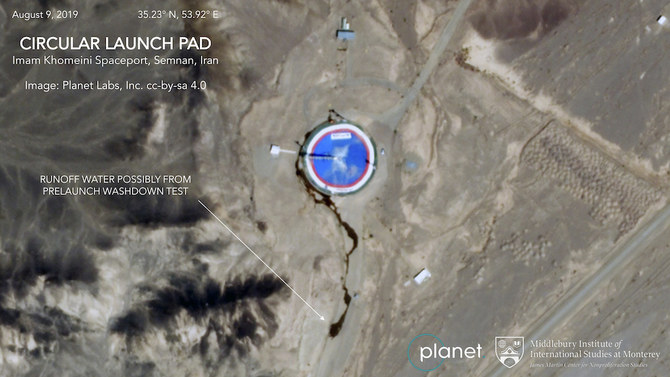
Satellite images of the Imam Khomeini Space Center in Iran’s Semnan province this month show increased activity at the site, as heightened tensions persist between Washington and Tehran over its collapsing nuclear deal with world powers.
While Iran routinely only announces such launches after the fact, that activity coupled with an official saying a satellite would soon be handed over to the country’s Defense Ministry suggests the attempt will be coming soon.
“The Imam Khomeini space launch center is usually quite empty,” said Fabian Hinz, a researcher at the James Martin Center for Nonproliferation Studies at the Middlebury Institute of International Studies in Monterey, California. “Now we’ve seen pictures where you can see activities at this assembly center and something happening at the (launch) pad.”
“If you put both together it sounds very likely there’s something that’s going to happen,” he said.
The satellite images of the space center, taken Aug. 9, show activity at one facility there, Hinz said Sunday. Another image of a launch pad at the facility shows water that’s run off it and pooled, likely a sign of workers preparing the site for a launch, he said.
CNN first reported on the satellite images of the space center, some 240 kilometers (150 miles) southeast of Iran’s capital, Tehran.
Iranian satellite launches had been anticipated before the end of the year.
In July, Iran’s Information and Communications Technology Minister Mohammad Javad Azari Jahromi told The Associated Press that Tehran planned three more launches this year, two for satellites that do remote-sensing work and another that handles communications.
The Nahid-1 is reportedly the telecommunication satellite, which authorities plan to have in orbit for two-and-a-half months. Nahid in Farsi means “Venus.”
The semi-official Mehr news agency quoted Jahromi on Aug. 13 as saying that the Nahid-1 was ready to be delivered to Iran’s Defense Ministry, signaling a launch date for the satellite was likely imminent. Iran’s National Week of Government, during which Tehran often inaugurates new projects, begins Aug. 24.
The launch of the Nahid-1 comes after two failed attempts at getting satellites into orbit in January and February. A separate fire at the Imam Khomeini Space Center in February also killed three researchers, authorities said at the time.
Over the past decade, Iran has sent several short-lived satellites into orbit and in 2013 launched a monkey into space.
The US alleges such launches defy a UN Security Council resolution calling on Iran to undertake no activity related to ballistic missiles capable of delivering nuclear weapons.
Iran, which has long said it doesn’t seek nuclear weapons, maintains its satellite launches and rocket tests have no military component. Tehran also says they don’t violate the UN resolution, as it only “called upon” Tehran not to conduct such tests.
The tests have taken on new importance to the US amid the maximalist approach to Tehran taken by President Donald Trump’s administration. Tensions have been high between the countries since Trump unilaterally withdrew the US from Iran’s nuclear deal over a year ago and imposed sanctions, including on Iran’s oil industry. Iran recently has begun to break the accord itself while trying to push Europe to help it sell oil abroad.
The State Department did not respond to a request for comment Sunday about the apparently forthcoming Iranian launch.


![]()

Satellite images suggest Iran satellite launch looms
Satellite images suggest Iran satellite launch looms
- This is the third time Iran would launch a satellite into space
- The other two attempts this year year failed to put one in orbit


Latest updates


Recommended


© 2026 SAUDI RESEARCH & PUBLISHING COMPANY, All Rights Reserved And subject to Terms of Use Agreement.