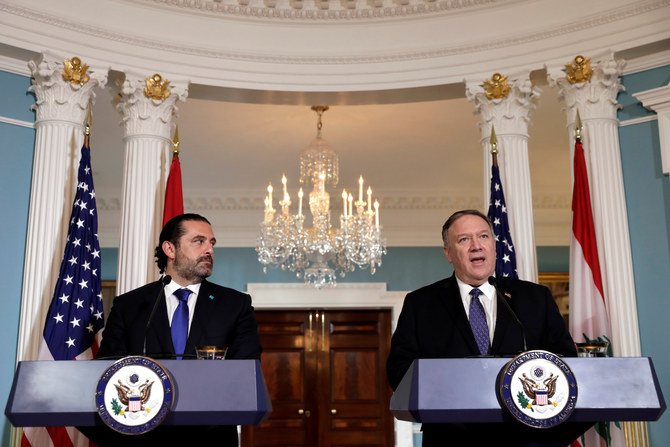
BEIRUT: US Secretary of State Mike Pompeo on Thursday praised the commitment of the Lebanese government to protecting its country in the face of the threat posed by Iran and Hezbollah.
It came during his meeting in Washington with Lebanese Prime Minister Saad Hariri. David Schenker, the assistant secretary of near eastern affairs, and David Hill, undersecretary of state for political affairs, were also present.
Pompeo also reassured Hariri of “the commitment of the United States to support Lebanon and its institutions, to preserve its security and stability, and to procure the needs of the Lebanese people.”
He also praised “Lebanon’s commitment to providing support to more than one million Syrian refugees residing on its soil, who have fled the injustice of the Assad regime.”
“We call for continuing the discussions related to the remaining points related to the Blue Line (the UN’s border demarcation between Lebanon and Israel) and the Lebanese maritime borders (with Israel). We are ready to mediate the maritime dispute between Lebanon and Israel and hope to reach concrete results,” Pompeo added.
After the meeting, Hariri said he hoped to “reach a conclusive decision in the upcoming months regarding the border demarcation negotiations.” He thanked the US for its “continuous support for the Lebanese Army,” and restated Lebanon’s commitment to fighting terrorism.
He also noted Lebanon’s “continuous support for the Cedar Conference (of international investors) and its investment plan, which is highly necessary to the Lebanese economy.” During a Cedar conference in Paris in April 2018, Lebanon secured pledges of $10.2 billion in loans and $860 million in grants, which are dependent on economic reforms.
Earlier, Hariri spent more than an hour with David Malpas, president of the World Bank, during which he assured the financier: “Lebanon’s relationship with the World Bank is very important and we continue to cooperate in various sectors, especially electricity, telecommunications and waste management.”
The prime minister said that he also explained to Malbas “the challenges that we face in Lebanon on the economic and political levels.”
Regarding the IMF’s reluctance to cooperate with Lebanon, Hariri said: “The IMF focuses mainly on the financial situation, while the World Bank is our partner and we are executing many projects with them.”
Asked whether or not his meetings in Washington made him optimistic that Lebanon’s credit rating will improve, Hariri said: “I know that Lebanon’s financial figures are critical and we have a great challenge with (credit rating agency) Standard & Poor’s, and we are working on improving our rating. However, this does not mean that our situation is not good; on the contrary, we are taking all necessary steps that would lead us to safety. The most important thing is not to respond to bad news by not performing our duties, and to reach safety.”
Lebanese authorities are awaiting the latest Standard & Poor’s report, which is due to be released on Aug. 23. They fear the nation’s credit rating will be downgraded to CCC, which would have negative repercussions on its economy, the banking sector and on the value of the Lebanese pound, especially given the strained political situation in the country at a time when it needs to begin implementing reforms required by Cedar investors.
Hariri was concluding a visit to Washington that comes less than a week after the Lebanese government reconvened following 40 days of inactivity in the wake of an incident in Mount Lebanon on June 30, during which two bodyguards working for Minister for Refugee Affairs Saleh Al-Gharib were shot and killed. This led to a political standoff between Druze leaders Walid Jumblatt, head of the Progressive Socialist Party, and Talal Arslan, leader of the Democratic Party and an ally of Al-Gharib, who each blamed the other’s supporters for the violence. A reconciliation agreement was reached on Aug. 9.
During his visit, Hariri also met Undersecretary of Defense John Rudd. They discussed “ways to support the Lebanese army and the security forces,” according to the prime minister’s office. He also met with Treasury officials, including Marshall Billingslea, the Treasury Department’s assistant secretary for terrorist financing, in light of the announcement by the US of fresh sanctions on Hezbollah officials. On July 9, the Treasury Department’s Office of Foreign Assets Control imposed sanctions on Hezbollah MPs Amin Sherri and Mohammad Raad, and on Wafiq Safa, Hezbollah’s security chief.
The US accuses Hezbollah of “using its members in the Lebanese Parliament to manipulate institutions to support the financial and security interests of the terrorist group and to promote malicious activities of Iran.” It also accuses Hezbollah of “threatening economic stability and security in Lebanon and the region as a whole, at the expense of the Lebanese people.”

Pompeo praises Lebanese government for standing firm against Iranian threat
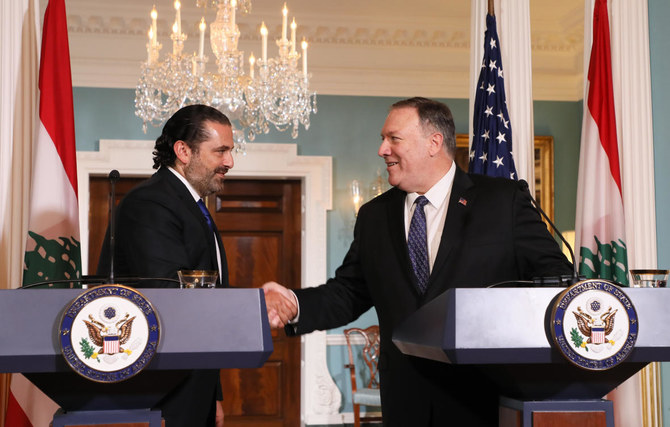
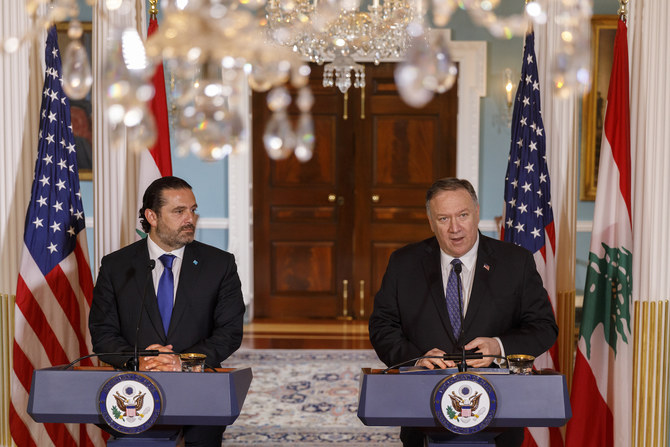
- Pompeo assures PM Saad Hariri Washington is committed to supporting Lebanon and preserving security
- Hariri thanks US for “continuous support,” pledges to continue battling terrorism and working on economic reform
Hezbollah saw new war with Israel as inevitable and rearmed for months, sources say
- The details of Hezbollah’s recent efforts to rearm have not been previously reported
- The head of Hezbollah’s media office, Youssef Al-Zein, told Reuters that Hezbollah would not comment on its military operations
BEIRUT: Lebanese armed group Hezbollah spent months restocking its arsenal of rockets and drones, using support from Iran and its own weapons factories to prepare for a new war with Israel, six sources familiar with the group’s preparations said.
Down but not out after its devastating 2024 conflict with Israel, Hezbollah had concluded that another round of fighting was inevitable — and that this time, it could face an existential threat, according to the sources.
Reuters spoke to three Lebanese sources briefed on Hezbollah’s activities, two foreign officials in Lebanon and an Israeli military official, who all spoke on condition of anonymity as they were not authorized to speak to the press.
The details of Hezbollah’s recent efforts to rearm have not been previously reported.
The head of Hezbollah’s media office, Youssef Al-Zein, told Reuters that Hezbollah would not comment on its military operations, though he said the group had decided to “fight to the last breath.”
PAYING SALARIES, REPLENISHING STOCKPILES
Founded by Iran’s Revolutionary Guards in 1982, Hezbollah launched rockets and drones at Israel on Monday to avenge the death of Iran’s Supreme Leader Ali Khamenei, pulling Lebanon into the war raging across the Middle East.
Although the decision caught some of its own officials off guard, Hezbollah had been readying its military stockpiles and its command-and-control structure for an eventual rematch with Israel, the six sources said.
To do so, it had drawn on a monthly budget of $50 million, most of it from Iran and earmarked for fighters’ salaries, according to one of the Lebanese sources, who has been briefed on the group’s finances and military activities. One of the foreign officials confirmed the $50 million budget.
It was not immediately clear how long the group had been relying on that monthly budget and how it compared to its previous financial resources.
The group has said funds from Iran helped finance rents for people displaced by the 2024 war. Around 60,000 Lebanese, most of them from the Shiite Muslim community from which Hezbollah draws its popular support, remained displaced over the last year, with their homes still in ruins.
Hezbollah had also worked to replenish its drone and rocket stashes through local manufacturing, the first Lebanese source, the foreign officials and the Israeli military official said. The Israeli military official said Hezbollah had used Iranian funding both to smuggle arms and make its own weapons, but added that its manufacturing capability had been diminished.
The second foreign official said the group had stationed new rockets and Iranian-made logistical materials in southern Lebanon before the latest war began.
Hezbollah’s media office did not immediately respond to questions on its rearmament and Iranian support for it.
Israeli military spokesperson Lt. Col. Nadav Shoshani told Reuters that Hezbollah “had a lot of arms left” and was also seeking to rearm. “They were trying to smuggle and we were preventing that,” Shoshani said.
PACE OF FIRE BUILDS UP
In 2024, a punishing two-month war with Israel ended with a ceasefire brokered by the United States. Hezbollah halted its attacks on Israel, which continued strikes on what it said were Hezbollah’s efforts to rebuild military capabilities.
Israel also kept troops in five hilltop positions in southern Lebanon.
Last year, Lebanon also began confiscating Hezbollah weapons in the country’s south — but Israel said the group was rearming faster than it was being disarmed.
Speaking to Reuters weeks before Hezbollah entered the regional war, the first Lebanese source confirmed that the group had been rebuilding its military capabilities “in parallel” with Israel’s campaign to destroy them.
The pace of Hezbollah’s attacks this week provides clues about its weapons stocks.
The group launched 60 drones and rockets on March 2, the first day it attacked Israel, and a similar number the following day, said the second foreign official, who tracks Hezbollah’s activities closely.
But on March 4, Hezbollah launched more than double that number of projectiles, a sign it had been able to draw from its larger caches, the official said.
ALMA, an Israeli think tank that monitors security on Israel’s northern border, said it assessed that Hezbollah’s arsenal on the eve of its attack included approximately 25,000 rockets and missiles, most of them short- and medium-range.
A video published by Hezbollah on March 4 showed a fighter setting up a drone in a wooded area. Riad Kahwaji, a Dubai-based defense analyst and founder of the Institute for Near East and Gulf Military Analysis, identified the drone in the video as a Shahed-101, which he told Reuters could be produced locally.
HEZBOLLAH EXPECTED A FIGHT FOR SURVIVAL
Hezbollah has also dispatched fighters from its elite Radwan force back to southern Lebanon, Reuters reported this week. They had been withdrawn from the area after the 2024 conflict.
Israeli strikes after the 2024 ceasefire included the targeting of what Israel said were Hezbollah training camps. In late February, the Israeli military said it struck eight military compounds used by the Radwan force to store weapons and prepare for a confrontation.
The Israeli official and the first foreign official said Hezbollah had been struggling to recruit new operatives as a result.
The group lost 5,000 fighters in the 2024 war, an unprecedented blow to its fighting force, though the second Lebanese source said it still had some 95,000 fighters left.
In the lead-up to its entry into the current regional war, Hezbollah had become convinced Israel would carry out a major strike on the group that would seek to “disable its ability to retaliate,” the first Lebanese source said.
A third foreign official familiar with Hezbollah’s thinking said that assessment had driven the group’s decision to launch the first salvo, fearing Israel would eventually turn its attention from Iran to Hezbollah.
“They knew they were next on the list,” the official said.