JAKARTA: Dozens of former terrorists took part in ceremonies to mark Indonesia’s 74th anniversary of independence as the country raised its red-and-white national flag and celebrated its vast diversity.
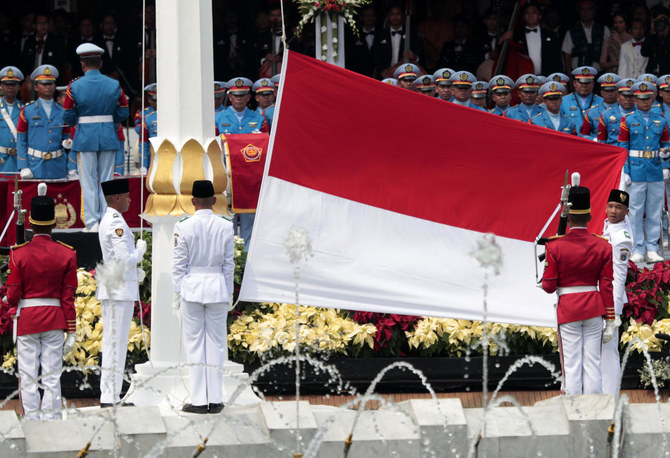
In the nation’s capital, President Joko Widodo presided over a flag-hoisting ceremony at the presidential palace with Vice President Jusuf Kalla, former presidents and vice presidents, Cabinet ministers and foreign ambassadors among the guests. Many wore traditional costumes representing Indonesia’s various ethnic groups.
The annual ceremony is marked by reading out the proclamation text at 10 a.m., the same time when Indonesia’s first president, Soekarno, read the original text to proclaim independence in Jakarta more than seven decades ago.
Jakarta Gov. Anies Baswedan presided over a similar ceremony with thousands of civil servants in attendance on an artificial islet off the northern coast of Jakarta.
The islet, which is the result of a disputed mega-reclamation project in Jakarta Bay, is now called Maju Beach.
“We are having the ceremony in this particular area because this is an area that did not exist when we declared our independence,” Anies said during the ceremony. “We want to convey a message to everyone that this is not private land, but a land that belongs to the Republic of Indonesia. This is our land and we want to make sure that the red-and-white flag is hoisted on this land.”
Dozens of former militants held a flag-raising ceremony in Tenggulun village in East Java, hosted by Yayasan Lingkar Perdamaian, the Peace Circle Foundation established by Ali Fauzi, the younger brother of Ali Ghufron and Amrozi, the two leading perpetrators executed for the 2002 Bali bombing that killed 202 people.
Amrozi’s son, Zulia Mahendra, and Khairul Mustain, the son of another man convicted of the Bali bombing, also took part as flag raisers.
“The ceremony this year included the former militants’ wives, children and their extended families. There were about 225 who took part, standing in the formation in front of the flagpole,” Ali told Arab News.
Some former terrorists and their families refused to take part in the ceremony, which included saluting the flag and singing the national anthem, he said.
“But I understand their objection. We cannot force them because this is about ideology. It takes time and I am sure with the right approach they will eventually be willing to do that,” he said.
An oath of loyalty to the republic was read aloud by Hamim Tohari, who was also convicted over the Bali attacks.
“Some of the women who wear the face veil also attended the ceremony,” Ali said. “This is also to show them that the Indonesian government guarantees their freedom to wear what they want in accordance with their faith, and also to show to the public that women who wear face veils should not be singled out as terrorists.”


![]()
![]()
![]()
![]()

Former militants fly the flag for Indonesian independence


Former militants fly the flag for Indonesian independence
- Dozens of former militants held a flag-raising ceremony in Tenggulun village in East Java
- An oath of loyalty to the republic was read aloud by Hamim Tohari, who was convicted over the Bali attacks


Latest updates


© 2026 SAUDI RESEARCH & PUBLISHING COMPANY, All Rights Reserved And subject to Terms of Use Agreement.