

Afghan palace emerges from ruins as centenary nears

1 / 6
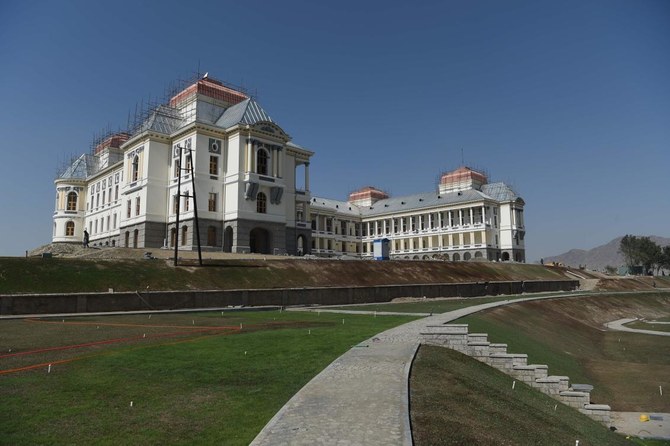
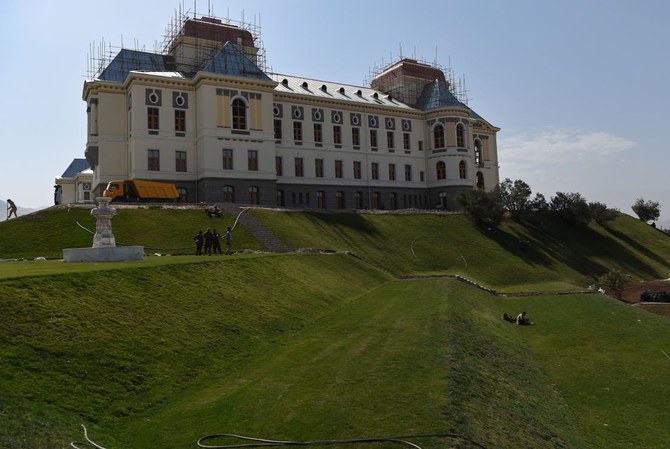
Above, the exterior of Darulaman Palace, which is undergoing a complete renovation, in Kabul. (AFP)
2 / 6
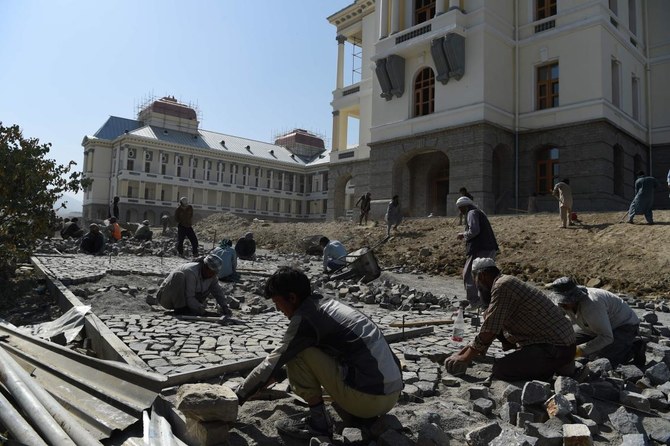
Laborers work on the exterior renovation of Darulaman Palace in Kabul. (AFP)
3 / 6
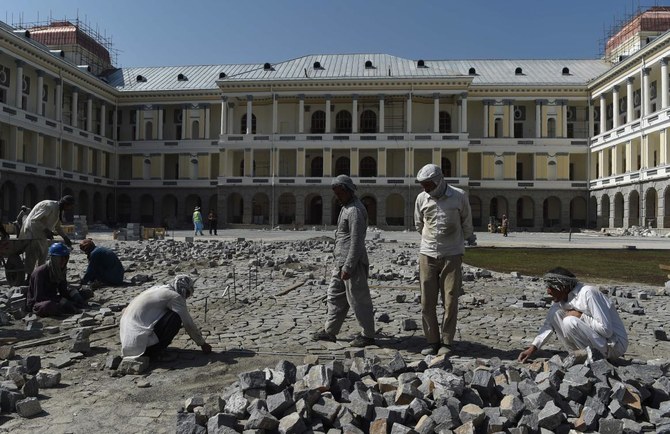
Laborers work on the exterior renovation of Darulaman Palace in Kabul. (AFP)
4 / 6
Laborers work on the renovation of Darulaman Palace in Kabul. (AFP)
5 / 6
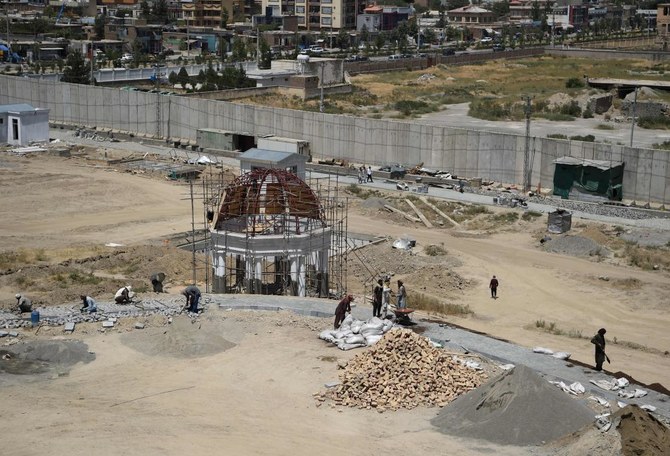
Laborers work on grounds of Darulaman Palace, which is undergoing a complete renovation, in Kabul. (AFP)
6 / 6
Above, the exterior of Darulaman Palace, which is undergoing a complete renovation, in Kabul. (AFP)
Updated 16 August 2019
Follow

Afghan palace emerges from ruins as centenary nears

  • Darulaman Palace, a hulking showpiece of Afghan architecture, came to symbolize the country’s turmoils during decades of war
  • Work at the famed palace must be completed by August 19, the date marking 100 years of Afghan independence from Britain

KABUL: Inside an imposing building in Kabul, a team of welders hastily fuse a sweeping metal bannister to a grand staircase. Outside, gardeners spray torrents of water over the parched earth, willing the grass to grow.
They have just days to finish a total renovation of the once-ruined Darulaman Palace, a hulking showpiece of Afghan architecture that came to symbolize the country’s turmoils during decades of war.
With questions looming over Afghanistan’s future and a possible deal between the US and the Taliban imminent, the war-torn nation is this month hoping to briefly celebrate its past — and Darulaman will be the centerpiece.
Work at the famed palace must be completed by August 19, the date marking 100 years of Afghan independence from Britain, when President Ashraf Ghani will inaugurate the newly renovated structure.
The final use for Darulaman — which means “Abode of Peace” — has not been finalized, but at least part will be turned into a museum.
Perched on a hill with an imposing view of Kabul, Darulaman was a total wreck until recently. Its roof was destroyed, its walls crumbling and pock-marked by bullet holes, and the once-magnificent neo-classical exterior covered in graffiti and appearing close to collapse.

But in 2016 Ghani ordered the palace’s renovation and, after finalizing design plans, construction work began in earnest in March 2018.
Project manager Javid Hammad said reconstructing Darulaman is vital to Afghanistan, as the work promises a new beginning after so much conflict.
“The message of the Darulaman Palace is a message of peace, security, brotherhood and coexistence,” Hammad said during a recent tour of the site, where about 500 workers are toiling round the clock to get the job done.
The $10.5-million renovation has been a boon to Kabul’s workforce. Cedar trimmings in high-ceilinged rooms that come from Kunar province in the west, and marble fittings from the western city of Herat mean businesses around the country have benefitted.
But not everyone is happy the palace is being returned to its former glory, wondering if the money could have been put to better use in one of the world’s poorest countries.
“It is a good thing to rebuild Darulaman Palace, but if this money would have been spent on solving people’s problems that would have been better,” local shopkeeper Ali said.
Another Kabul resident, Ghulam Mohammad, said the battered palace should have been left in its eerie, ruined condition as a testament to Afghan’s troubled past.
“It should have remained the same so people can remember how brutal the war was,” Mohammad said.
“Prior to the reconstruction, the palace was beautiful.”
On August 19, 1919, London and Kabul signed the Anglo-Afghan Treaty in which Britain recognized Afghan independence and vowed that British India would not extend west beyond the Khyber Pass.
Designed by German engineers for King Amanullah Khan in the early 1920s, Darulaman Palace was originally intended to be the location for Afghanistan’s new parliament.
But over the years, due to shifting political currents, it has also seen a string of other uses including as a home for various government ministries, a medical school and a museum.
It was gutted by fire in 1968, and since then has been repeatedly caught up in Afghanistan’s conflicts.
It was again set ablaze during a coup attempt in 1978, and was subsequently shelled during fighting in the 1990s.
Afghans today are nervously awaiting the outcome of a deal between the US and the Taliban.
The Pentagon is widely expected to cut its troop presence in return for various guarantees from its longtime foe, but many in Afghanistan do not trust the insurgents and worry they will try to seize power.


In southeast Pakistan, Ramadan brings Hindus and Muslims closer

Updated 11 March 2026
Follow

In southeast Pakistan, Ramadan brings Hindus and Muslims closer

MITHI: Partab Shivani, a Hindu in Muslim-majority Pakistan, has fasted on and off during Ramadan for years, but this time is different as he practices abstinence for the entire holy month.
Every year, he and his friends in the southeastern city of Mithi arrange iftar, when Muslims break their daily fast, to foster peace and solidarity between the two religions.
“I believe we need to promote interfaith harmony. First, we are humans — religions came later,” Shivani, a 48-year-old social activist, told AFP, adding that he also reads the teachings of the Buddha.
“His message is about peace and ending war. Peace can spread through solidarity and by standing with one another. Distance only widens the gap between people,” he added.
Ninety-six percent of Pakistan’s 240 million people are Muslim. Just two percent are Hindu, most of them living in rural areas of Sindh province where Mithi is located.
In Mithi itself, most of the 60,000 inhabitants are Hindu.
Many of the city’s Hindus also observe Ramadan and iftar has become a social gathering where people from both faiths happily participate.
“This has been a wonderful tradition of ours for a very long time,” said Mir Muhammad Buledi, a 51-year-old Muslim friend who attended Shivani’s iftar gathering.
“It is a beautiful example of harmony between the two communities.”
Like brothers
Discrimination against minorities runs deep in Pakistan.
Following the end of British rule in South Asia in 1947, the subcontinent was partitioned into mainly Hindu India and Muslim-majority Pakistan.
That triggered widespread religious bloodshed in which hundreds of thousands were killed and millions displaced.
According to the Human Rights Commission of Pakistan, freedom of religion or belief is under constant threat, with religiously motivated violence and discrimination increasing yearly.
State authorities, often using religious unrest for political gain, have failed to address the crisis, the independent non-profit says.
But such tensions are absent in Mithi.
“I am a Hindu but I keep all the fasts during this month,” said Sushil Malani, a local politician. “I feel happy standing with my Muslim brothers.
“We celebrate Eid together as well. This tradition in the region is very old.”
Restaurants and tea stalls are closed across Pakistan during Ramadan.
Ramesh Kumar, a 52-year-old Hindu man who sells sweets and savoury items outside a Muslim shrine, keeps his push cart covered and closed until iftar.
“There is no discrimination among us if someone is Muslim or Hindu. I have been seeing this since my childhood that we all live together like brothers,” he said.
Muslim shrine, Hindu caretaker
Locals say Mithi’s peaceful religious coexistence can be traced to its remote location, emerging from the sand dunes of the Tharparkar desert, which borders the modern Indian state of Rajasthan.
Cows — considered sacred in Hinduism — roam freely in Mithi city, as they do in neighboring India.
At two Sufi Muslim shrines in the middle of the city, Hindu families arrange meals, bringing fruit, meals and juices for their Muslim neighbors to break their fasts.
“We respect Muslims,” said Mohan Lal Malhi, a Hindu caretaker of one of the shrines.
Mohan said his parents and elders taught him to respect people regardless of religion or color, and the traditions pass from one generation to the next.
Local residents said both communities consider their social relationships more important than their religious identity.
“You will see a (Sikh) gurdwara, a mosque, and a shrine standing side by side here,” Mohan said. “The atmosphere of this area teaches humanity.”