

Taliban says latest talks end on US Afghanistan withdrawal

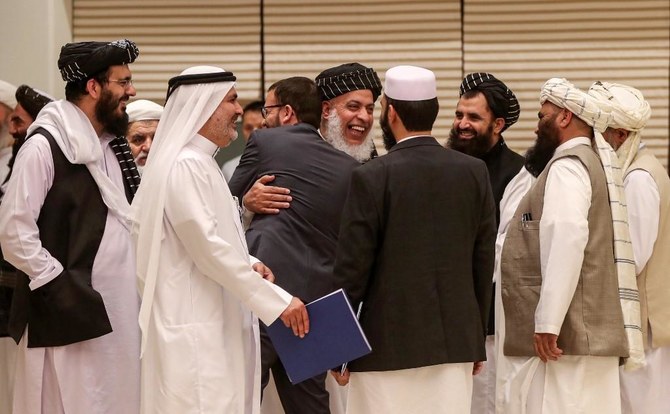
Taliban are expected to guarantee that Afghanistan will not be used as a base for extremist groups as part of the deal. (File/AFP)
Updated 12 August 2019
Follow

Taliban says latest talks end on US Afghanistan withdrawal

  • Taliban spokesman said the latest talks were “long and useful”
  • The deal will include a cease-fire

KABUL: The latest round of talks between the Taliban and the United States on a deal to withdraw thousands of US troops from Afghanistan has ended and now both sides will consult with their leadership on the next steps, a Taliban spokesman said Monday.

The eighth round of talks in the Gulf Arab nation of Qatar concluded after midnight and was “long and useful,” Zabihullah Mujahid said in a statement.

He made no statements on the outcome of the talks.

Last week, another Taliban spokesman had said a deal was expected to follow this round as both sides seek an end to the nearly 18-year war, America’s longest conflict.

An agreement — if reached — is expected to include Taliban guarantees that Afghanistan would not be a base for other extremist groups in the future. However, both the Daesh group’s affiliate and Al-Qaeda remain active in the country. The Taliban stage near-daily attacks across Afghanistan, mainly targeting Afghan forces and government officials but also killing many civilians.

The deal also could include a cease-fire and stipulate that the Taliban would negotiate with Afghan representatives, though the insurgent group has so far refused to negotiate with Kabul representatives, dismissing the Afghan government as a US puppet.

There was no immediate comment on Monday from US envoy Zalmay Khalilzad, who on Sunday tweeted that “I hope this is the last Eid where #Afghanistan is at war.”

Sunday was the first day of the Muslim holiday of Eid-al-Adha, which unfolded without any major violence reported in Afghanistan.

Khalilzad later added that “Many scholars believe that the deeper meaning of Eid Al-Hadha is to sacrifice one’s ego. Leaders on all sides of the war in Afghanistan must take this to heart as we strive for peace.”

Some in Afghanistan saw it as a response to President Ashraf Ghani, who on Sunday declared that “Our future cannot be decided outside, whether in the capital cities of our friends, nemeses or neighbors. The fate of Afghanistan will be decided here in this homeland. ... We don’t want anyone to intervene in our affairs.”

While Ghani insists that the upcoming Sept. 28 presidential election is crucial for giving Afghanistan’s leader a powerful mandate to decide the country’s future after years of war, Khalilzad is seeking a peace deal by Sept. 1, weeks before the vote.

The Taliban control roughly half of Afghanistan and are at their strongest since the US-led invasion toppled their five-year government in 2001 after the group had harbored Al-Qaeda leader Osama bin Laden. More than 2,400 US service members have died in Afghanistan since then.

The US and NATO formally concluded their combat mission in Afghanistan in 2014. The some 20,000 American and allied troops that remain are carrying out airstrikes on the Taliban and IS militants, and are working to train and build the Afghan military.


France provided ‘logistical’ support to help Benin thwart coup: Macron aide

Updated 4 sec ago
Follow

France provided ‘logistical’ support to help Benin thwart coup: Macron aide

  • Macron led a “coordination effort” by speaking with key regional leaders
  • The situation in Benin “caused serious concern for the president (Macron) ,” said the aide

PARIS: France provided logistical support and surveillance assistance to help the west African state of Benin thwart a coup attempt that was foiled at the weekend, an aide to President Emmanuel Macron said Tuesday.
Macron led a “coordination effort” by speaking with key regional leaders, while France — at the request of the Beninese authorities — provided assistance “in terms of surveillance, observation and logistical support” to the Benin armed forces, the aide, asking not to be named, told reporters.
Further details on the nature of the assistance were not immediately available.
A group of soldiers on Sunday took over the national television station and announced that President Patrice Talon had been deposed.
But loyalist army forces ultimately defeated the attempted putsch with the help of neighboring Nigeria, which carried out military strikes on Cotonou and deployed troops.
West Africa has endured a sequence of coups in the last years that have severely eroded French influence and presence in what were French colonies up until independence.
Mali saw coups in 2020 and 2021, followed by Burkina Faso in 2022 and then Niger in 2023. French forces that had been deployed in these countries for an anti-jihadist operation consequently pulled out.
A successful putsch in Benin, also a former French colony, would have been seen as a new blow to the standing of Paris and Macron in the region.
On Sunday, Macron spoke with Talon as well as the leaders of top regional power Nigeria, and Sierra Leone, which holds the presidency of West African regional bloc ECOWAS, the aide said.
The situation in Benin “caused serious concern for the president (Macron), who unequivocally condemned this attempt at destabilization, which fortunately failed,” said the aide.
ECOWAS has said troops from Ghana, Ivory Coast, Nigeria and Sierra Leone were being deployed to Benin to help the government “preserve constitutional order.”
The bloc had threatened intervention during Niger’s 2023 coup that deposed president Mohamed Bazoum — an ally of Macron — but ultimately did not act.
France also did not carry out any intervention against the Niger coup.
“France has offered its full political support to ECOWAS, which made a very significant effort this weekend,” said the aide.