

Saudi Arabia harnessed all capabilities to serve pilgrims, says top diplomat

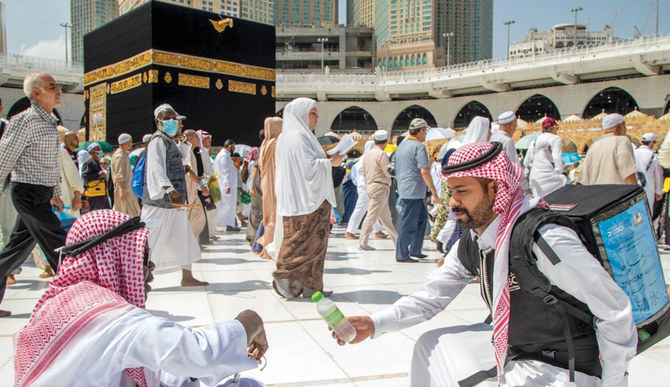
Saudi volunteers distribute water to pilgrims who are performing Tawaf Al-Ifadah for the completion of their Hajj rituals. (SPA)
Updated 15 August 2019
Follow

Saudi Arabia harnessed all capabilities to serve pilgrims, says top diplomat

  • More than 350,000 people had worked to provide pilgrims with support and services
  • Around 2.5 million pilgrims performed the Hajj this year

JEDDAH:  Saudi Minister of Interior Prince Abdul Aziz bin Saud bin Naif conveyed Eid Al-Adha greetings to King Salman and Crown Prince Mohammed bin Salman and congratulated them on the success of this year’s Hajj, the Saudi Press Agency reported.

He thanked the king for taking care of the pilgrims and for providing them with all the facilities and services needed. Around 2.5 million pilgrims performed the Hajj this year and all the measures put in place by authorities and agencies were successful, he added.

The minister said: “I congratulate you on the success achieved in this year’s Hajj season, in the implementation of wise directives and ... and preparing all the services and facilities for pilgrims to perform their rituals with ease, comfort, security and tranquility, including the Makkah Route initiative launched three years ago.”

The Hajj season this year was characterized by the successful implementation of all security, preventative, organizational, service and traffic plans.

Pilgrims arrived in Arafat, Nafra, Muzdalifah and Mina in record time according to strict organization and smooth streamlining, up to Jamarat (where pilgrims throw stones) and flocking to the Grand Mosque to perform Tawaf Al-Ifadah (circumambulation) and completion of their Hajj rituals.
The security situation remained stable and there were no incidents disturbing the pilgrimage, Prince Abdul Aziz said.

Minister of Foreign Affairs Ibrahim Al-Assaf stressed that the Kingdom has harnessed all its capabilities and sectors to serve the guests of Allah and provide all means to facilitate the performance of their rituals with ease and tranquility, sensing the great responsibility toward Muslims in all countries of the world without differentiation or discrimination.

He said that the role of the ministry during the Hajj season integrates with the roles of other sectors of the state under the directives of the leadership to provide everything that reflects the Kingdom’s efforts in the service of visitors of the Two Holy Mosques.

Makkah Gov. Prince Khalid Al-Faisal also thanked King Salman and Crown Prince Mohammed bin Salman for supervising the services offered to pilgrims during this year’s Hajj.

Prince Khalid said all Saudis were proud of the efforts made to help pilgrims during their stay in the Kingdom.

The Makkah governor said that more than 350,000 people had worked to provide pilgrims with support and services.  

He also said that 35,000 volunteers, in addition to 120,000 security personnel, 30,000 health practitioners and 200,000 workers from other sectors, had contributed to the success of the Hajj season.

Minister of Health Dr. Tawfiq bin Fawzan Al-Rabiah said the Hajj health plans for this year were successful and there was nothing that might have negatively affected public health.

He praised the king and the crown prince for supporting the Ministry of Health, its employees and all sectors connected to this year’s Hajj operations.

Prince Khalid bin Bandar bin Sultan, Saudi Arabia’s ambassador to the UK, also congratulated the king and crown prince on a successful Hajj season.

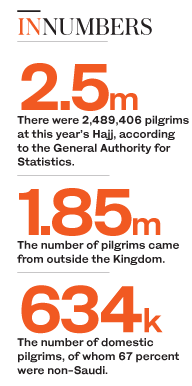
There were 2,489,406 pilgrims at this year’s Hajj, according to the General Authority for Statistics, and 1,855,027 of them came from outside the Kingdom. There were 634,379 domestic pilgrims, of whom 67 percent were non-Saudi. 

There were 1,385,234 male pilgrims and 1,104,172 female pilgrims, the authority added.


Yemenis in Rafha find a home away from home this Ramadan

Updated 6 sec ago
Follow

Yemenis in Rafha find a home away from home this Ramadan

RAFHA: The Yemeni community in Rafha governorate, in the Northern Borders region of Saudi Arabia, is an enduring model of coexistence and social integration. 

One of the oldest expatriate communities in the governorate, Yemeni residents have contributed for decades to the social and economic fabric of the area, becoming an inseparable part of its local identity.

With the arrival of the holy month of Ramadan, those bonds come into sharper relief. Ancient Yemeni traditions blend seamlessly with the Kingdom’s Ramadan atmosphere in scenes that speak to a spirit of brotherhood and mutual enrichment — underscoring the depth of a shared human experience in a country that prides itself on security, stability, and cultural diversity.

Speaking to the Saudi Press Agency, Yemeni residents in Rafha said they feel no sense of estrangement during their time in the Kingdom, citing the social and historical ties that unite the two peoples. They noted that Ramadan creates a unifying space where shared values converge — chief among them generosity, kinship, and social solidarity — most visibly expressed through iftar tables that bring together neighbors and friends of all nationalities.

Abdulrazzaq Al-Shuja’a explained that Yemeni families take care to preserve their Ramadan traditions as an expression of cultural identity, from extended family gatherings and the exchange of traditional dishes, to the observance of Ramadan evenings through prayer and communal activities.

Iftar spreads are anchored by dishes carried down through generations, most notably shafoot, saltah, bint al-sahn, hareesh, areekah, fahsah, masoub, lahoh, mandi with lamb, and sahawiq, set beside Saudi staples in an easy, unforced blending of two culinary cultures.

Bashar Al-Shuja’a described the Kingdom as a genuinely multicultural environment, one where different nationalities live alongside one another with real mutual respect rather than mere tolerance. Ramadan, he said, brings that quality into the open and gives it renewed force.

For Iyad Al-Hassani, the picture is also an economic one. Yemeni workers and families have contributed to development in numerous sectors and regions of the Kingdom, he said, and their participation in civic and communal life — including the shared rituals of Ramadan — reflects the depth of long-rooted human ties and embodies a genuine sense of shared responsibility.

Several Yemeni residents described the Ramadan atmosphere in the Kingdom as one that gives them a feeling of warmth and reassurance — particularly through charitable initiatives and communal iftar projects that foster connection and reinforce values of cooperation and goodwill.

The Ramadan experience for Yemenis in Rafha ultimately distills the meaning of a human belonging that transcends borders, where memories and traditions intertwine in an atmosphere of mutual appreciation. In this way, Ramadan becomes a season for deepening social ties and entrenching the values of coexistence, offering yet another reflection of the Kingdom as a model of cultural diversity and communal harmony under the unifying canopy of Islamic values.