Mexico City suspends six police in rape investigation

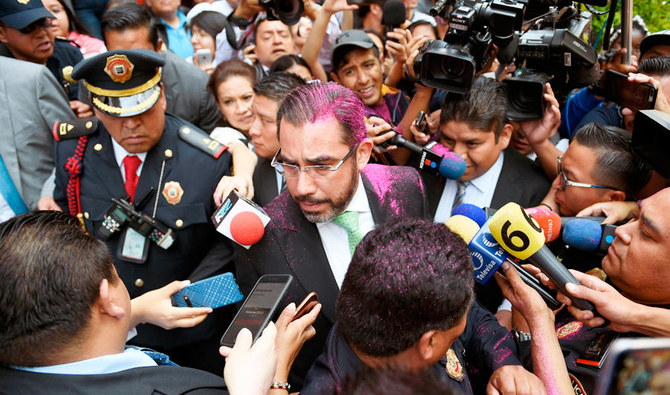
The Secretary of the Public Security of Mexico City Jesus Orta Martinez -with his hair sprayed by a demonstrator- is hounded by the press during a protest called by civil organizations against the police, after four police officers had been accused of raping a minor las t weekend in their patrol car in the Azcapotzalco neighborhood, in front of the Ministry of Public Security in Mexico City on August 12, 2019. (AFP)
Updated 14 August 2019
Follow

Mexico City suspends six police in rape investigation

  • The rapes are the latest incidents to trigger outrage over the high rate of violence against women and girls in Mexico

MEXICO CITY: Mexico City’s mayor said on Tuesday that six police officers were suspended as part of an investigation into the rape of two teenage girls, after demonstrations by hundreds of women demanding justice.
Around 250 people had taken to the streets on Monday, dousing the capital’s security minister in pink glitter and smashing the glass doors of the local prosecutor’s office.
The protests were in response to two recent cases: that of a 17-year-old girl who says four policemen raped her in their patrol car as she left a party on the capital’s north side, and that of a 16-year-old girl who says a policeman raped her at the national photography archive museum, in the city center.
“Six police have been suspended from their duties while the investigation continues,” said Mayor Claudia Sheinbaum, the first woman elected to the job, in a video posted to Twitter. “There will be no impunity nor any fabrication of guilt.
The rapes are the latest incidents to trigger outrage over the high rate of violence against women and girls in Mexico.
One policeman was already arrested Thursday in the case that occurred at the museum.
In addition to covering the capital’s security minister, Jesus Orta, with glitter as he appealed for calm, the protesters, who were mostly women, spray-painted a group of policemen and displayed a pig’s head outside the local prosecutor’s office.
Masked demonstrators later hurled rocks at the building, shattering the glass entrance.
Machismo plays a prominent role in Mexican culture, and levels of violence against women and girls are high in the country.
Nine women are murdered in Mexico every day, according to the United Nations.


Ireland’s defense gaps exposed as EU presidency nears

Cathal Berry, former Irish army special forces member, on The Curragh plain. (AFP)
Updated 7 sec ago
Follow

Ireland’s defense gaps exposed as EU presidency nears

  • Militarily neutral Ireland is not a NATO member, yet its waters — seven times its landmass — account for around 16 percent of the EU’s total

THE CURRAGH: Sheep amble around steel fences skirting Ireland’s largest military base on a grassy plain west of Dublin, a bucolic scene masking an underfunded defense force struggling with outdated equipment.

Ireland’s threadbare military and its long-standing policy of neutrality are under heightened scrutiny as the country prepares to assume the rotating EU presidency from July.

“Ireland is the only EU country with no primary radar system, nor have we sonar or anti-drone detection equipment — let alone the ability to disable drones,” said former Irish special forces member Cathal Berry.

“We can’t even monitor the airspace over our capital city and main airport,” he said as he surveyed Ireland’s main military base at The Curragh.

Militarily neutral Ireland is not a NATO member, yet its waters — seven times its landmass — account for around 16 percent of the EU’s total.

Nearly three-quarters of transatlantic subsea cables run close to or beneath them.

But the Irish army numbers only a few thousand troops, is focused largely on UN peacekeeping missions and has neither a combat air force nor a sizeable navy.

Ireland’s annual defense spending of roughly €1.2 billion is the lowest in Europe at around 0.2 percent of the GDP, well below the EU average of 1.3.

“Neutrality itself is actually a fine policy. If you want to have it, it must be defended,” said retired Irish army colonel Dorcha Lee.

“That’s the whole point. Undefended neutrality is absolutely definitely not the way to go.”

Berry points to a long-standing “complacency” about defense in Ireland that has fueled a vacuum in debate over neutrality and military spending.

“If you wanted to squeeze the EU without any risk of NATO retaliation, Ireland is where you’d come,” he said, adding that also applied to US interests in Europe.

US tech giants like Google, Apple and Meta have their European headquarters in Ireland, supported by vast data centers that analysts say are vulnerable to cyberattacks.

European Council President Antonio Costa said he was still “confident” Ireland could protect EU summits during its presidency.

Defense Minister Helen McEntee has pledged that new counter-drone technology will be in place by then.

Speaking in front of a row of aging army vehicles at the Curragh military site, she also announced a broader increase in military spending, although the actual details remain unclear.

On Dec. 17, the Irish government said it plans to buy a military radar system from France at a reported cost of between €300 and €500 million (around $350-$585 million).

For Paul Murphy, a left-wing opposition member of parliament, “scaremongering over allegedly Russian drones with concrete evidence still unprovided” is

giving the government cover to steer Ireland away from neutrality toward NATO.

“But it’s more important than ever that we’re genuinely neutral in a world that is increasingly dangerous,” he told AFP.

Ireland has historically prioritized economic and social spending over defense investment, he said.

“Joining an arms race that Ireland cannot compete in would waste money that should be spent on real priorities like climate change,” he added.

Pro-neutrality sentiment still holds sway among the Irish public, with an Irish Times/Ipsos poll earlier this year finding 63 percent of voters remained in favor of it.

And very few voices in Ireland are calling to join NATO.

Left-winger Catherine Connolly, who won Ireland’s presidential election in October by a landslide, is seen as a pacifist.

“I will be a voice for peace, a voice that builds on our policy of neutrality,” she said in her victory speech.