

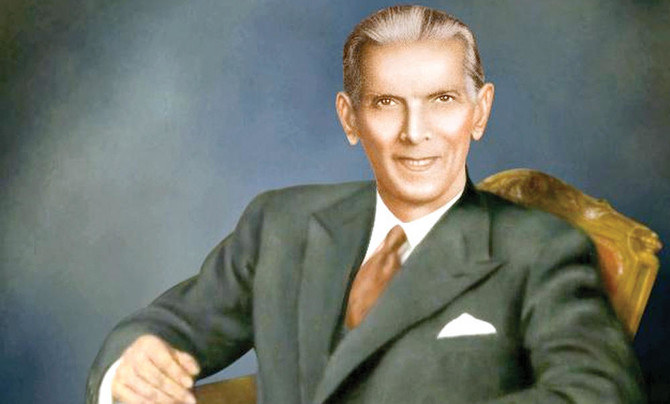
Pakistan founder Quaid-e-Azam Mohammed Ali Jinnah — a true statesman

Pakistan founder Quaid-e-Azam Mohammed Ali Jinnah
Updated 13 August 2019
Follow

Pakistan founder Quaid-e-Azam Mohammed Ali Jinnah — a true statesman

Quaid-e-Azam Mohammed Ali Jinnah, the founder of Pakistan, was no doubt one of the most charismatic leaders in world history. He was there at just the right moment, when Muslims in pre-partition India were facing severe challenges.

Under his leadership, the Muslims of the sub-continent gained independence and created a sovereign state, Pakistan, without a shot's being fired. This has no parallel in the chronicles of history.

Otto von Bismarck, the former German Chancellor, once said: “Man cannot control the current of events. He can only float with them and steer.” Jinnah’s statecraft proved this statement to be true, as he skillfully and successfully steered the adverse currents of events in 1946 and brought the battered Muslim ship ashore, safe and sound, within a year.

Jinnah’s attraction to the world of politics began as a young man working in London. He was very impressed by Dadabhai Naoroji, a Parsi from Bombay who was the first Indian to become an MP in Britain, and upon returning to India Jinnah entered the world of politics and joined the Indian National Congress. The first of the party’s annual sessions that he attended was its 20th, held in Bombay in December 1904.

There is no denying that initially Quaid-e-Azam was an ambassador for Hindu-Muslim unity; given the presence of a non-native government, he did not wish to exacerbate the problems between Muslims and Hindus. Nevertheless, he stood up for the rights of Muslims even when he was a member of Congress. In 1916, a result of his efforts was the Lucknow Pact, an agreement in which Congress accepted the right of Muslims to have separate constituencies and expressed willingness to give them constitutional guarantees.

Quaid-e-Azam was a man of principle who set very high political standards and values and never compromised on them. There were two main keys to Jihisnnah’s successful statesmanship: a rational approach to politics, and a keen knowledge of objective realities, however awkward or complex.

He had the uncanny ability to always make the right choice at the right moment. His statesmanship is evidenced by the fact that he considered each and every proposal put to him, whether it came from the British or from Congress, including the Lucknow Pact, the Roundtable Conferences of the early 1930s on constitutional reform, and the Cabinet Mission that came to India in 1946 to discuss the transfer of power from the British government. He studied them and found and used every opportunity they offered for securing the rights of Muslims.

US historian Stanley Wolpert wrote in his book “Jinnah of Pakistan:” “Few individuals significantly alter the course of history. Fewer still modify the map of the world. Hardly anyone can be credited with creating a nation-state. Mohammad Ali Jinnah did all three.”


Muhammad Arshad Munir is press counselor at the Pakistani Consulate in Jeddah.


Aleppo Citadel is a witness to the city’s great history and legacy

This aerial view shows the Citadel of Aleppo overlooking the northern Syrian city on December 11, 2024. (AFP)
Updated 11 sec ago
Follow

Aleppo Citadel is a witness to the city’s great history and legacy

  • Parts of military fortress date back nearly 2 millennia
  • Historian Abdullah Hajjar provides an extensive study

DAMASCUS: Towering above the old city, the Aleppo Citadel has stood for centuries as both a military stronghold and symbol of the location’s layered history.

After years of closure, neglect, and damage during the war, the Aleppo Citadel reopened to visitors on Sept. 27 following months of restoration.

The site has been listed as a UNESCO World Heritage landmark since 1986.

Rising around 38 meters above its surroundings, the fortress has played a central role in Aleppo’s political, military, and urban development.

Surrounded by a deep defensive moat, the citadel reflects advanced military engineering.

According to historian Abdullah Hajjar in his book “Archaeological Landmarks of Aleppo,” first published in 2010, the moat was excavated and reinforced during the reign of Ayyubid ruler Al-Zahir Ghazi.

At times it was 22 meters deep and about 30 meters wide, and filled with water to strengthen defenses.
Parts of the citadel date back nearly two millennia.

The lower section of its main entrance originates from the third century A.D., while the upper additions were made in the 15th century. Most of the towers and walls were built or expanded between the 13th and 16th centuries.

The citadel has repeatedly been damaged and rebuilt over the centuries. It was destroyed by the Sassanids in 540 A.D., but later restored.

Inside its walls, the citadel contains mosques, military structures, and residential buildings, offering a rare glimpse into daily life within a medieval fortress.

Among its landmarks are the Ibrahim Al-Khalil Mosque, the Great Mosque, defensive towers, barracks, and several historic houses.

Archaeological excavations have uncovered remains from multiple eras. This includes a ninth-century B.C. temple, Roman and Byzantine sarcophagi, and water cisterns dating to the reign of Byzantine Emperor Justinian, who rebuilt Aleppo’s fortifications in the sixth century against Persian invaders.

The citadel flourished during the Mamluk period, when it was restored by Sultan Baybars after the 1260 Battle of Ain Jalut.

Later inscriptions document victories by Mamluk rulers over Crusader and Mongol forces.

Under Ottoman rule, following the Battle of Marj Dabiq in 1516, the fortress gradually lost its military role and became an administrative and residential site.

The book outlines the various stages of restoration of the Aleppo Citadel over the centuries.

It highlights that Al-Zahir Ghazi, son of Saladdine Ayyubi, excavated the moat, reinforced the entrance with three wrought-iron gates, and built a large mosque within the fortress.

Later, Al-Zahir Baybars restored the citadel after the Mongol invasion, and in 1417, Sultan Al-Mu’ayyad Shaykh repaired its walls following their destruction by Timur in 1401.

The Aleppo Citadel has also survived powerful earthquakes, including a devastating quake in 1138 and another in 1822, each followed by major restoration efforts led by regional rulers of the time.

Beyond the citadel itself, Hajjar’s research documents Aleppo’s wider architectural heritage, including historic bathhouses and caravanserais that once supported the city’s role as a major trade center.