

Sandstorm hits Riyadh, rain tipped for Makkah

1 / 2
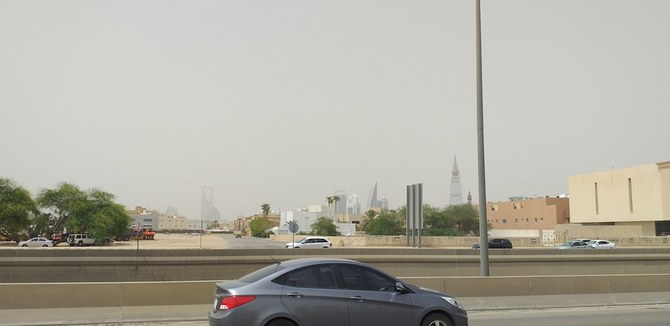
Sandstorms shrouded a number of cities in Saudi Arabia, including the capital Riyadh, in dust on Tuesday. (AN Photo)
2 / 2
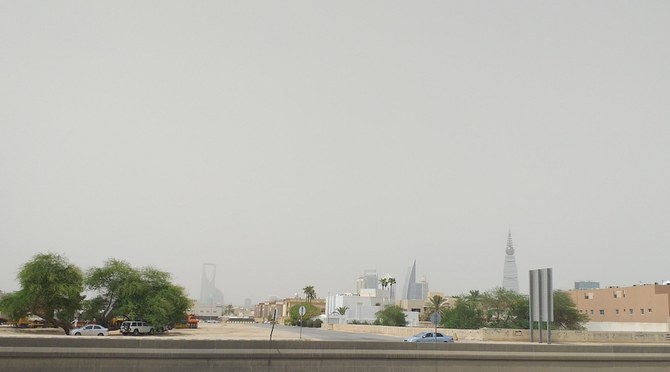
Sandstorms shrouded a number of cities in Saudi Arabia, including the capital Riyadh, in dust on Tuesday. (AN Photo)
Updated 14 August 2019
Follow

Sandstorm hits Riyadh, rain tipped for Makkah

  • Rain showers with strong winds have been forecast for parts of the Madinah highlands
  • Wind speeds of up to 34 km per hour were recorded in Riyadh

RIYADH: Sandstorms shrouded a number of cities in Saudi Arabia, including the capital Riyadh, in dust on Tuesday, while rain and thunderstorms were forecast for western and southern parts of the Kingdom.

Strong, dust-laden winds and thunderstorms are likely in the Jazan, Asir, Baha and Makkah regions, including Makkah city and the holy sites, on Tuesday and Wednesday, the General Authority of Meteorology and Environment Protection said.

Widespread dust storms are predicted in Najran and parts of the central region.

Moderate to heavy thunderstorms accompanied by widespread dust will limit visibility in these regions, the meteorology authority’s website warned.

Rain showers with strong winds have been forecast for parts of the Madinah highlands, it added.

The authority said that the surface wind movement in the Red Sea is westerly-southerly to westerly-northerly at 16-38 km per hour, while surface wind movement in the Arabian Gulf is easterly-southerly to southerly at 14-36 km per hour.

A rise in humidity in the eastern region has also been forecast.

The road safety authority and Saudi Highway Security warned drivers in the Riyadh region to exercise caution due to poor visibility caused by dust.

People with respiratory problems were also advised to avoid going outside where possible because of the risks of breathing problems associated with sandstorms.

Wind speeds of up to 34 km per hour were recorded in Riyadh.

Though not infrequent at this time of year, the sandstorm brought unfavorable conditions, with a maximum temperature of 43 C and a minimum of 31 C.

Relative humidity in Riyadh was low at 8 percent.


Saudi authority sets new standards for beach operators on the Red Sea

Updated 5 sec ago
Follow

Saudi authority sets new standards for beach operators on the Red Sea

JEDDAH: The Saudi Red Sea Authority has announced a new regulatory framework for beach operations, redefining beaches as managed operating sites rather than informal recreational spaces, the Saudi Press Agency reported.

The framework introduces standardized requirements for beach operators, focusing on licensing, safety, risk management and service quality across coastal tourism activities.

Under the regulations, beach operations will be permitted only through licensed entities, with license issued for two-year periods. 

Renewal applications must be submitted at least 30 days before expiration. The authority said the system is intended to bring consistency to beach management and provide operators with clearer operational timelines.

The framework applies along more than 1,800 km of Red Sea coastline and establishes a unified national approach to regulating beach activities. The authority said no beach operation will be allowed without an official license. 

The initiative supports the authority’s broader objectives to develop a coastal tourism sector that contributes SR85 billion ($22.66 billion) to GDP by 2030, creates approximately 210,000 jobs, and attracts 19 million visitors, the SPA noted. 

To ensure a smooth transition, the regulations will come into effect one month after their announcement, while existing operators will be granted a one-year grace period to comply. 

Safety forms a central pillar of the new framework. Licensing conditions include environmental permits, insurance coverage, approved safety plans, defined activity zones, and assessments of beach capacity.

Operators will also be required to provide licensed lifeguards, safety equipment, and systems for incident reporting and analysis.

The requirements extend to infrastructure and operation standards, including compliance with the Saudi Building Code to ensure accessibility for people with disabilities and structural safety.

Operators are also encouraged to align with international benchmarks such as Blue Flag standards and the ISO 13009:2024 for beach management, the SPA added.

The authority said this framework is designed to reduce operational risks, improve oversight and support the sustainable development of coastal tourism.

Unified requirements reduce operational risks, minimize inconsistencies, and improve the sector’s ability to attract financing and scale sustainably.