

Why such rainy, cold weather in the Middle East this spring?

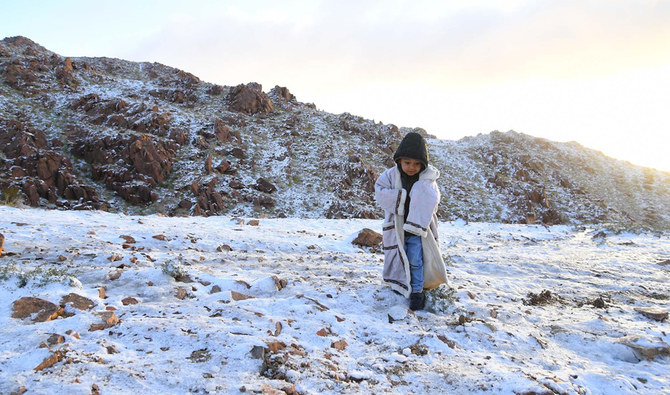
Snowfall in the Saudi region of Tabuk in late March 2019. (SPA)
Updated 16 April 2019
Follow

Why such rainy, cold weather in the Middle East this spring?

  • Experts say the unusual weather patterns could be a sign of climate change
  • On the bright side, one company has seen a ‘surge’ in sales of winter clothes

DUBAI: Unstable weather conditions across the Middle East and North Africa (MENA) have left residents and experts wondering why spring in the region has felt more like winter.

From cloud seeding to climate change, a number of reasons have been attributed to the storms, rainfall and lightning that have hit the region this month.

“It’s usually warmer in April. This isn’t familiar weather in this period,” said Dr. Ahmad Habib, a meteorological expert at the National Center of Meteorology in the UAE. “It’s a period of instability for all the region.”

Last month, the Saudi General Authority for Meteorology and Environmental Protection warned of thunderstorms, dust and active winds in the southwestern city of Najran and the western city of Al-Baha.

Citizens and residents were warned of wind and dust limiting visibility, with a chance of rain and clouds in the Tabuk region, including coastal areas.

Climate experts have called the sudden change in weather “exceptional” compared to the last three years of dryness witnessed across MENA. Last week, several parts of Tunisia were hit by snow and torrential rainfall, causing fatalities. Floods and colder temperatures were also felt throughout the Levant.
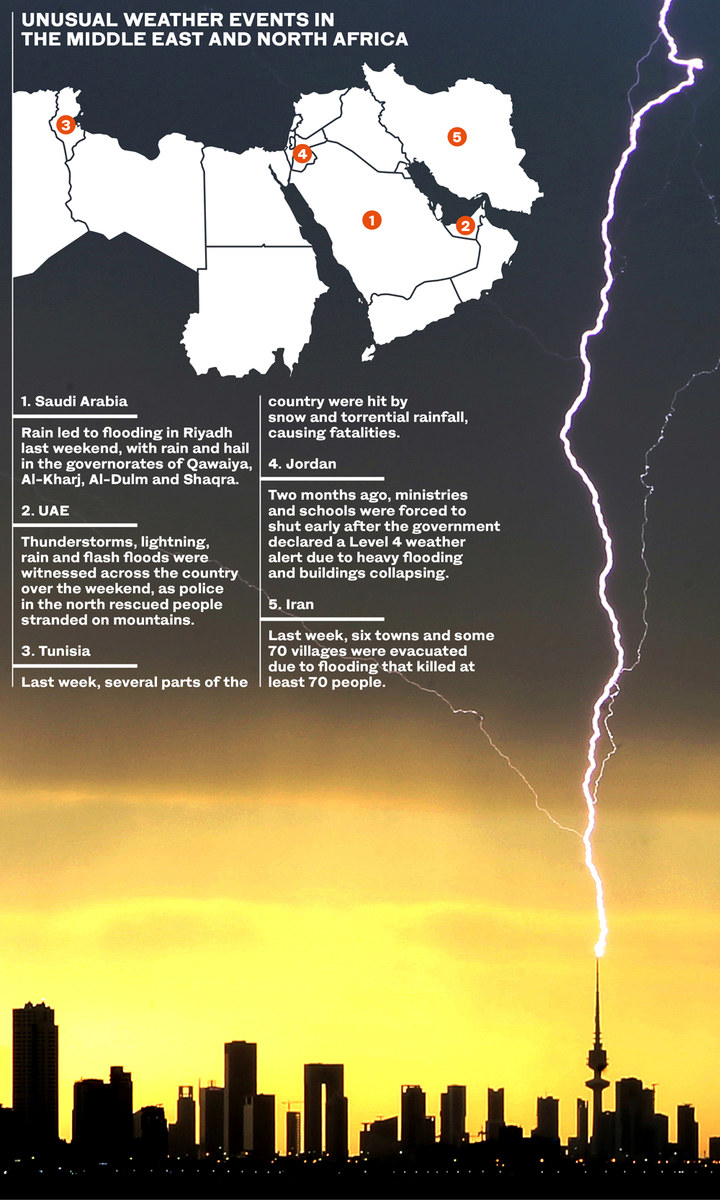
“This April was exceptional in many countries, like the snow that hit Tunisia … We feel it’s exceptional because the last three years have been three successive dry years in North Africa,” said Dr. Karim Bergaoui, a climate and water-modeling scientist at the International Center for Biosaline Agriculture in Dubai.

“It has been a very cold and rainy year, even in Jordan, where there were a lot of floods. This year was exceptionally wet.”

Rainfall and humidity have been high across much of the Middle East, particularly in the Arabian Peninsula, according to the ECMWF Copernicus Climate Change Service.

“The differences we’ve experienced are the result of high-level atmospheric conditions, which have brought predominantly low pressure systems over MENA,” said Dr. Rachael McDonnell, global fellow at the Daugherty Water for Food Institute at the University of Nebraska.

“This ensures that rain-bearing weather frontal systems are drawn along this area, so bringing the rain,” she added. “Normally these frontal systems are over northwest Europe, but this year they’re more southerly because the jet stream is further south.”

While Bergaoui called for more analysis, he said climate change could be one of the causes of such unstable weather conditions in the region. “We know from a climatological point of view that the sea surface temperature really affects the convective system (a collection of thunderstorms that act as a system) here, so it might be one of the causes. We need to study the sea surface temperature in the Gulf,” he added.

Dr. Taoufik Ksiksi, associate professor of biology at United Arab Emirates University, said: “We can be sure that when these extreme events become more frequent and more intense, it can be attributed to a change in climate.”
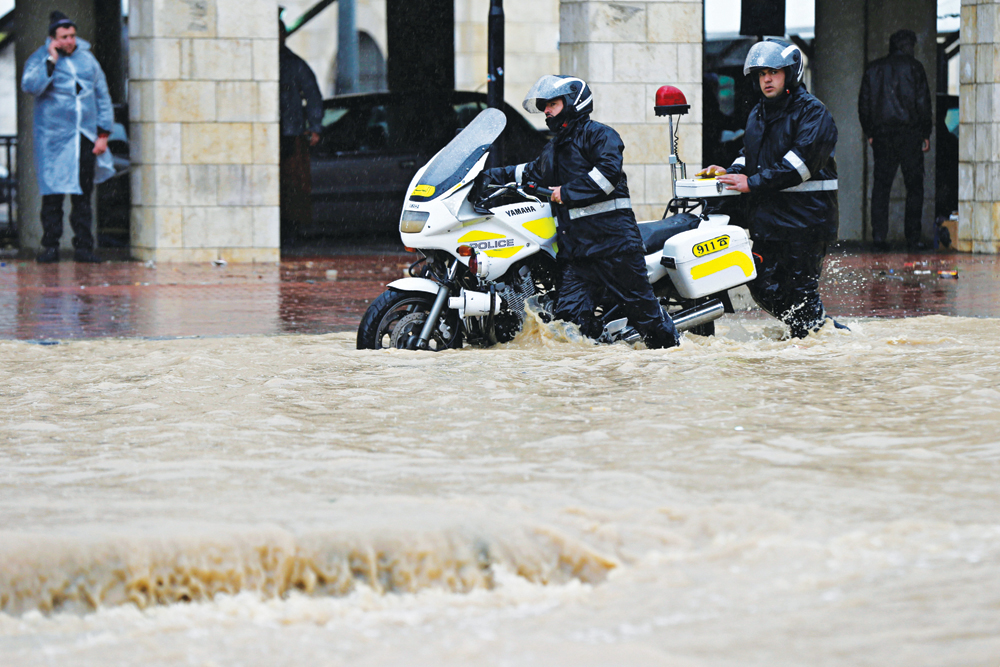


Traffic policemen push a motorcycle through a flooded street during heavy rains in Amman, Jordan, on Feb. 28, 2019. (Reuters)

He added: “We’re using more fossil fuels, and we aren’t relying enough on renewable energy. We’re changing land use from a natural ecosystem to a human-made ecosystem, and we aren’t energy efficient anymore in transportation. There are very good attempts in the UAE and Saudi Arabia to change the electricity supply from coal to gas, which is a big step, but we need to do more.”

Ksiksi said: “The weather is unusual in North Africa and West Asia … Such extreme weather events, whether it’s very intense snow or rain, are out of season. You see snow in relatively mild weather periods, and floods, dust storms and colder temperatures in some parts of northern Saudi Arabia, Lebanon and parts of Syria, all of which are very likely the outcome of this changing climate and increased greenhouse gases.”

He added: “It has to be a common effort. We need to do more because our environmental ecosystems are fragile. We have the resources, scientifically and financially, to do something about it.”

Johnny Bowen of outdoor clothing company Great British Outfitters noted a 26 percent increase in sales of winter clothing in the region during the first quarter of 2019 compared to the same period last year.

“Last month, there was a surge in sales of rainproof jackets to the UAE,” he said. “Often, the sales come when people from the UAE are going on holidays where the climate is colder. This year, we’re seeing them buy jumpers and jackets to wear in the UAE … It has been really unusual.”


First Ramadan after truce brings flicker of joy in devastated Gaza

Updated 55 min 51 sec ago
Follow

First Ramadan after truce brings flicker of joy in devastated Gaza

  • Ramadan lanterns and string lights appear on streets lined with collapsed buildings and piles of rubble in Gaza City
  • The first holy month since the October ceasefire brings mixed feelings for the many still living in tents

GAZA CITY: Little Ramadan lanterns and string lights appeared on streets lined with collapsed buildings and piles of rubble in Gaza City, bringing joy and respite as Islam’s holiest month began — the first since October’s ceasefire.
In the Omari mosque, dozens of worshippers performed the first Ramadan morning prayer, fajr, bare feet on the carpet but donning heavy jackets to stave off the winter cold.
“Despite the occupation, the destruction of mosques and schools, and the demolition of our homes... we came in spite of these harsh conditions,” Abu Adam, a resident of Gaza City who came to pray, told AFP.
“Even last night, when the area was targeted, we remained determined to head to the mosque to worship God,” he said.
A security source in Gaza told AFP Wednesday that artillery shelling targeted the eastern parts of Gaza City that morning.
The source added that artillery shelling also targeted a refugee camp in central Gaza.
Israel does not allow international journalists to enter the Gaza Strip, preventing AFP and other news organizations from independently verifying casualty figures.

‘Stifled joy’

In Gaza’s south, tens of thousands of people still live in tents and makeshift shelters as they wait for the territory’s reconstruction after a US-brokered ceasefire took hold in October.
Nivin Ahmed, who lives in a tent in the area known as Al-Mawasi, told AFP this first Ramadan without war brought “mixed and varied feelings.”
“The joy is stifled. We miss people who were martyred, are still missing, detained, or even traveled,” she said.
“The Ramadan table used to be full of the most delicious dishes and bring together all our loved ones,” the 50-year-old said.
“Today, I can barely prepare a main dish and a side dish. Everything is expensive. I can’t invite anyone for Iftar or suhoor,” she said, referring to the meals eaten before and after the daily fast of Ramadan.
Despite the ceasefire, shortages remain in Gaza, whose battered economy and material damage have rendered most residents at least partly dependent on humanitarian aid for their basic needs.
But with all entries into the tiny territory under Israeli control, not enough goods are able to enter to bring prices down, according to the United Nations and aid groups.

‘Still special’

Maha Fathi, 37, was displaced from Gaza City and lives in a tent west of the city.
“Despite all the destruction and suffering in Gaza, Ramadan is still special,” she told AFP.
“People have begun to empathize with each other’s suffering again after everyone was preoccupied with themselves during the war.”
She said that her family and neighbors were able to share moments of joy as they prepared food for suhoor and set up Ramadan decorations.
“Everyone longs for the atmosphere of Ramadan. Seeing the decorations and the activity in the markets fills us with hope for a return to stability,” she added.
On the beach at central Gaza’s Deir el-Balah, Palestinian artist Yazeed Abu Jarad contributed to the holiday spirit with his art.
In the sand near the Mediterranean Sea, he sculpted “Welcome Ramadan” in ornate Arabic calligraphy, under the curious eye of children from a nearby tent camp.
Nearly all of Gaza’s 2.2 million residents were displaced at least once during the more than two years of war between Israel and Hamas, sparked by the latter’s unprecedented October 7 attack on Israel.
Mohammed Al-Madhoun, 43, also lives in a tent west of Gaza City, and hoped for brighter days ahead.
“I hope this is the last Ramadan we spend in tents. I feel helpless in front of my children when they ask me to buy lanterns and dream of an Iftar table with all their favorite foods.”
“We try to find joy despite everything,” he said, describing his first Ramadan night out with the neighbors, eating the pre-fast meal and praying.
“The children were as if they were on a picnic,” he said.