Volatility in China’s yuan linked to US trade friction

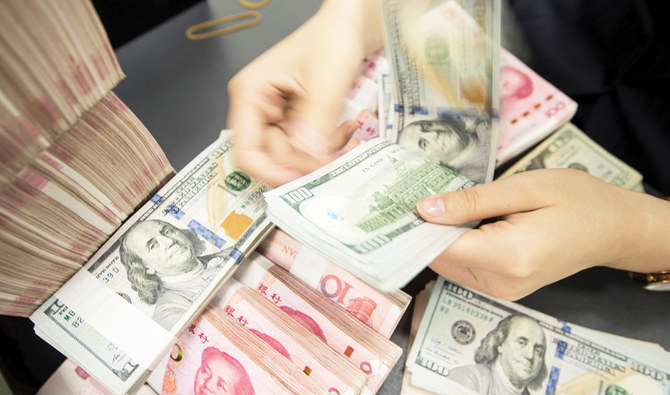
A Chinese bank employee counts 100-yuan notes and US dollar bills at a bank counter in Nantong in China’s eastern Jiangsu province. (AFP)
Updated 11 August 2019
Follow

Volatility in China’s yuan linked to US trade friction

  • The US is the IMF’s largest shareholder and has strong sway over who will be its new leader after Christine Lagarde resigned last month

SHANGHAI: Volatility in China’s yuan since August is a normal market reaction to escalating trade frictions stoked by the US and was caused, to some extent, by Washington’s decision to raise tariffs, a senior Chinese central bank official said.
Zhu Jun, director-general of the People’s Bank of China’s international department, made the comments to a forum held in the northern Chinese province of Heilongjiang.
The US Treasury Department on Monday labeled China a currency manipulator, hours after China let the yuan drop through a key support level to its lowest point in more than a decade. The moves jolted financial markets, fueling fears of a global currency war.
Days earlier, US President Donald Trump had vowed to impose a 10 percent tariff on $300 billion of Chinese imports from Sept. 1, ending a temporary truce and sharply escalating the trade dispute.
Zhu said that the yuan’s move was a normal reaction to Trump’s tariff threat. “The labeling ... violates basic, common economic sense and international consensus, and is unconvincing,” Zhu said, adding that the Chinese economy was resilient and capable of coping with various situations.
The year-long trade war between the world’s two largest economies has already spread beyond tit-for-tat tariffs on goods to other areas such as technology, and analysts caution retaliation could widen in scope and severity, weighing further on business confidence and global economic growth.
The yuan lost 1.6 percent against the dollar last week, but there were signs in the last few sessions that authorities were trying to stabilize it.
The International Monetary Fund (IMF) has been reluctant to comment on the US move. The US is the IMF’s largest shareholder and has strong sway over who will be its new leader after Christine Lagarde resigned last month.
A US Treasury official said Secretary Steven Mnuchin spoke with IMF Acting Managing Director David Lipton this week by telephone about currency consultations and also about the leadership succession.
On Friday, the head of the IMF’s China department, James Daniel, stood by the fund’s assessment last month in a report on currencies and trade balances that the value of China’s yuan was broadly in line with economic fundamentals.
He provided no clues to the path forward on the IMF’s engagement with Treasury.
“Our discussions with the US Treasury are ongoing on a range of issues,” Daniel told reporters on a conference call about the IMF’s annual review of China’s economic policies.
G7 officials have also declined to discuss the issue despite repeated queries.
Prominent economists, including former IMF chief economist Maurice Obstfeld and former Treasury Secretary Larry Summers, say there is no evidence to support the move.
China’s global current account surplus is close to zero and Beijing has spent hundreds of billions of dollars to prop up the yuan’s value in the face of mounting tariff pressures.
For the moment, European nations are in no mood to aggravate China or support Trump given his threats to impose tariffs on EU exports, said Stephanie Segal, a former senior Treasury official now at the Center for Strategic and International Studies.
Any attempt to intervene on currency markets would be difficult to do alone, Segal said.
“Currency markets are just too big to act unilaterally, even if it’s the United States,” she said. “It’s not sustainable.”
Naoyuki Yoshino, dean of the Asian Development Bank Institute and former chairman of the Japanese Ministry of Finance’s council on foreign exchange, said the announcement was all about politics, not economic fundamentals.
“The best solution is (for China) to open its capital market,” he said. “Then, if their exports keep on going, capital inflows will come and then the (yuan) should automatically appreciate,” he said.
This currency move would not be the first time that the Trump administration has ignored established policy-making protocols to carry out the president’s directives.
Philip Diehl, a former senior US Treasury official who ran the US Mint when China was last labeled a currency manipulator in 1994, said the designation followed intense deliberations within the Treasury and State Departments that also weighed human rights issues.
He said the Trump administration’s actions call into question the legitimacy of the whole process for evaluating currency manipulations.
“They’re not well thought out, they’re impulsive and they do not appear to be coordinated with our allies,” Diehl said.


New SPARK launch ushers Eastern Province from black gold to EV charging and AI mobility

Updated 15 min 35 sec ago
Follow

New SPARK launch ushers Eastern Province from black gold to EV charging and AI mobility

DAMMAM: The lavender carpet was rolled out and the symbolic shovels were placed in decorative sandboxes as Smart Mobility broke ground, bringing Saudi-made EV charging to life at its first manufacturing facility at King Salman Energy Park in Dammam.

As part of the ceremony, Smart Mobility inaugurated SPARK’s first electric vehicle charging station.

The project brought together Foxconn Interconnect Technology, a unit of Taiwan’s Foxconn that makes components used for connectivity, and Saudi’s Saleh Suleiman Alrajhi & Sons. 

It also represented a significant milestone in supporting foreign investment in the Kingdom and a major step toward localizing advanced manufacturing capabilities in order to support the rapidly-growing EV market.

“As we gather today to celebrate a groundbreaking of an important edition in this ecosystem …we’re creating a community— with all that comes with a community,” SPARK President and CEO Mishal Al-Zughaibi said.

He highlighted the park’s proximity to the Kingdom’s core energy infrastructure.

It will be headquartered in the Eastern Province, notably near to where Aramco’s Well No. 7, later named “Prosperity Well,” struck black gold in 1938, six years after the country unified as a Kingdom. That discovery changed the country — and the world. 

In recent years, there has been a tremendous effort to diversify beyond oil and, once again, the Eastern Province is at the forefront, but this time, it is using innovation and AI to catapult the Kingdom into that new realm. 

The location was also ideal, it was noted, on several levels, including how it would allow for ample access to ports, and the planned integration with the future GCC Railway network would additionally create a unified regional manufacturing and export corridor. 

According to Smart Mobility, SPARK facility was created with the aim to produce Saudi-made EV charging solutions, including the Charging Point Management System. Three products are already certified by the Saudi Standards, Metrology and Quality Organization. 

Launching in 2026, the project aims to align with Vision 2030 and to support local content goals, which will be overseen by the Local Content and Government Procurement Authority.

Smart Mobility CEO, Prince Fahad Nawaf Al Saud, who was on hand, said the decision to build at SPARK was strategic.

“SPARK is the Kingdom’s primary hub for energy, logistics and industrial innovation. For EV infrastructure to scale reliably, it must be integrated with the country’s most critical energy assets,” he said.

Prince Fahad also addressed the evolving and morphing nature of the industry, saying: “Mobility is being reshaped by artificial intelligence. Vehicles are becoming intelligent systems that think, react and connect. Level-4 autonomous capability is accelerating globally and these systems depend on electric platforms.”

He added that if the Kingdom aims to lead in AI, automation and smart city technologies, it must develop EV infrastructure as a foundational national pillar.

“EVs are not simply a fuel alternative — they are the operating system of the AI era,” he said.

Prince Fahad stated: “This groundbreaking ceremony is not only a milestone for Smart Mobility, it is a milestone for the Kingdom.”

He added: “Guided by his Royal Highness Crown Prince Mohammed bin Salman, we built this with the support from the Ministry of Energy, Ministry of Industry, and Ministry of Investment and many government entities that continue to empower our national ambitions to localization and advanced manufacturing.” 

Continuing to address the crowd, Prince Fahad said: “Some people in Saudi love petrol cars, fuel is cheap — why would anyone shift it to electric? And they are right (to question that). Traditional vehicles are still deeply loved, but we must also recognize the truth.” 

The truth, to him, is that AI is “no longer science fiction,” it is reality now. “We are entering an age where we must respond quickly to global changes … we have much work ahead to test, to certify, to scale and to deliver on the promise,” he said.

“The world is entering a new chapter defined not by horsepower but by computing power — and Saudi Arabia must lead, not follow in this transition,” Prince Fahad added. 

FIT Chairman and CEO Sidney Lu noted that next year the Chinese calendar will welcome the Year of the Horse, an apt metaphorical transition as it signals powerfully moving forward from old to now.

He was excited to be on the ground on his first visit to the Eastern Province. 

“FIT brings decades of experience in precision manufacturing, high-reliability electronics, and large-scale global production,” Lu said, adding: “Our shared objective is clear: bring world-class technologies into Saudi Arabia, embed them locally and position Saudi-made solutions for future export.”

While Lu headed back to his home in Taiwan following the meeting “to recharge,” he said the joint venture will be showcasing FIT’s global manufacturing expertise with Saudi Arabia’s industrial ambitions — and that gives him much energy. 

 “I love this place. Every time I come over here, I get inspired; inspired by the spirits, by the energy, by the youth. And I really get inspired with how people are willing to move forward,” Lu told Arab News.