Egyptian tradition of painting Hajj pilgrims’ homes lives on

1 / 2
2 / 2
Updated 11 August 2019
Follow

Egyptian tradition of painting Hajj pilgrims’ homes lives on

  • The pilgrimage season was one of the most important occasions on a calligrapher’s calendar with Hajj pilgrims hiring them to write and draw on their homes
  • Each artist uses their own unique style to portray modes of transport such as camels, planes and ships, holy sites like the Grand Mosque in Makkah, and passages from the Qur’an

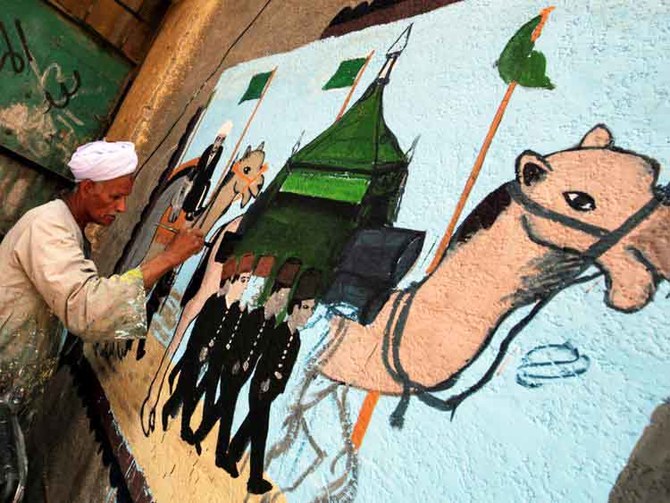
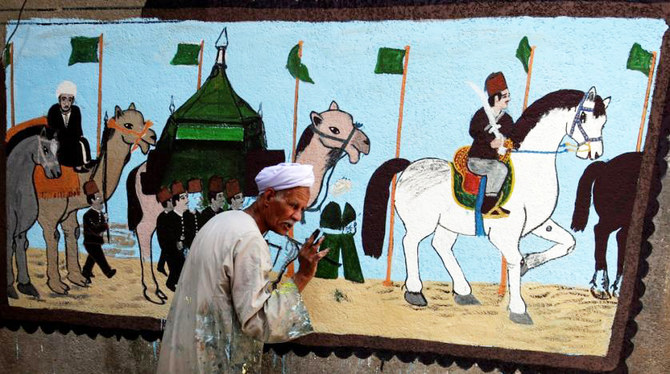
CAIRO: An Egyptian tradition of painting the homes of Hajj pilgrims with religious verses and images continues to withstand the passage of time.

The pilgrimage season sees calligraphers and painters busy sketching the journeys of worshippers on the front walls of houses in villages, towns and cities throughout the country.

Each artist uses their own unique style to portray modes of transport such as camels, planes and ships, holy sites like the Grand Mosque in Makkah, and passages from the Qur’an.

Ahmed Sayed Ahmed, 30, is one of the most well-known calligraphers in the Ghouria area of central Cairo, where he has worked for more than 15 years.

He told Arab News that the decoration process began with painting walls white to create a clean canvas for the artwork which usually included the name, gender and age of the person performing the pilgrimage.

Gamal Al-Arabi, another calligrapher and painter from Cairo, said that the tradition was still popular among Egyptian Muslims. Raised in Abnoub in Assiut governorate, he studied Arabic calligraphy for two years in Cairo and later traveled to Saudi Arabia where he worked as a calligrapher and painter.

He said that the pilgrimage season was one of the most important occasions on a calligrapher’s calendar with Hajj pilgrims hiring them to write and draw on their homes.

“In some desert villages they draw the camel, for example, and pilgrims around the Kaaba or during prayer. Recently, the majority of drawings involve ships and planes, but paintings of the Kaaba and the sacred house of God are fundamental,” Al-Arabi added.

He pointed out that his favorite fonts for Islamic inscriptions were diwan and rekea because they were easy to read.


First responders enter devastated Aleppo neighborhood after days of deadly fighting

Updated 12 January 2026
Follow

First responders enter devastated Aleppo neighborhood after days of deadly fighting

  • The US-backed SDF, which have played a key role in combating the Daesh group in large swaths of eastern Syria, are the largest force yet to be absorbed into Syria’s national army

ALEPPO, Syria: First responders on Sunday entered a contested neighborhood in Syria’ s northern city of Aleppo after days of deadly clashes between government forces and Kurdish-led forces. Syrian state media said the military was deployed in large numbers.
The clashes broke out Tuesday in the predominantly Kurdish neighborhoods of Sheikh Maqsoud, Achrafieh and Bani Zaid after the government and the Syrian Democratic Forces, the main Kurdish-led force in the country, failed to make progress on how to merge the SDF into the national army. Security forces captured Achrafieh and Bani Zaid.
The fighting between the two sides was the most intense since the fall of then-President Bashar Assad to insurgents in December 2024. At least 23 people were killed in five days of clashes and more than 140,000 were displaced amid shelling and drone strikes.
The US-backed SDF, which have played a key role in combating the Daesh group in large swaths of eastern Syria, are the largest force yet to be absorbed into Syria’s national army. Some of the factions that make up the army, however, were previously Turkish-backed insurgent groups that have a long history of clashing with Kurdish forces.
The Kurdish fighters have now evacuated from the Sheikh Maqsoud neighborhood to northeastern Syria, which is under the control of the SDF. However, they said in a statement they will continue to fight now that the wounded and civilians have been evacuated, in what they called a “partial ceasefire.”
The neighborhood appeared calm Sunday. The United Nations said it was trying to dispatch more convoys to the neighborhoods with food, fuel, blankets and other urgent supplies.
Government security forces brought journalists to tour the devastated area, showing them the damaged Khalid Al-Fajer Hospital and a military position belonging to the SDF’s security forces that government forces had targeted.
The SDF statement accused the government of targeting the hospital “dozens of times” before patients were evacuated. Damascus accused the Kurdish-led group of using the hospital and other civilian facilities as military positions.
On one street, Syrian Red Crescent first responders spoke to a resident surrounded by charred cars and badly damaged residential buildings.
Some residents told The Associated Press that SDF forces did not allow their cars through checkpoints to leave.
“We lived a night of horror. I still cannot believe that I am right here standing on my own two feet,” said Ahmad Shaikho. “So far the situation has been calm. There hasn’t been any gunfire.”
Syrian Civil Defense first responders have been disarming improvised mines that they say were left by the Kurdish forces as booby traps.
Residents who fled are not being allowed back into the neighborhood until all the mines are cleared. Some were reminded of the displacement during Syria’s long civil war.
“I want to go back to my home, I beg you,” said Hoda Alnasiri.