

WEEKLY ENERGY RECAP: Pondering Permian pipeline

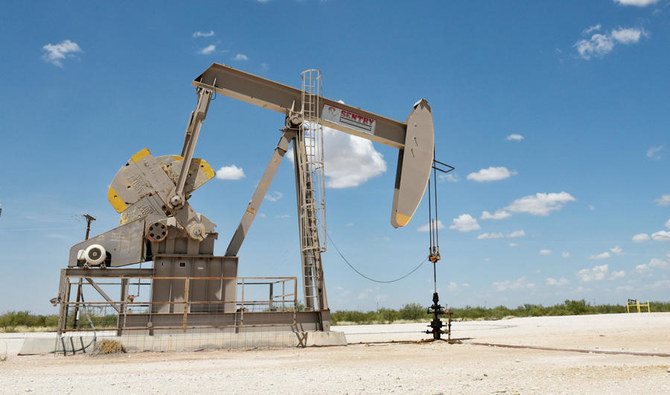
A pump jack operates in the Permian Basin oil production area near Wink, Texas U.S. August 22, 2018. (REUTERS)
Updated 11 August 2019
Follow

WEEKLY ENERGY RECAP: Pondering Permian pipeline

Oil prices tumbled last week as Brent crude fell below $60 per barrel for the first time in eight months. Brent finished at $58.53 while WTI fell to $54.50 per barrel.
Some analysts suggest that Brent has dropped on fears that the trade spat will expand into a full currency war, overshadowing the risk of supply disruptions in the Arabian Gulf. There has also been much attention paid to gloomy global economic sentiment dragging the oil price down — yet demand continues to be strong in China, the world’s biggest buyer of crude oil, and that has been reflected by record high imports.
We should instead consider the financial fragility of the US shale industry amid tightening of liquidity that has made it clear that US shale requires longer investment horizons than expected. The US oil rig count is at a 19-month low amid a broad drilling slowdown.
Shale risks being left behind by increasingly skeptical US capital markets. Drilling has slowed in the Permian Basin, and the slowdown has been even more acute outside this region.
The key mathematics of US shale oil growth have become more challenging, partly because of the rapid growth achieved in 2018. Decline rates for existing wells have risen, and production growth means the month-to-month decline is applied across a higher base. Changes in Permian well productivity estimates suggest that shale is much less resilient and hence output growth is set to slow sharply amid lower plans for capex.
Small and mid-sized shale producers have suffered from a financing squeeze since late 2018 when oil prices plummeted to similar prices levels. Shale investors are growing weary of a sector that has struggled to generate cash returns.
US loans to sub-investment energy companies fell by a third in the first half of 2019, compared with the same period last year.
Equity offerings were down by two-thirds and bonds by half. Shareholder pressure on larger explorers has dampened interest in acquisitions. This makes the capital constraints facing smaller producers all the more onerous, with investors shunning the space enough to crush equity values and kill off attempts to build scale.
Last year saw midstream operators deftly circumvent anticipated capacity shortfalls through de-bottlenecking and accelerated construction schedules.
Estimates vary, but the market largely expects a major shortfall in Permian pipeline takeaway capacity to persist late into 2019. At that point, Permian producers are expected to breathe a collective sigh of relief, with no further oil infrastructure bottlenecks on the horizon till 2020.
The Permian Basin continues to dominate US shale oil output growth but the rapid pace is becoming increasingly difficult to sustain in the face of pipeline constraints.
So far, infrastructure expansion has failed to keep pace with Permian output growth. So the future sustainability of oil recovery in the Permian is still questionable as shale producers have different levels of exposure to the bottlenecks.

Faisal Faeq is an energy and oil marketing adviser. He was formerly with OPEC and Saudi Aramco. Twitter:@faisalfaeq


AI will never replace human creativity, says SRMG CEO 

Updated 30 January 2026
Follow

AI will never replace human creativity, says SRMG CEO 

  • Speaking to Maya Hojeij, senior business anchor at Asharq with Bloomberg, Jomana R. Alrashid expressed pride in SRMG platforms that had absorbed and adopted AI

RIYADH: Jomana R. Alrashid, CEO of Saudi Research and Media Group, highlighted how AI cannot replace human creativity during a session at The Family Office’s “Investing Is a Sea” summit at Shura Island on Friday. 

“You can never replace human creativity. Journalism at the end of the day, and content creation, is all about storytelling, and that’s a creative role that AI does not have the power to do just yet,” Alrashid told the investment summit. 

“We will never eliminate that human role which comes in to actually tell that story, do the actual investigative reporting around it, make sure to be able to also tell you what’s news or what’s factual from what’s wrong ... what’s a misinformation from bias, and that’s the bigger role that the editorial player does in the newsroom.”

Speaking on the topic of AI, moderated by Maya Hojeij, senior business anchor at Asharq with Bloomberg, the CEO expressed her pride in SRMG platforms that had absorbed and adopted AI in a way that was “transformative.”

“We are now translating all of our content leveraging AI. We are also now being able to create documentaries leveraging AI. We now have AI-facilitated fact-checking, AI facilities clipping, transcribing. This is what we believe is the future.”

Alrashid was asked what the journalist of the future would look like. “He’s a journalist and an engineer. He’s someone who needs to understand data. And I think this is another topic that is extremely important, understanding the data that you’re working with,” she said.

“This is something that AI has facilitated as well. I must say that over the past 20 years in the region, especially when it comes to media companies, we did not understand the importance of data.”


The CEO highlighted that previously, media would rely on polling, surveys or viewership numbers, but now more detailed information about what viewers wanted was available. 

During the fireside session, Alrashid was asked how the international community viewed the Middle Eastern media. Alrashid said that over the past decades it had played a critical role in informing wider audiences about issues that were extremely complex — politically, culturally and economically — and continued to play that role. 

“Right now it has a bigger role to play, given the role again of social media, citizen journalists, content creators. But I also do believe that it has been facilitated by the power that AI has. Now immediately, you can ensure that that kind of content that is being created by credible, tier-A journalists, world-class journalists, can travel beyond its borders, can travel instantly to target different geographies, different people, different countries, in different languages, in different formats.”

She said that there was a big opportunity for Arab media not to be limited to simply Arab consumption, but to finally transcend borders and be available in different languages and to cater to their audiences. 


The CEO expressed optimism about the future, emphasizing the importance of having a clear vision, a strong strategy, and full team alignment. 

Traditional advertising models, once centered on television and print, were rapidly changing, with social media platforms now dominating advertising revenue.

“It’s drastically changing. Ultimately in the past, we used to compete with one another over viewership. But now we’re also competing with the likes of social media platforms; 80 percent of the advertising revenue in the Middle East goes to the social media platforms, but that means that there’s 80 percent interest opportunities.” 

She said that the challenge was to create the right content on these platforms that engaged the target audiences and enabled commercial partnerships. “I don’t think this is a secret, but brands do not like to advertise with news channels. Ultimately, it’s always related with either conflict or war, which is a deterrent to advertisers. 

“And that’s why we’ve entered new verticals such as sports. And that’s why we also double down on our lifestyle vertical. Ultimately, we have the largest market share when it comes to lifestyle ... And we’ve launched new platforms such as Billboard Arabia that gives us an entry into music.” 

Alrashid said this was why the group was in a strong position to counter the decline in advertising revenues across different platforms, and by introducing new products.

“Another very important IP that we’ve created is events attached to the brands that have been operating in the region for 30-plus years. Any IP or any title right now that doesn’t have an event attached to it is missing out on a very big commercial opportunity that allows us to sit in a room, exchange ideas, talk to one another, get to know one another behind the screen.” 

The CEO said that disruption was now constant and often self-driving, adding that the future of the industry was often in storytelling and the ability to innovate by creating persuasive content that connected directly with the audience. 

“But the next disruption is going to continue to come from AI. And how quickly this tool and this very powerful technology evolves. And whether we are in a position to cope with it, adapt to it, and absorb it fully or not.”