


ANKARA: Turkey on Monday remained poised for military action in northeastern Syria as critical talks got underway again with the US over the establishment of safe zone in the region.
President Recep Tayyip Erdogan announced on Sunday that his country’s forces would carry out operations in an area controlled by Kurdish YPG militia, as several high-level diplomats warned that Turkish patience had run out.
Turkish-backed Syrian rebels were recently killed during clashes with the YPG.
Russia and the US have been informed about the imminent operation that would be Turkey’s third such offensive into Syria.
“We entered Afrin, Jarablus, and Al-Bab. Now we will enter the east of the Euphrates,” Erdogan said.
However, the US State Department responded on the same day, warning Ankara against taking uncoordinated military action, particularly as American personnel could be there.
The announcement came on the eve of a new round of negotiations between Turkish and American military officials in Ankara on the creation of a safe zone.
Oytun Orhan, coordinator of Syria studies at the Ankara-based think-tank ORSAM, said the threat of a Turkish military operation had been aimed at enhancing Ankara’s bargaining position with the US to secure the best possible deal and show its determination over the issue.
“However, Ankara expects a deeper safe zone where the military control is totally in its hands, and where Turkish-backed political elements become much more efficient,” Orhan told Arab News.
Turkey’s National Security Council met last Tuesday to discuss a possible military offensive into Syria against the YPG which the country accuses of being affiliated with the PKK terror group that has waged a decades-long insurgency against the Turkish state.
Ankara sees the presence of the YPG as a security threat that could exploit the power vacuum in the Syrian territory and intends to create a 32 km safe zone in the region clear of Kurdish forces.
But, in the stalled safe-zone negotiations between Turkey and the US, Washington now proposes a more restricted security zone of 5 km to 14 km, with heavy weapons drawn back.
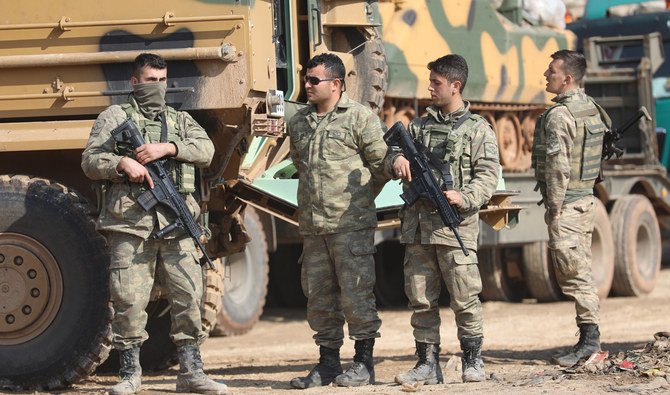
Thousands of Turkish soldiers, along with tanks and armor, have been deployed along the Syrian border over recent days.
However, any unilateral operation poses a significant risk with both parties still struggling to find a compromise over the Kurds: Washington supports the YPG and is against any Turkish military action in the area.
Orhan said that, after notifying Washington, Turkish armed forces could take possession of some settlements along the border avoiding any clashes with American forces whose numbers have already been cut and who are mostly settled in US bases in Syria.
“Some strategic hills, towns such as Tal Abyad and its southern towns with a high density of Arab population may become first targets of such an operation. Such a move will cut the geographic continuity between the settlements held by the YPG. It will also push Washington to revise its current negotiation position,”
he added.
However, considering the de-facto no-fly zone of the US over northeastern Syria, any Turkish operation in the region would not require aerial support as it would be conducted in nearby settlements within missile and artillery range, experts noted.
Dr. Nicholas Danforth, visiting senior fellow at the US German Marshall Fund think tank, said that negotiations between Turkey and the US had been hindered by the discrepancy between Turkey’s stated desire for a safe zone that will keep its border safe and its deeper strategic interest in occupying enough of the region to prevent the emergence of an autonomous Kurdish statelet.
“The deeper the incursion the deeper the ensuing rift between Ankara and Washington,” he told Arab News.
Some experts also argue that the defeat of the YPG by a Turkish operation may lead to the formation of a new Syrian Democratic Forces with non-YPG elements which could cooperate with Turkey, while suggestions for Ankara to cooperate with Syrian President Bashar Assad’s regime for any eventual offensive in northeastern Syria are also being discussed among prominent experts in Turkey.
“Ironically, so far, the US has proved more supportive of a safe zone than any other actors in the region, including Russia and Syria. Even if America left tomorrow, Ankara would face a choice between permanently occupying the region and turning it over to Damascus,” Danforth said.
“Both of these would forestall the creation of a PKK-dominated statelet, but not necessarily bring Ankara a lasting victory against the PKK.”


