

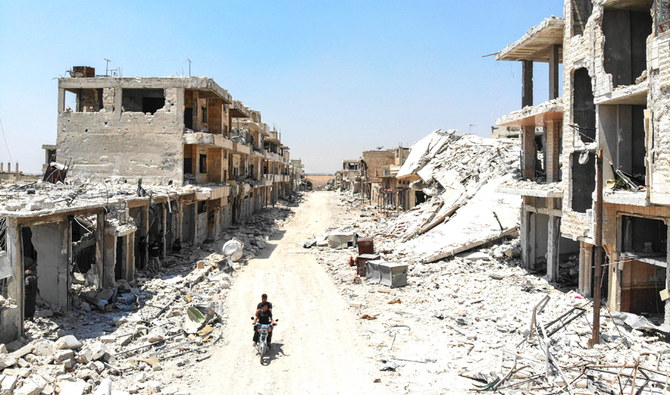

IDLIB: Shopkeepers and residents in Syria’s Idlib city have found relief from airstrikes but remain wary after a cease-fire halted fierce regime bombing against the opposition foothold.
For three months, an army offensive backed by Russia has killed at least 400 people in northwest Syria and uprooted more than 440,000, the UN says.
Since Damascus declared a cease-fire on Thursday night, its warplanes have not mounted airstrikes, though the combatants are still shelling each other.
Idlib lies in the last major chunk of territory opposition groups hold after facing defeat across much of Syria at the hands of Damascus with its allies Russia and Iran.
At the weekend, the streets of Idlib city buzzed with cars
and people. Some stopped by market stalls to look at clothes, while others lined up at kiosks to buy juice.
“Before, there was panic. Every time the warning sirens rang, the market became empty right away,” Mhamad Al-Omar, who sells cold drinks, told Reuters. “Now that there’s a bit of calm, there’s traffic today Praise God ... People are tired.”
Airstrikes have hit schools, hospitals, markets and bakeries in the latest assault, UN human rights chief Michelle Bachelet said last week. Damascus, which denies striking civilians in the eight-year-old war, says it has been responding to militant attacks.
“The cease-fire is good for everyone. But we don’t know what’s waiting for us,” said Munaf Daher, a college student in Idlib. “We hope it will be good and people will keep coming back to their homes, this is the biggest joy.”
Hasan Abdelallal, a local aid worker who was displaced from his city of Aleppo in 2016, said people had started returning after weeks of living in olive groves near the Turkish border.
“But we don’t know what will happen under the table,” he added.
NUMBER
400 - Syrians in the northwest were killed in just three months by a regime offensive backed by Russia that also uprooted more than 440,000.
Other residents also said they remained cautious after a series of truce deals or Russian-Turkish talks that have failed to end the fighting.
Under its deals with Moscow, Ankara has forces stationed on the ground in the Idlib region at a dozen military positions.
Opposition factions have agreed to the latest cease-fire while reserving the right to respond to attacks.
Syrian state media said on Thursday the cease-fire would depend on opposition fulfilling a Russian-Turkish deal that tried last year to create an Idlib buffer zone. The terms include fighters and heavy weapons leaving the zone.
The dominant force in Idlib is the Hayat Tahrir Al-Sham (HTS) — formerly the Nusra Front — though Turkey-backed opposition also operates there.
HTS has rejected conditions of the 2018 “de-escalation deal” such as relinquishing its weapons. Its leader Abu Mohammad Al-Jolani was cited on Saturday night as saying his fighters would not withdraw from that zone.
In recent years, the population of the northwest — which UN estimates put at 3 million — has ballooned with civilians and opposition fighters whose hometowns went back under state rule.
Ahmed Hmeid, who owns a vegetable shop, said the cease-fire would at least let people enjoy the upcoming Eid Al-Adha holiday.
“People had been scared of the bombing on the markets the most, the massacres,” he said. “Now there is some safety, one percent safety, people are coming out, seeing each other.”


