Syrian regime gains ground in opposition bastion

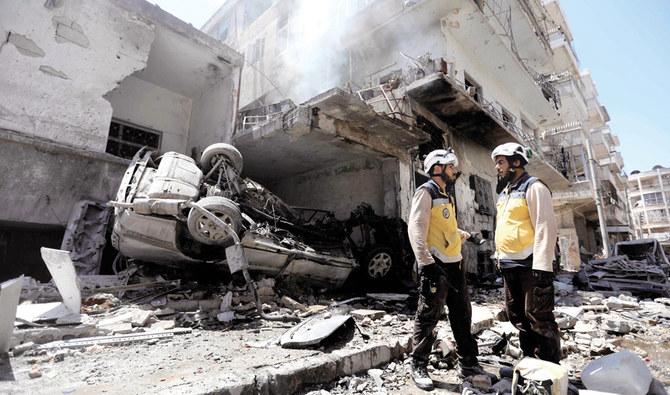
Members of the Syrian Civil Defense, or White Helmets, gather at the site of a reported airstrike on the town of Ariha, in the south of Syria's Idlib province on Wednesday. (AFP)
Updated 01 August 2019
Follow

Syrian regime gains ground in opposition bastion

  • Damascus vows to capture Idlib if ‘Russia does not reach a diplomatic solution with pro-opposition Turkey’

BEIRUT: Syrian regime forces have gained some ground in the country’s last opposition bastion during a Russian-backed offensive that aid agencies warn is growing bloodier.

The wave of violence in northwest Syria since late April has killed more than 400 civilians and forced more than 440,000 to flee toward the Turkish border, the UN said last week.

Syria’s army seized a handful of villages, fields and hills in the Hama countryside in the past two days, a military media unit for Lebanon’s Hezbollah, which fights alongside Damascus, said on Thursday.

The region — including Idlib province and parts of nearby Hama — is part of the last major stronghold of armed opposition to Syria’s Bashar Assad, who has vowed to reclaim all of Syria, though his side has not made major advances in this latest assault.

In rare public comments, the Syrian army’s political chief pledged to seize Idlib if Russia, Assad’s key ally, does not reach a diplomatic solution with Turkey, long an opposition backer.

Airstrikes by the Syrian regime and its allies have hit schools, hospitals, markets and bakeries, UN human rights chief Michelle Bachelet said last week. She denounced the “apparent international indifference” to the mounting civilian casualties.

Bombing has escalated in the last four weeks, killing and wounding more people than at any time this year, the nonprofit Doctors Without Borders said on Wednesday night.

At least 33 children were killed since the end of June, more than during all of 2018, the charity Save the Children said last week. “Bodies, some torn into pieces or burned beyond recognition, are still being recovered from the rubble,” it said.

Maj. Gen. Hasan Hasan, head of the Syrian Army’s political bureau, said on Thursday that the military path to eliminate “terrorism” in the north is ongoing.

He told the pro-regime Al-Watan newspaper that it would be good if Moscow or Tehran could find a solution through talks with Ankara, which has Turkish forces stationed in the northwest.

“But at the same time, when matters reach a dead end, then the Syria Arab Army which cleansed all these vast areas ... will not stop at all, neither at Idlib nor at any area,” he said.

The dominant force in Idlib is Tahrir Al-Sham, formerly the Nusra Front, and factions backed by Turkey also have a presence in the region.

The regime has described its operations as responses to militant violations and has denied targeting civilians during the eight-year war.

Idlib falls within a “de-escalation zone” agreed on last year.


Iraq says it will prosecute Daesh detainees sent from Syria

Updated 8 sec ago
Follow

Iraq says it will prosecute Daesh detainees sent from Syria

  • Iraq government says transfer was pre-emptive step to protect national security
  • Prosoners have been held for years in prisons and camps guarded by the Kurdish-led SDF
BAGHDAD: Iraq’s Supreme Judicial Council said on Thursday it would begin ​legal proceedings against Daesh detainees transferred from Syria, after the rapid collapse of Kurdish-led forces in northeast Syria triggered concerns over prison security.
More than 10,000 members of the ultra-hard-line militant group have been held for years in about a dozen prisons and detention camps guarded by the Kurdish-led Syrian Democratic Forces (SDF) in Syria’s northeast.
The US military said on Tuesday its forces had transferred 150 Daesh detainees from Syria to Iraq and that the operation could eventually see up to 7,000 detainees moved out of Syria.
It cited concerns over security at the prisons, which also hold thousands more women and children with ties to the militant group, after military setbacks ‌suffered by the ‌SDF.
A US official told Reuters on Tuesday that about 200 low-level ‌Daesh ⁠fighters ​escaped from ‌Syria’s Shaddadi prison, although Syrian government forces had recaptured many of them.
Iraqi officials said Prime Minister Mohammed Shia Al-Sudani mentioned the transfer of Daesh prisoners to Iraq in a phone call with Syrian President Ahmad Al-Sharaa on Tuesday, adding that the transfers went ahead following a formal request by the Iraqi government to Syrian authorities.
Iraqi government spokesperson Basim Al-Awadi said the transfer was “a pre-emptive step to protect Iraq’s national security,” adding that Baghdad could not delay action given the rapid pace of security and political developments in Syria.
Daesh emerged in Iraq and Syria, and at the ⁠height of its power from 2014-2017 held swathes of the two countries. The group was defeated after a military campaign by ‌a US-led coalition.
An Iraqi military spokesperson confirmed that Iraq had received ‍a first batch of 150 Daesh detainees, including ‍Iraqis and foreigners, and said the number of future transfers would depend on security and field assessments. The ‍spokesperson described the detainees as senior figures within the group.
In a statement, the Supreme Judicial Council said Iraqi courts would take “due legal measures” against the detainees once they are handed over and placed in specialized correctional facilities, citing the Iraqi constitution and criminal laws.
“All suspects, regardless of their nationalities or positions within the terrorist ​organization, are subject exclusively to the authority of the Iraqi judiciary,” the statement said.
Iraqi officials say under the legal measures, Daesh detainees will be separated, with senior figures including foreign nationals to ⁠be held at a high-security detention facility near Baghdad airport that was previously used by US forces.
Two Iraqi legal sources said the Daesh detainees sent from Syria include a mix of nationalities, with Iraqis making up the largest group, alongside Arab fighters from other countries as well as European and other ‌Western nationals.
The sources said the detainees include nationals of Britain, Germany, France, Belgium and Sweden, and other European Union countries, and will be prosecuted under Iraqi jurisdiction.