UNITED NATIONS: Leaders of the Daesh extremist group are aiming to consolidate and create conditions for an “eventual resurgence in its Iraqi and Syrian heartlands,” UN experts said in a new report.
The panel of experts said in a report to the Security Council this week that the process is more advanced in Iraq, where Daesh leader Abu Bakr Al-Baghdadi and most of the militant group’s leadership are now based following the fall of the so-called “caliphate” that he declared in the two neighboring countries.
In Syria, where the last Daesh stronghold was toppled in March, the Daesh covert network is spreading and sleeper cells are being established at the provincial level, mirroring what has been happening in Iraq since 2017, the report said.
As for Al-Qaeda, the panel said the extremist group “remains resilient” though its immediate global threat is not clear, with its leader, Ayman Al-Zawahiri, “reported to be in poor health and doubts as to how the group will manage the succession.”
The report said “the most striking international developments” during the first six months of 2019 include “the growing ambition and reach of terrorist groups in the Sahel and West Africa,” where fighters from Daesh and Al-Qaeda are collaborating to undermine fragile countries. “The number of regional states threatened with contagion from insurgencies in the Sahel and Nigeria has increased,” said the experts, who monitor UN sanctions against both extremist groups.
In a video message in late April, Al-Baghdadi said Daesh “still aspires to have global relevance and expects to achieve this by continuing to carry out international attacks,” the panel said.
The experts said Daesh is currently dependent on attacks that it inspires like the Easter Sunday church bombings in Sri Lanka. Al-Baghdadi mentioned the bombings but the panel said Daesh leaders “clearly knew nothing” in advance.
Whether or not the Sri Lankan attacks were motivated by a previous attack on Muslims at mosques in Christchurch, New Zealand, in March, “the narrative of interfaith conflict is concerning,” the panel added.
Looking ahead, the experts said the Daesh group “will reinvest in the capacity to direct and facilitate complex international attacks when it has the secure space and time to do so.” The panel added, “The current abatement of such attacks, therefore, may not last long, possibly not even until the end of 2019.”
The panel said up to 30,000 foreign fighters and others who traveled to the so-called “caliphate” that Daesh established in parts of Iraq and Syria may still be alive, “and their future prospects will be of international concern for the foreseeable future.”
Outside Syria and Iraq, the experts said, Daesh and Al-Qaeda are contending “for dominance and international relevance.” They said that in Afghanistan, concerns remain about short-term and long-term threats posed by groups affiliated with both Daesh and Al-Qaeda as well as “foreign terrorist fighters who have established themselves on Afghan territory.”
Here are the experts’ assessments of threats posed by Daesh and Al-Qaeda in other regions:
ARABIAN PENINSULA — Regional member states say the temporary strategy of Al-Qaeda in the Arabian Peninsula is to prioritize the fight against the Daesh affiliate in Yemen to maintain its dominant position, rather than fight Houthi Shiite rebels who are in a war with the government, which is backed by a Saudi-led coalition. An unidentified country reported that Al-Qaeda has been unable to establish itself in Saudi Arabia.
AFRICA — Daesh activity in southern Libya gained momentum as a result of preoccupation with fighting around the capital of Tripoli, and the extremist group is assessed to have substantial financial resources seized when it controlled the city of Sirte. A sharp rise in violence and recruitment efforts in West Africa, motivated by Daesh or Al-Qaeda affiliates, has been exacerbated “by porous borders and authorities ill-equipped to confront the growing threat.” In Somalia, Al-Qaeda affiliate Al-Shabab has shifted from high-impact attacks to sustained, frequent and eventually daily multiple attacks.
EUROPE — Online propaganda encouraging low-tech, Daesh-inspired attacks is still available but member states report a reduced incidence of successful attacks. Nonetheless, European countries “assess that the risk remains high.”
ASIA — Countries in central Asia see the greatest threat from their nationals returning from Iraq and Syria, and to a lesser extent from Afghanistan. In Southeast Asia, a series of successful and thwarted attacks attributed to Daesh-affiliated groups “underscores the persistent nature of the threat in the region.”

UN experts: Daesh aims for resurgence in Iraq, Syria
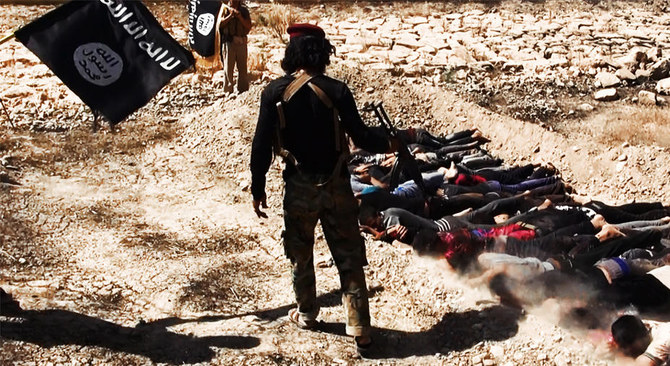
- The process is more advanced in Iraq, where Daesh leader Al-Baghdadi and most of the militant group’s leadership are now based
Israel says it has launched ‘broad wave’ of strikes on Iran, as Tehran widens its response across the region
- US military says 17 Iranian navy ships destroyed, struck nearly 2,000 targets in Iran thus far
- US and Israeli attacks have killed 787 people in Iran: Iranian Red Crescent
JERUSALEM/DUBAI/TEHRAN: Israel early Wednesday launched new attacks on Iran as the US military said it has hit nearly 2,000 targets inside the Islamic republic, which tried to impose a cost by expanding a missile and drone barrage across the region.
With global energy prices on the rise, President Donald Trump said the US Navy was ready to escort oil tankers through the Strait of Hormuz, the vital chokepoint into the Gulf that Iran has threatened to seal off.
Israel’s military said it launched a “broad wave of strikes” after midnight across Iran, which in the hours before had launched three separate missile barrages at Israel, causing mild injuries to a woman in Tel Aviv.
The US military has destroyed 17 Iranian ships, including a submarine, and struck nearly 2,000 targets in Iran, the commander of the US Central Command said on Tuesday.
“Today, there is not a single Iranian ship underway in the Arabian Gulf, Strait of Hormuz, or Gulf of Oman,” US Central Command’s Brad Cooper said in a video posted to X.
Cooper said the US military has “severely degraded Iran’s air defenses” and taken out hundreds of ballistic missiles, launchers and drones.
The video showed missiles and jets launching from US ships, and targets exploding on the ground.
Cooper noted that Iran has launched over 500 ballistic missiles and more than 2,000 drones in retaliation.
But he said the US is “hunting” Iran’s last remaining mobile ballistic missile launchers to eliminate their “lingering launch capability.”
Cooper said the operation has involved more than 50,000 troops, 200 fighter jets, two aircraft carriers and bombers, and “more capability is on the way.”
“We’ve just begun,” Cooper said, adding that the US military is targeting “all the things that can shoot at us.”
“These forces bring a massive amount of firepower, representing the largest buildup by the US in the Middle East in a generation,” he said in the video message, describing the first day’s barrage as bigger than the so-called “shock and awe” against Saddam Hussein’s Iraq in 2003.
Iran‘s response
The US and Israeli attacks have killed 787 people in Iran, according to the Iranian Red Crescent, a toll that could not be independently confirmed.
Iran vowed to inflict a heavy price in retaliation. Drones struck adjacent the US consulate in Dubai, starting a fire but inflicting no casualties, and against the US military base at Al-Udeid in Qatar.
The attacks came a day after strikes on the US embassies in Riyadh and Kuwait City and on a US air base in Bahrain.
“We are saying to the enemy that if it decides to hit our main centers, we will hit all economic centers in the region,” Islamic Revolutionary Guard General Ebrahim Jabbari said.
Iranian attacks have killed at least nine people and wounded dozens in the Gulf region, according to various reports quoting local authorities.
Among the latest death was an 11-year-old girl who was killed after shrapnel fell in a residential area in Kuwait City, health authorities said Wednesday.
The Kuwait army said in a statement the shrapnel fell over a house and left casualties while forces were intercepting “several hostile aerial targets” over the country.
The Health Ministry said in a separate statement that the child died of her wounds at the hospital.
The child’s mother and three other relatives were injured and being treated at the hospital, it said.
Vessel hit in Gulf of Oman
A vessel was hit by a projectile early Wednesday in the Gulf of Oman off the United Arab Emirates, an agency of the UK military said.
There were no reported casualties.
The United Kingdom Maritime Trade Operations Center said the vessel was struck 8 miles east of Fujairah, one of the UAE’s seven emirates.
The attack damaged the vessel’s steel plating.
No fire or water intake was reported, it said.
Iran hits US embassies
The US State Department said Tuesday it’s preparing military and charter flights for Americans who want to leave the Middle East. Several other countries also arranged evacuation flights for their citizens.
An attack from two drones on the US Embassy in Riyadh caused a “limited fire,” according to the Saudi Arabian Defense Ministry, and the embassy urged Americans to avoid the compound.
An Iranian drone struck a parking lot outside the US consulate in Dubai, sparking a small fire, Secretary of State Marco Rubio said in Washington. He said all personnel were accounted for.
The United Arab Emirates said it has intercepted the vast majority of more than 1,000 Iranian missile and drone attacks against it.
US embassies in Saudi Arabia, Kuwait and Lebanon said they were closed to the public.
The US State Department ordered the evacuation of non-emergency personnel and family in Kuwait, Bahrain, Iraq, Qatar, Jordan and the United Arab Emirates. And US citizens were urged to leave more than a dozen Middle Eastern countries, though many were stranded because of airspace closures.
The US military has confirmed six deaths of American service members.
Four of the American soldiers killed were identified as Capt. Cody A. Khork, 35, of Winter Haven, Florida; Sgt. 1st Class Noah L. Tietjens, 42, of Bellevue, Nebraska; Sgt. 1st Class Nicole M. Amor, 39, of White Bear Lake, Minnesota; and Sgt, Declan J. Coady, 20, of West Des Moines, lowa, who received a posthumous promotion in rank. They were assigned to the Iowa-based 103rd Sustainment Command.
Ghost town
In Tehran, residents who have not fled remained shut away in their homes for fear of the US-Israeli bombardment.
The Iranian capital is normally home to around 10 million people, but in recent days “there are so few people that you’d think no one ever lived here,” said Samireh, a 33-year-old nurse.
Authorities had previously urged people to leave the city, and police officers, armed security forces and armored vehicles have been stationed at main junctions, carrying out random checks on vehicles.
In the more upmarket north of Tehran, the meowing of cats and chirping of birds replaced the usual din of traffic jams.
Iranian authorities said a strike on a school in the city of Minab on the first day of the war killed more than 150 people.
Drone downed near Baghdad airport
In Baghdad, a drone was shot down on Wednesday near Baghdad’s international airport, a day after a similar attack on the facility, two security sources told AFP.
“A drone was downed near Baghdad airport, with no casualties or material damage reported,” an Iraqi security source said. Another security source in Baghdad confirmed the incident.
The airport includes a military base that hosts a US diplomatic facility and previously housed US-led coalition troops.


