ISLAMABAD: Funeral prayers for the crew members killed in the military plane crash were held in Rawalpindi on Tuesday.
Army chief Gen. Qamar Javed Bajwa, senior military officers and family members of the five-member crew killed in the accident were in the attendance, the military’s media wing said in a statement.
The small Pakistani military aircraft was on a training flight when it crashed in a built-up area in the garrison city of Rawalpindi in wee hours of Tuesday morning.
All five crew members aboard were killed along with 12 civilians while another 12 were injured, a statement by the army confirmed.
President Arif Alvi and Prime Minister Imran Khan expressed deep grief and sorrow over the loss of precious lives in the unfortunate incident in separate statements.
A statement by the President’s office said that Alvi expressed “grief and sorrow over the loss of precious lives in Rawalpindi aircraft crash.” He condoled with the bereaved families and prayed for early recovery of the injured, the statement added.
Prime Minister Imran Khan also lamented the loss of precious lives and commiserated with the bereaved families. The premier also prayed for the recovery of those injured in the incident, a statement by the Prime Minister’s Office read.
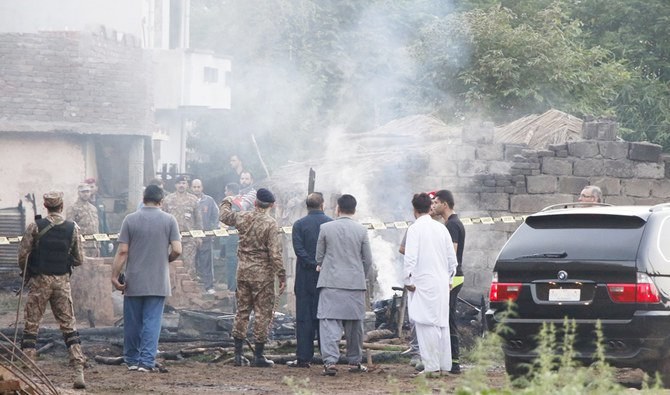
The trainer plane burst into flames after hitting the residential compound in Mora Kalu village on the outskirts of Rawalpindi just before dawn, reported the Associated Press.
After rescue efforts ended, troops and police cordoned off the residential area to search for plane debris and investigate the crash site.
Rescue officials said there were no survivors on the plane and that 13 civilians were killed on the ground. The army said in a statement that five crew members, including two pilots, died in the crash.
Farooq Butt, an official at the state-run emergency service, said 15 people were also injured in the crash. There were concerns the death toll could rise further since some of those injured were in critical condition.
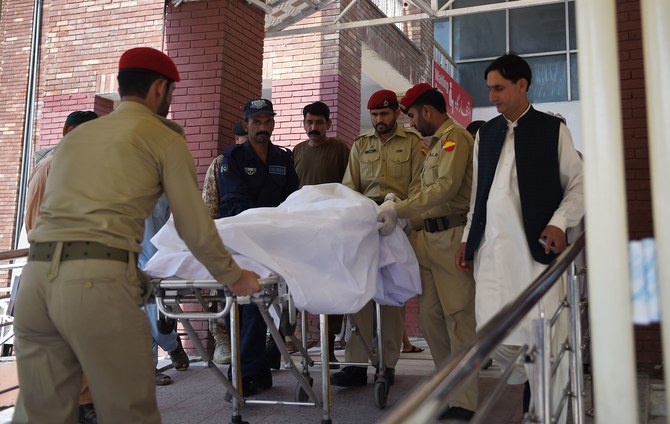
“We have moved all the bodies and injured persons to hospitals,” Butt told The AP. “Most of the victims received burn injuries.”
He added that there were children among the dead.
Residents said they woke up when they heard an explosion and saw debris of a burning plane near their homes. Army helicopters were seen hovering over the crash site later.
“My sister, her husband and their three children were killed when the plane crashed into their home,” said Mohammad Mustafa, as he sobbed near his sister’s badly damaged home. He said rescuers and troops quickly reached the area after the crash.
Several men and women who lost their relatives in the crash were seen wailing and crying as rescuers put charred bodies of the victims into ambulances. Footage on social media showed the plane was flying very low before it quickly went down.
Abdul Rehman, a medical doctor, said at least three homes were badly damaged and the pilots’ bodies had been retrieved.
“According to our latest information, a total of 18 people were killed in the plane crash. They include five crew members and 13 civilians who were killed when the plane crashed into homes and quickly caught fire,” he said.
Pakistan’s President Arif Alvi and Prime Minister Imran Khan in separate statements expressed their condolences.
The military said the army aircraft was on a routine training flight when it crashed, but had no information on the possible cause. An investigation was underway.
Pakistan’s military has been on high alert since February, when India launched an airstrike inside Pakistan to target Pakistan-based militants behind the suicide bombing that killed 40 Indian troops in Indian-administered Kashmir.
Pakistan at the time retaliated and said it shot down two Indian air force planes. One Indian pilot was captured and later released amid signs of easing tensions.
In 2010, a Pakistani passenger jet crashed into the hills surrounding the capital, Islamabad, in poor weather, killing all 152 people on board.


![]()
![]()
![]()
![]()

Funeral prayers for crew killed in military plane crash offered in Rawalpindi


Funeral prayers for crew killed in military plane crash offered in Rawalpindi
- 17 people were killed and 12 others injured in a military plane crash on Tuesday
- The trainer aircraft crashed in a built-up area in Rawalpindi city
Latest updates




© 2026 SAUDI RESEARCH & PUBLISHING COMPANY, All Rights Reserved And subject to Terms of Use Agreement.