

Smoky tea baked in clay: tandoori chai heats up Pakistan

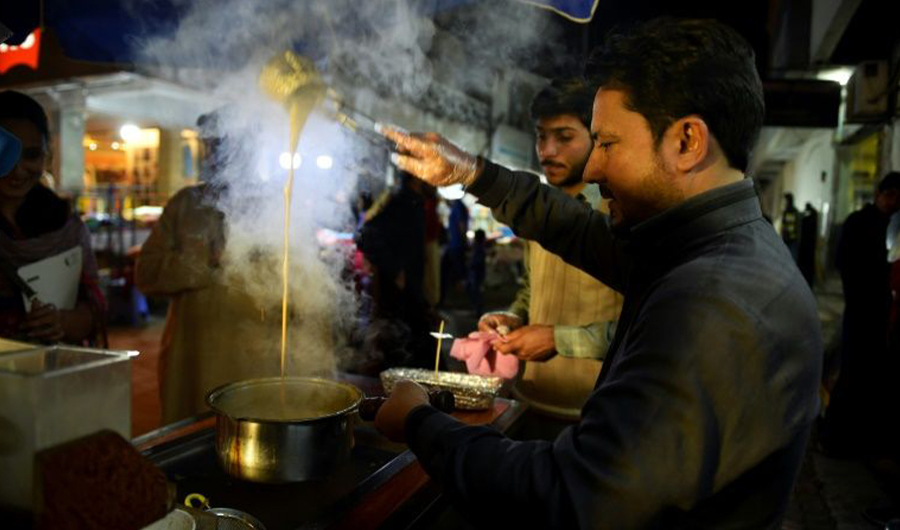
It's a cuppa like no other. Every evening in Islamabad a crowd arrives at Sanaullah's street stall to taste his "tandoori chai" -- milk tea served in terracotta mugs, still hot from his traditional oven (AFP)
Updated 29 July 2019
Follow

Smoky tea baked in clay: tandoori chai heats up Pakistan

  • Classic milk tea -- thick, strong, and generously sweet -- dominates all strata of society
  • Pakistan is one of the top tea consumers globally

ISLAMABAD: It’s a cuppa like no other. Every evening in Islamabad a crowd arrives at Sanaullah’s street stall to taste his “tandoori chai” — milk tea served in terracotta mugs, still hot from his traditional oven.
The old-fashioned cups are placed directly inside the tandoor, where they are baked at high temperatures.
The tea, prepared separately, is then poured in to the cups, where it starts to boil on hitting the hot clay.
In Pakistan, where the classic milk tea — thick, strong, and generously sweet — dominates all strata of society, the particular alchemy of tandoori chai seduces patrons intrigued by its traditional roots and distinct earthy taste.
The tandoor is ubiquitous in South Asia, most commonly used to bake bread.


Pakistan is one of the top tea consumers globally according to research firm Euromonitor International (AFP)

But the concept of making tea this way, is the main draw for many, explains Sanaullah, the jovial owner of a trendy shop located in an upmarket area of the Pakistani capital.
“The process of making it is really very interesting, which makes people like it,” he said, adding that the tea also has a smoky flavour which attracts many.
Sitting among the customers on a low rush stool, Muhammad Ishaq Khawar is a frequent customer.
“There is a different kind of atmosphere, especially the way in which we are served tea. It was a very old system which goes back to the old days when the terracotta pots were used,” he explains.
It may seem like a niche product but the drink has become so popular the Tandoori Chai Company cafes, which recently launched in Lahore, has expanded to a second branch.
And while coffee culture has caught on in Pakistan’s main cities with big name chains and local cafes a hit urban youths, tea, regardless of how it is prepared, is nonetheless an essential component of the daily menu.
The country is one of the top tea consumers globally according to research firm Euromonitor International, while a recent study by Gallup found 73 percent of Pakistani tea drinkers have at least two or more cups a day.
“Not only in Pakistan, but in the entire subcontinent, it has been mixed in our blood,” says Mohammad Asim Khan, a customer at a small eatery in Islamabad.
He adds: “Your physical fatigue will go away by taking tea and you get fresh.”


Pakistan’s OGDC ramps up unconventional gas plans

Updated 4 sec ago
Follow

Pakistan’s OGDC ramps up unconventional gas plans

  • Pakistan has long been viewed as having potential in tight and shale gas but commercial output has yet to be proved
  • OGDC says has tripled tight-gas study area to 4,500 square km after new seismic, reservoir analysis indicates potential

ISLAMABAD: Pakistan’s state-run Oil & Gas Development Company is planning a major expansion of unconventional gas developments from early next year, aiming to boost production and reduce reliance on imported liquefied natural gas.

Pakistan has long been viewed as having potential in both tight and shale gas, which are trapped in rock and can only be released with specialized drilling, but commercial output has yet to be proved.

Managing Director Ahmed Lak told Reuters that OGDC had tripled its tight-gas study area to 4,500 square kilometers (1,737 square miles) after new seismic and reservoir analysis indicated larger potential. Phase two of a technical evaluation will finish by end-January, followed by full development plans.

The renewed push comes after US President Donald Trump said Pakistan held “massive” oil reserves in July, a statement analysts said lacked credible geological evidence, but which prompted Islamabad to underscore that it is pursuing its own efforts to unlock unconventional resources.

“We started with 85 wells, but the footprint has expanded massively,” Lak said, adding that OGDC’s next five-year plan would look “drastically different.”

Early results point to a “significant” resource across parts of Sindh and Balochistan, where multiple reservoirs show tight-gas characteristics, he said.

SHALE PILOT RAMPS UP

OGDC is also fast-tracking its shale program, shifting from a single test well to a five- to six-well plan in 2026–27, with expected flows of 3–4 million standard cubic feet per day (mmcfd) per well.

If successful, the development could scale to hundreds or even more than 1,000 wells, Lak said.

He said shale alone could eventually add 600 mmcfd to 1 billion standard cubic feet per day of incremental supply, though partners would be needed if the pilot proves viable.

The company is open to partners “on a reciprocal basis,” potentially exchanging acreage abroad for participation in Pakistan, he said.

A 2015 US Energy Information Administration study estimated Pakistan had 9.1 billion barrels of technically recoverable shale oil, the largest such resource outside China and the United States.

A 2022 assessment found parts of the Indus Basin geologically comparable to North American shale plays, though analysts say commercial viability still hinges on better geomechanical data, expanded fracking capacity and water availability.

OGDC plans to begin drilling a deep-water offshore well in the Indus Basin, known as the Deepal prospect, in the fourth quarter of 2026, Lak said. In October, Turkiye’s TPAO with PPL and its consortium partners, including OGDC, were awarded a block for offshore exploration.

A combination of weak gas demand, rising solar uptake and a rigid LNG import schedule has created a surplus of gas that forced OGDC to curb output and pushed Pakistan to divert cargoes from Italy’s ENI and seek revised terms with Qatar.