

’Shop window’ Caracas angers rest of Venezuela

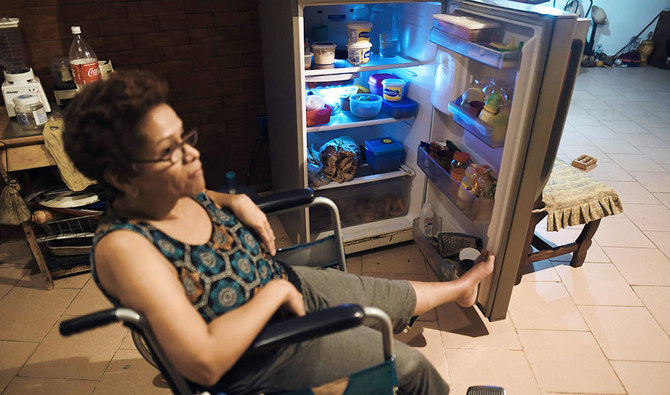
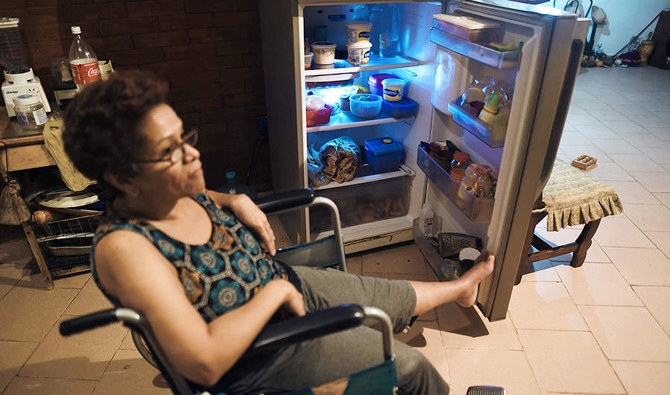
A resident, who remains in a wheelchair due to a broken leg, shows groceries and vegetables in her fridge, in Petare slum, Caracas on July 25, 2019. (AFP)
Updated 28 July 2019
Follow

’Shop window’ Caracas angers rest of Venezuela

  • Fuel is heavily subsidized in Venezuela to keep the price absurdly low

CARACAS/MARACAIBO: While authorities concentrate on presenting an image of normality in Caracas, Venezuelans elsewhere in the country who are suffering from severe shortages amid a political and economic crisis are livid.
The capital is a “shop window” for ambassadors and foreigners as well as a “propaganda operation,” said Andres Canizalez, an expert in political communication.
It’s an outlook shared by many Venezuelans, who see a harsh reality play out in places like the grocery store and gas station.
Gendry Parra fumed recently as he watched a video of a man in Caracas taking just five minutes to fill his vehicle with fuel.
The 44-year-old shopkeeper had spent three days queuing for fuel in Maracaibo, a city in the country’s far west close to the border with Colombia.
“It disgusts me that we’re in the same country and it’s one thing there and another here,” he said.
Parra doesn’t have running water, fuel or cash, and blackouts can last days in his hometown of Maracaibo even though it was the first city in Venezuela to have electricity.
It’s also the capital of Zulia state, which used to be an important source of Venezuelan oil and gas.
Alberto Arriechi, the man pumping gas in the video, said he recognizes the privilege he has over millions of Venezuelans who live in the country’s interior and are hit harder by Venezuela’s declining oil production and lack of cash for imports.
Like other people in Caracas, the 29-year-old engineer does not suffer as severely from electricity rationing carried out by the government ever since a massive blackout in March.
The latest rationing came Monday: Caracas was without power for seven hours, other parts of the country suffered for two days.
When it comes to fuel, customers in places like Maracaibo complain that some unscrupulous gas stations illegally ask for payment in dollars.
Fuel is heavily subsidized in Venezuela to keep the price absurdly low. Arriechi bought his for a handful of bolivars.

On the shores of Lake Maracaibo, Johannis Semprun, a victim of the country’s economic crisis, sighs.
“Right now we have electricity. And I mean ‘right now.’ Don’t be surprised if it goes in a moment,” said the 37-year-old, who has six children and a handicapped wife. Due to financial troubles, he had to take his children out of school and they now eat at an evangelical church.
“Everything has got worse,” he said.
Maracaibo was once booming thanks to oil but Venezuela’s production has plummeted from 3.2 million barrels a day 10 years ago to just one million.
The disparities between life in Caracas and elsewhere have left some feeling envious.
Warin Guerrero, a livestock industry leader in the western state of Barinas, has implored cattle ranchers not to send food to the capital.
“Over there, they don’t have any problems ... we’re treated like second class citizens,” he said.
While Caracas’ special status has historical roots in centralization, nowadays it’s about government bias, said Canizalez, the political communication expert.
“There’s a belief that if there were a social disruption in Caracas, it would spread throughout the rest of the country,” he said.
“If Caracas is kept relatively well, if it doesn’t rebel, everything else will work.”
The apparent normality of Caracas includes a greater choice of products. There’s also a proliferation of imported goods, with prices in dollars.
But few can afford them as salaries and savings have been rendered almost worthless by hyperinflation which the International Monetary Fund says will reach 10 million percent this year.
At the Las Pulgas market in Maracaibo, it’s normal for poor people to buy bones and entrails to eat.
Cleaning lady Josefina Galindo, 49, feels “outrage, impotence” when hearing the price of coffee in a store: $15 for 250 grams. She earns only $9 a month.
She hasn’t bought meat in a year. On her way home she goes through a street market.
“All I do is look at meat and the prices,” she says.


Uganda partially restores internet after president wins 7th term

Supporters of President Yoweri Museveni celebrate his winning the polls. (AFP)
Updated 58 min 18 sec ago
Follow

Uganda partially restores internet after president wins 7th term

  • “The internet shutdown implemented two days before the elections limited access to information, freedom ‌of association, curtailed economic activities ... it also created suspicion and mistrust on the ‍electoral process,” the team said in ‍their report

KAMPALA: Ugandan authorities have partially restored internet services late after 81-year-old President Yoweri Museveni won a seventh term to extend his rule into a fifth decade with a landslide ​victory rejected by the opposition.
Users reported being able to reconnect to the internet and some internet service providers sent out a message to customers saying the regulator had ordered them to restore services excluding social media.
“We have restored internet so that businesses that rely on internet can resume work,” David Birungi, spokesperson for Airtel Uganda, one of the country’s biggest telecom companies said. He added that the state communications regulator had ordered that social media remain shut down.
The state-run Uganda Communications Commission said it had cut off internet to ‌curb “misinformation, disinformation, ‌electoral fraud and related risks.” The opposition, however, criticized the move saying ‌it was ​to ‌cement control over the electoral process and guarantee a win for the incumbent.
The electoral body in the East African country on Saturday declared Museveni the winner of Thursday’s poll with 71.6 percent of the vote, while his rival pop star-turned-politician Bobi Wine was credited with 24 percent of the vote.
A joint report from an election observer team from the African Union and other regional blocs criticized the involvement of the military in the election and the authorities’ decision to cut off internet.
“The internet shutdown implemented two days before the elections limited access to information, freedom ‌of association, curtailed economic activities ... it also created suspicion and mistrust on the ‍electoral process,” the team said in ‍their report.

In power since 1986 and currently Africa’s third longest-ruling head of state, ‍Museveni’s latest win means he will have been in power for nearly half a century when his new term ends in 2031.

He is widely thought to be preparing his son, Muhoozi Kainerugaba, to take over from him. Kainerugaba is currently head of the military and has expressed presidential ambitions.
Wine, who was taking on ​Museveni for a second time, has rejected the results of the latest vote and alleged mass fraud during the election.
Scattered opposition protests broke out late on Saturday after results were announced, according to a witness and police.
In Magere, a suburb in Kampala’s north where Wine lives, a group of youths burned tires and erected barricades in the road prompting police to respond with tear gas.
Police spokesperson Racheal Kawala said the protests had been quashed and that arrests were made but said the number of those detained would be released later.
Wine’s whereabouts were unknown early on Sunday after he said in a post on X he had escaped a raid by the military on his home. People close to him said he remained at an undisclosed location in Uganda. Wine was briefly held under house arrest following the previous election in 2021.
Wine has said hundreds of his supporters were detained during the months leading up ‌to the vote and that others have been tortured.
Government officials have denied those allegations and say those who have been detained have violated the law and will be put through due process.