

ECP confirms independent candidates won maximum seats in tribal areas’ first provincial election

1 / 2
A security personnel searches tribesmen as they line up outside a polling station for the first provincial elections in Jamrud on July 20, 2019. (AFP)
2 / 2
Women pose for a group photo after casting their vote in the first-ever provincial assembly election in Khyber tribal district on Saturday July 20, 2019 (Courtesy PTI Khyber District)
Updated 22 July 2019
Follow

ECP confirms independent candidates won maximum seats in tribal areas’ first provincial election

  • Free and Fair Election Network says turnout was lower than expected
  • Soldiers were deployed in and around polling stations as people went out to vote

PESHAWAR: The Election Commission of Pakistan on Sunday announced results of the first-ever provincial elections in Pakistan’s seven previously lawless tribal regions bordering Afghanistan, confirming that independent candidates had won six out of 16 general seats.
In all, 285 candidates, which included 202 independents, contested the election, with Prime Minister Imran Khan’s Pakistan Tehreek-e-Insaf (PTI) party winning five seats, Jamiat Ulema-i-Islam-Fazl (JUI-F) securing three seats while Jamaat-e-Islami (JI) and Awami National Party (ANP) getting one seat each.
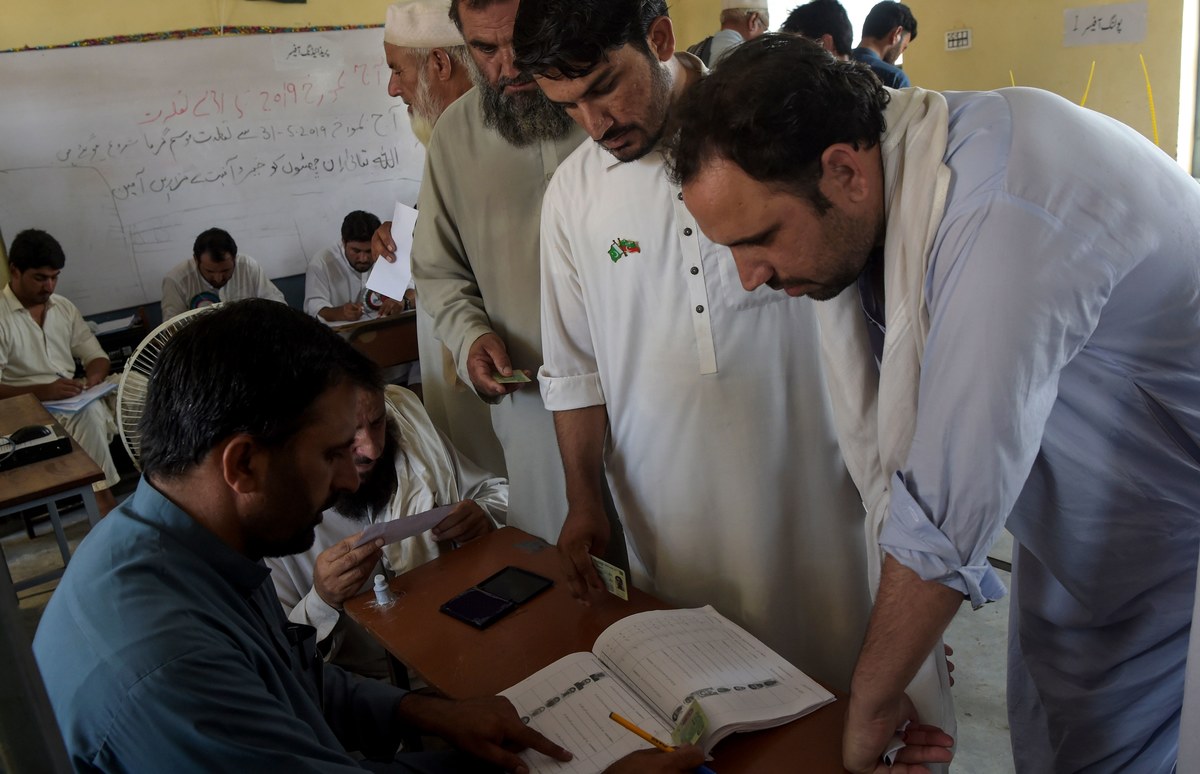


Tribesmen interact with an election official in a polling station for the first provincial elections in Jamrud, a town of the Khyber Pakhtunkhwa province on July 20, 2019. (AFP)

According to a preliminary report of the Free and Fair Election Network (FAFEN), a conglomerate of more than 50 domestic civil society organizations, nearly 27.6 percent of the registered voters in seven tribal districts voted in the electoral contest.
“However, these elections did not yield a turnout that was expected, which remained lower by 6.3 percent in comparison to the turnout for the National Assembly seats on July 25 last year,” the report added.
FAFEN further noted that “almost 20 percent of women voters turned out to vote in this election as compared to 23.8 percent on July 25, 2018.”
The election observation network also informed it had not received “any report on bar on women’s voting,” though it maintained there could be “further elaborations on this matter in the detailed report based on the observation of more than 1,600 polling stations and their result forms.”
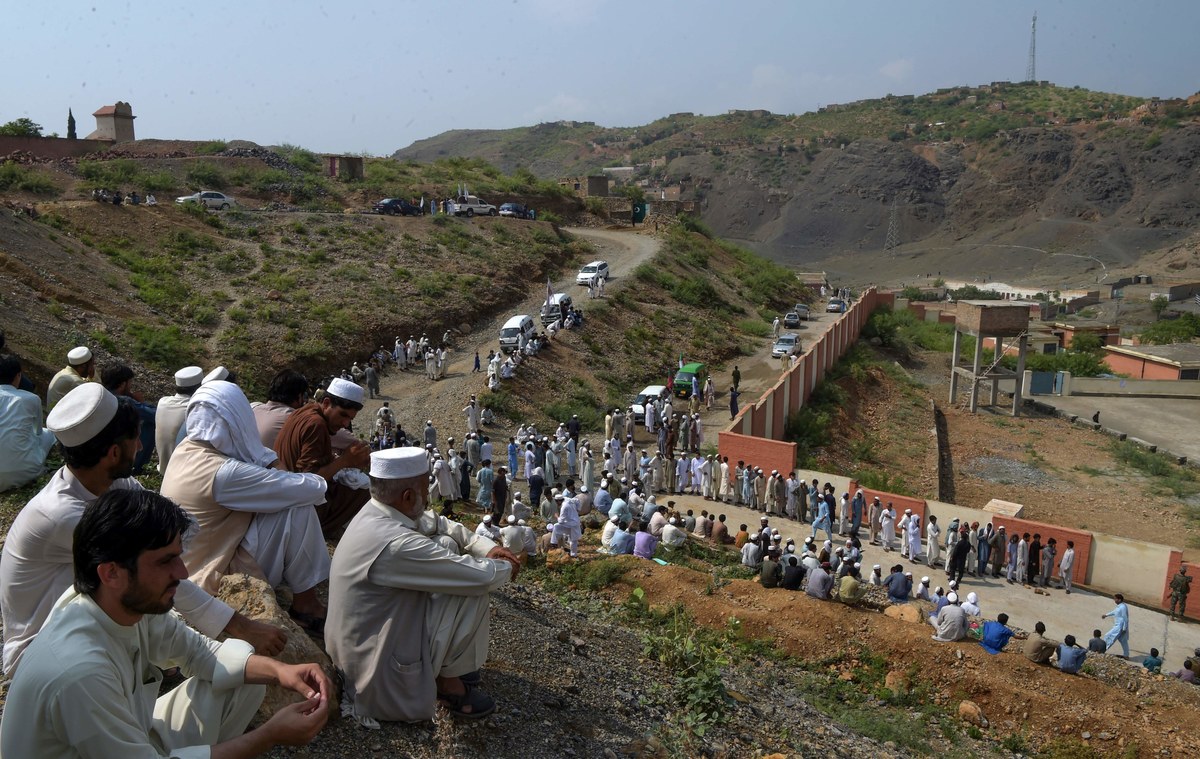


Tribesmen line up to cast their vote outside a polling station for the first provincial elections in Jamrud, a town of the Khyber Pakhtunkhwa province on July 20, 2019. Pakistan's tribal areas held their first ever provincial elections on July 20 amid high security, a key step bringing the northwestern region into the political mainstream after years of turmoil fuelled by militancy. (AFP)

Polling in Pakistan’s tribal districts concluded without any major reported incident of violence, with tens of thousands of troops and special unit police patrolling the province on Saturday. Last May, Pakistan’s parliament voted to merge the seven tribal districts – North Waziristan, South Waziristan, Kurram, Mohmand, Khyber, Bajur and Orkazai – called the Federally Administered Tribal Areas (FATA) into KP province, granting the area’s five million majority ethnic Pashtuns the same constitutional rights as other Pakistanis. Previously, the area was ruled by draconian colonial era laws that denied people even basic rights.
Over the years, the lawlessness of the region has also seen it become a haven for militants, gun runners and drug smugglers, with residents complaining they are caught between the brutality of the militant groups that sheltered there and a state that has tried to combat them through military operations. Security remains precarious.
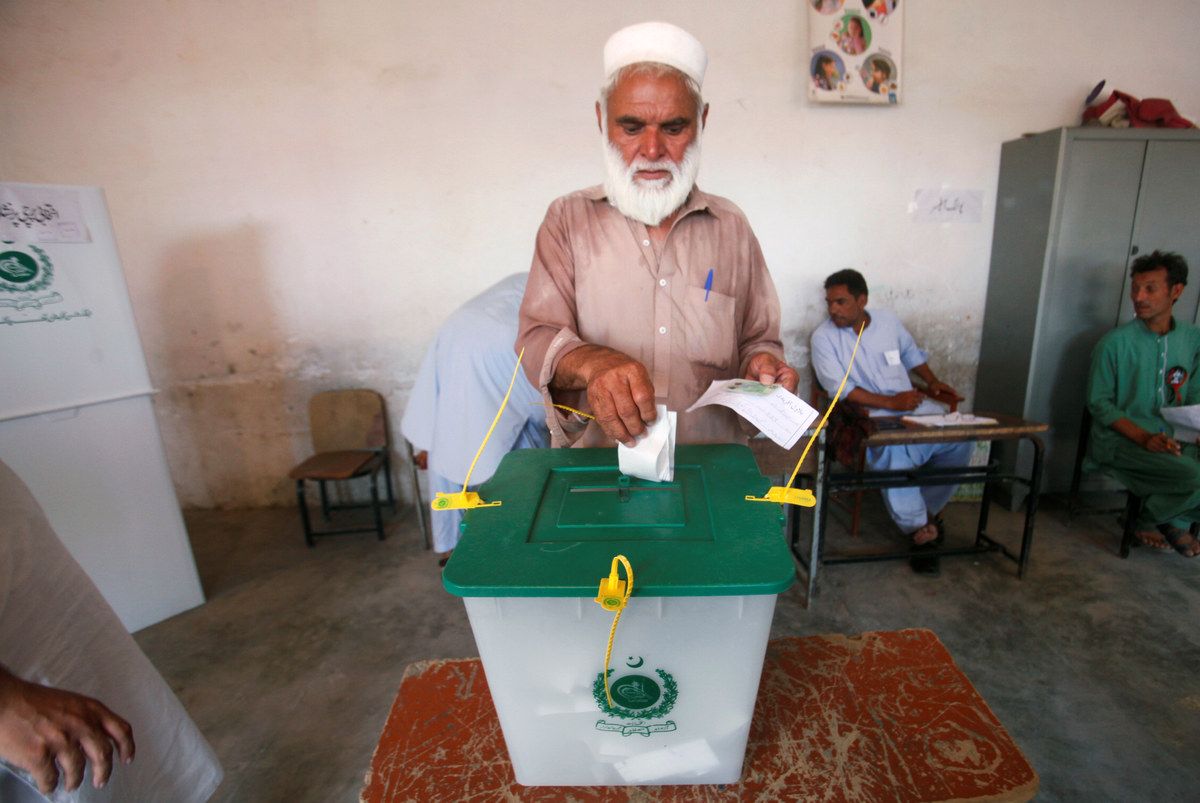


A voter casts his vote at a polling station during the first provincial elections in Jamrud, Pakistan July 20, 2019. (REUTERS)  

Though the result of Saturday’s election will have little direct impact on national politics, the exercise marks a significant milestone for an impoverished region that, without provincial status, had long suffered from a lack of national investment.
“It is really a historic moment and people are celebrating and jubilant in a manner as if it were Eid,” Sohail Khan, a spokesman for the provincial Election Commission of Pakistan (ECP), told Arab News.
Complaints of vote-rigging and influence peddling by some of the candidates and their supporters were also reported by media in the run-up to the elections, though the ECP denies this.
Despite these challenges, including the inaccessibility of polling stations for people from remote corners of the mountainous region, there were reports of a large voter turnout. Reports on social media said cellphone signals and Internet were jammed through the tribal areas on Saturday. Many people complained that they were assigned polling stations 50 miles away when there were booths right outside their homes.


IMF board to approve Pakistan reviews today ‘if all goes well,’ say officials

Updated 08 December 2025
Follow

IMF board to approve Pakistan reviews today ‘if all goes well,’ say officials

  • IMF’s executive board is scheduled to meet today to discuss the disbursement of $1.2 billion
  • Economists say the money will boost Pakistan’s forex reserves, send positive signals to investors

KARACHI: The International Monetary Fund’s (IMF) executive board is scheduled to meet today, Monday, to approve the release of about $1.2 billion for Pakistan under the lender’s two loan facilities, said IMF officials who requested not to be named.

The IMF officials confirmed the executive board was going to decide on the Fund’s second review under the $7 billion Extended Fund Facility (EFF) and first review under the $1.4 billion Resilience and Sustainability Facility (RSF), a financing tool that provides long-term, low-cost loans to help countries address climate risks.

“The board meeting will be taking place as planned,” an IMF official told Arab News.

“The board is on today yes as per the calendar,” said another.

A well-placed official at Pakistan’s finance ministry also confirmed the board meeting was scheduled today to discuss the next tranche for Pakistan.

The IMF executive board’s meeting comes nearly two months after a staff-level agreement (SLA) was signed between the two sides in October.

Procedurally, the SLAs are subject to approval by the executive board, though it is largely viewed as a formality.

“If all goes well, the reviews should pass,” said the second IMF official.

On approval, Pakistan will have access to about $1 billion under the EFF and about $200 million under the RSF, the IMF said in a statement in October after the SLA.

The fresh transfer will bring total disbursements under the two arrangements to about $3.3 billion, it added.

Experts see smooth sailing for Pakistan in terms of the passing of the two reviews, saying the IMF disbursements will help the cash-strapped nation to strengthen its balance of payments position.

Samiullah Tariq, group head of research at Pakistan Kuwait Investment Company Limited, said the IMF board’s approval will show that Pakistan’s economy is on the right path.

“It obviously will help strengthen [the country’s] external sector, the balance of payments,” he told Arab News.

Until recently, Pakistan grappled with a macroeconomic crisis that drained its financial resources and triggered a balance of payments crisis.

Pakistan has reported financial gains since 2022, recording current account surpluses and taming inflation that touched unprecedented levels in mid-2023.

Economists also viewed the IMF’s bailout packages as crucial for cash-strapped Pakistan, which has relied heavily on financing from bilateral partners such as Saudi Arabia, China and the United Arab Emirates, as well as multilateral lenders.

Saudi Arabia, through the Saudi Fund for Development, last week extended the term of its $3 billion deposit for another year to help Pakistan boost its foreign exchange reserves, which stood at $14.5 billion as of November 28, according to State Bank of Pakistan statements.

“In our view this [IMF tranche] will be approved,” said Shankar Talreja, head of research at Karachi-based brokerage Topline Securities Limited.

“This will help strengthen reserves and will eventually help a rating upgrade going forward,” he said.

The IMF board’s nod, Talreja said, would also send a signal to the international and local investors regarding the continuation of the reform agenda by Pakistan’s government.