

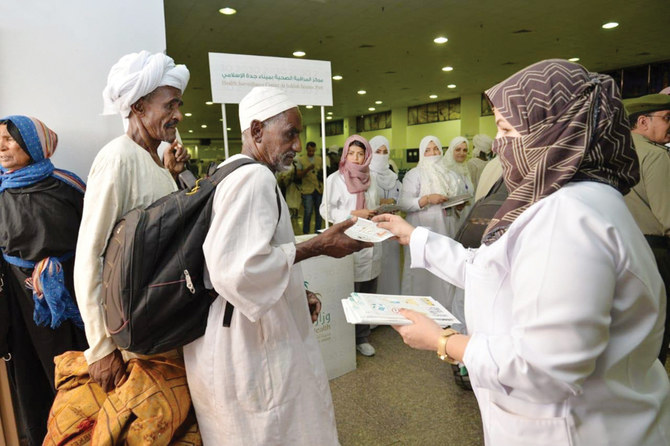
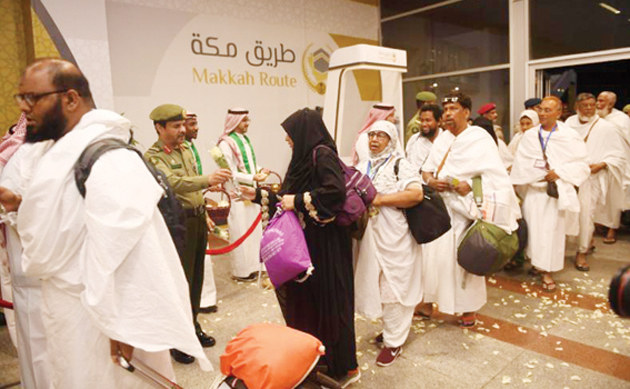

RIYADH: One of the services provided by the Makkah Route initiative, which aims to smooth the Hajj journey of pilgrims and provide top-quality service, is to ensure that all health requirements are met.
The Communication, Relations and Health Awareness General Department of the Ministry of Health is implementing the initiative in two ways.
The first is to ensure that the proper application of the health requirements for Hajj and Umrah is followed in targeted countries before issuing the Kingdom’s entry visa (Malaysia, Indonesia, Bangladesh, Pakistan, and Tunisia).
The second is to check that preventive measures are taken according to the world’s epidemiological situation, for instance in Pakistan.
“Preventive measures” mean, for example, providing polio vaccines for pilgrims. The vaccine, approved by the World Health Organization (WHO), is provided through the Pakistani health authorities at the departure area of the airport.
“The ministry is also deploying a team of five people qualified to supervise the application of health requirements and assess the vaccination procedure and the application of preventive measures,” the department added.
HIGHLIGHTS
The Makkah Route initiative aims to ensure that the proper application of the health requirements for Hajj and Umrah is followed in targeted countries before issuing the Kingdom’s entry visa.
The initiative also ensures that preventive measures are taken according to the world’s epidemiological situation, for instance in Pakistan.
The workforce at the different land, air, and sea entry/exit points during this year’s Hajj season numbers more than 1,700 individuals.
The teams include 131 experienced doctors, general health specialists, epidemiological monitors, and other staff to provide the necessary treatment and preventive services to pilgrims.
The ministry’s procedures in the departure hall include prepping emergency clinics at the points where Makkah Route pilgrims are received.
These clinics deal with urgent cases, prepare awareness information for pilgrims and coordinate with the General Authority of Civil Aviation regarding their distribution on the targeted airlines.
The workforce at the different land, air, and sea entry/exit points during this year’s Hajj season numbers more than 1,700 individuals, including 131 experienced doctors, general health specialists, epidemiological monitors, and other staff to provide the necessary treatment and preventive services to pilgrims.
The ministry stated that the number of health practitioners assigned to the service of pilgrims during Hajj “is more than 30,000.”
The ministry encourages volunteering during the Hajj season; it believes that it is a very important and noble service toward fellow citizens, nations and the religion, where Islam highly encourages volunteering and serving others.
The ministry is coordinating the major institutions and commissions via its Hajj volunteering link to register volunteers so that they can participate through the societal partnership program.
The missions affiliated with the pilgrim’s affairs offices provide basic treatment services and refer patients to the ministry’s health facilities, keeping an eye on the overall health situation and reporting any suspicious infectious diseases.
The ministry monitors all the health institutions and medical missions affiliated with the pilgrim’s affairs offices to make sure the health requirements are being properly applied, to ensure pilgrims’ safety and guarantee an environment free of infectious diseases.
The Health Ministry has confirmed that so far that there has been no incidence of any epidemic diseases or quarantine cases recorded among pilgrims, who arrived and the health situation is reassuring.
Since the first of Dul Qaada, the ministry has provided preventive services, via access points, to 257,981 pilgrims, with a total rate of commitment to vaccination reached 87.4 percent for meningitis, 67.3 percent for yellow fever and 95.3 percent for polio.


