HONG KONG: Tens of thousands of people rallied in support of Hong Kong’s police and pro-Beijing leadership on Saturday, a vivid illustration of the polarization coursing through the city after weeks of anti-government demonstrations.
Hong Kong has been rocked by more than a month of huge and largely peaceful protests — as well as a series of separate violent confrontations with police — sparked by a proposed law that would have allowed extraditions to mainland China and other countries.
The bill has since been suspended, but that has done little to quell public anger which has evolved into a wider movement calling for democratic reforms, universal suffrage and a halt to sliding freedoms in the semi-autonomous financial hub.
Saturday’s rally was a moment for the establishment to muster their own supporters.
A predominantly older crowd was joined by families and younger residents, waving Chinese flags and holding banners supporting the police.
“Friends who used violence say they love Hong Kong too, but we absolutely cannot approve of their way of expressing themselves,” said Sunny Wong, 42, who works in insurance.
A 60-year-old woman surnamed Leung said protesters who stormed and vandalized the legislature earlier this month must be held responsible for their acts.
“I really dislike people using violence on others... it was so extreme,” Leung said.
Police estimated a turnout of 103,000 people at the peak of the rally, while local media cited organizers as saying 316,000 attended.
Hong Kong’s police are in the midst of a major reputational crisis.
With no political solution on the table from the city’s pro-Beijing leaders, the police have become enmeshed in a seemingly intractable cycle of clashes with protesters who have continued to hit the streets in huge numbers for six weeks.
Demonstrators and rights groups have accused riot police of using excessive force, including tear gas and rubber bullets, and public anger against the force is boiling over.
Police insist their crowd control responses have been proportionate and point to injured officers as proof that a hardcore minority of protesters mean them harm.
Some of the most violent clashes occurred last Sunday when riot police battled protesters hurling projectiles inside a luxury mall. Some 28 people were injured, including 10 officers.
There is growing frustration among the police force’s exhausted rank and file that neither the city’s leaders, nor Beijing, seem to have any idea how to end the crisis.
Chinese state media and powerful pro-Beijing groups threw their weight behind the pro-police rally.
Saturday’s edition of Hong Kong’s staunchly pro-Beijing newspaper Ta Kung Pao ran a front page encouraging readers to join with the headline: “Kick away the violence.”
It featured a drawing of a large foot kicking over a pro-democracy demonstrator.
Many of those at the rally held aloft large slogans printed on the spread of Wen Wei Po, another stridently pro-Beijing newspaper in the city.
A rally last month by police supporters saw ugly scenes, with many participants hurling insults and scuffling with younger democracy protesters as well as media covering the gathering.
While the pro-government protests have mustered decent crowds, they have paled in comparison with the huge pro-democracy marches that have regularly drawn hundreds of thousands of people.
Anti-government protesters are planning another large march Sunday afternoon and say they have no plan to back down until key demands are met.
Tensions were also raised after police on Saturday said they had discovered a homemade laboratory making high-powered explosives. A 27-year-old man was arrested and pro-independence materials were also discovered.
Under the 1997 handover deal with Britain, China promised to allow Hong Kong to keep key liberties such as its independent judiciary and freedom of speech.
But many say that 50-year deal is already being curtailed, citing the disappearance into mainland custody of dissident booksellers, the disqualification of prominent politicians and the jailing of pro-democracy protest leaders.
Authorities have also resisted calls for the city’s leader to be directly elected by the people.


![]()

Thousands rally in support of Hong Kong police
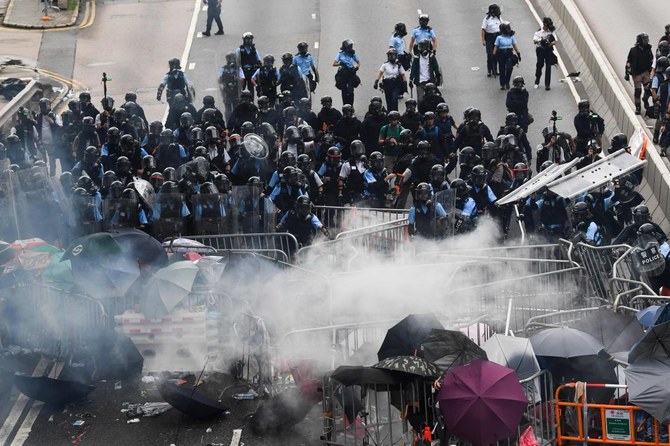
Thousands rally in support of Hong Kong police
- Hong Kong has been rocked by more than a month of huge and largely peaceful protests
- Demonstrators and rights groups have accused riot police of using excessive force, including tear gas and rubber bullets, and public anger against the force is boiling over


Latest updates


Recommended


© 2026 SAUDI RESEARCH & PUBLISHING COMPANY, All Rights Reserved And subject to Terms of Use Agreement.