JERUSALEM: An Israeli spyware firm thought to have hacked WhatsApp in the past has told clients it can scoop user data from the world’s top social media, the Financial Times reported Friday.
The London paper wrote that NSO group had “told buyers its technology can surreptitiously scrape all of an individual’s data from the servers of Apple, Google, Facebook, Amazon and Microsoft, according to people familiar with its sales pitch.”
An NSO spokesperson, responding in a written statement to AFP’s request for comment, denied the allegation.
“There is a fundamental misunderstanding of NSO, its services and technology,” it said.
“NSO’s products do not provide the type of collection capabilities and access to cloud applications, services, or infrastructure as listed and suggested in today’s FT article.”
In May, Facebook-owned WhatsApp said it had released an update to plug a security hole in its messaging app that allowed insertion of sophisticated spyware that could be used to spy on journalists, activists and others.
It said the attack bore “all the hallmarks of a private company that works with a number of governments around the world.”
It did not name a suspect but Washington-based analyst Joseph Hall, chief technologist at the Center for Democracy and Technology, said at the time that the hack appeared related to the NSO’s Pegasus software.
It is normally sold to law enforcement and intelligence services.
Friday’s FT report, citing documents it had viewed and descriptions of a product demonstration, said the program had “evolved to capture the much greater trove of information stored beyond the phone in the cloud, such as a full history of a target’s location data, archived messages or photos.”
NSO says it does not operate the Pegasus system, only licensing it to closely vetted government users “for the sole purpose of preventing or investigating serious crime including terrorism.”
The group came under the spotlight in 2016 when researchers accused it of helping spy on an activist in the United Arab Emirates.
NSO is based in the Israeli seaside hi-tech hub of Herzliya, near Tel Aviv. It says it employs 600 people in Israel and around the world.
Pegasus is a highly invasive tool that can reportedly switch on a target’s cell phone camera and microphone, and access data on it, effectively turning the phone into a pocket spy.
“Increasingly sophisticated terrorists and criminals are taking advantage of encrypted technologies to plan and conceal their crimes, leaving intelligence and law enforcement agencies in the dark and putting public safety and national security at risk,” the company statement said.
“NSO’s lawful interception products are designed to confront this challenge.”

Israel spyware firm can mine data from social media: FT
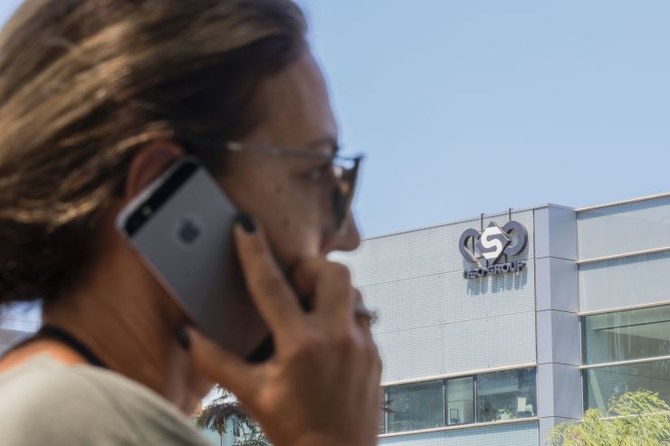
- An Israeli cybersecurity company has developed spyware that can scrape data from the servers of Apple, Google, Facebook, Amazon and Microsoft products
- Pegasus harvests not only data stored on a device, but also any information stored in the cloud, including a user’s location data, archived messages and photos
Khartoum markets back to life but ‘nothing like before’
- The hustle and bustle of buyers and sellers has returned to Khartoum’s central market, but “it’s nothing like before,” fruit vendor Hashim Mohamed told AFP, streets away from where war first broke out
KHARTOUM: The hustle and bustle of buyers and sellers has returned to Khartoum’s central market, but “it’s nothing like before,” fruit vendor Hashim Mohamed told AFP, streets away from where war first broke out nearly three years ago.
On April 15, 2023, central Khartoum awoke to battles between the Sudanese army and the paramilitary Rapid Support Forces (RSF), who had been allies since 2021, when they ousted civilians from a short-lived transitional government.
Their war has since killed tens of thousands and displaced millions.
In greater Khartoum alone, nearly four million people — around half the population — fled the city when the RSF took over.
Hashim Mohamed did not.
“I had to work discreetly, because there were regular attacks” on businesses, said the fruit seller, who has worked in the sprawling market for 50 years.
Like him, those who stayed in the city reported having lived in constant fear of assaults and robberies from militiamen roaming the streets.
Last March, army forces led an offensive through the capital, pushing paramilitary fighters out and revealing the vast looting and destruction left behind.
“The market’s not what it used to be, but it’s much better than when the RSF was here,” said market vendor Adam Haddad, resting in the shade of an awning.
In the market’s narrow, dusty alleyways, fruits and vegetables are piled high on makeshift stalls or tarps spread on the ground.
Two jobs to survive
Khartoum, where entire neighborhoods have been damaged by the fighting, is no longer threatened by the mass starvation that stalks battlefield cities and displacement camps elsewhere in Sudan.
But with the economy a shambles, a good living is still hard to provide.
“People complain about prices, they say it’s too expensive. You can find everything, but the costs keep going up: supplies, labor, transportation,” said Mohamed.
Sudan has known only triple-digit annual inflation for years. Figures for 2024 stood at 151 percent — down from a 2021 peak of 358 percent.
The currency has also collapsed, going from trading at 570 Sudanese pounds to the US dollar before the war to 3,500 in 2026, according to the black market rate.
One Sudanese teacher, who only a few years ago could provide comfortably for his two children, told AFP he could no longer pay his rent with a monthly salary of 250,000 Sudanese pounds ($71).
To feed his family, pay for school and cover health care, he “works in the market or anywhere” on his days off.
“You have to have another job to pay for the bare minimum of basic needs,” he said, asking for anonymity to protect his privacy and to avoid “problems with security services.”
Beyond Khartoum, the war still rages, with the RSF in control of much of western and southern Sudan and pushing into the central Kordofan region.
For Adam Haddad, the road to recovery will be a long one.
“We don’t have enough resources or workers or liquidity going through the market,” he said, adding that reliable electricity was still a problem.
“The government is striving to restore everything, and God willing, in the near future, the power will return and Khartoum will become what it once was.”
On April 15, 2023, central Khartoum awoke to battles between the Sudanese army and the paramilitary Rapid Support Forces (RSF), who had been allies since 2021, when they ousted civilians from a short-lived transitional government.
Their war has since killed tens of thousands and displaced millions.
In greater Khartoum alone, nearly four million people — around half the population — fled the city when the RSF took over.
Hashim Mohamed did not.
“I had to work discreetly, because there were regular attacks” on businesses, said the fruit seller, who has worked in the sprawling market for 50 years.
Like him, those who stayed in the city reported having lived in constant fear of assaults and robberies from militiamen roaming the streets.
Last March, army forces led an offensive through the capital, pushing paramilitary fighters out and revealing the vast looting and destruction left behind.
“The market’s not what it used to be, but it’s much better than when the RSF was here,” said market vendor Adam Haddad, resting in the shade of an awning.
In the market’s narrow, dusty alleyways, fruits and vegetables are piled high on makeshift stalls or tarps spread on the ground.
Two jobs to survive
Khartoum, where entire neighborhoods have been damaged by the fighting, is no longer threatened by the mass starvation that stalks battlefield cities and displacement camps elsewhere in Sudan.
But with the economy a shambles, a good living is still hard to provide.
“People complain about prices, they say it’s too expensive. You can find everything, but the costs keep going up: supplies, labor, transportation,” said Mohamed.
Sudan has known only triple-digit annual inflation for years. Figures for 2024 stood at 151 percent — down from a 2021 peak of 358 percent.
The currency has also collapsed, going from trading at 570 Sudanese pounds to the US dollar before the war to 3,500 in 2026, according to the black market rate.
One Sudanese teacher, who only a few years ago could provide comfortably for his two children, told AFP he could no longer pay his rent with a monthly salary of 250,000 Sudanese pounds ($71).
To feed his family, pay for school and cover health care, he “works in the market or anywhere” on his days off.
“You have to have another job to pay for the bare minimum of basic needs,” he said, asking for anonymity to protect his privacy and to avoid “problems with security services.”
Beyond Khartoum, the war still rages, with the RSF in control of much of western and southern Sudan and pushing into the central Kordofan region.
For Adam Haddad, the road to recovery will be a long one.
“We don’t have enough resources or workers or liquidity going through the market,” he said, adding that reliable electricity was still a problem.
“The government is striving to restore everything, and God willing, in the near future, the power will return and Khartoum will become what it once was.”
© 2026 SAUDI RESEARCH & PUBLISHING COMPANY, All Rights Reserved And subject to Terms of Use Agreement.


